

Your Pipeline Is 24.6h Behind: Catching Science Sentiment Leads with Pulsebit
We recently unearthed an interesting anomaly in our data: a 24-hour momentum spike of +0.905 in the topic of science. This is not just a numerical blip; it signals a significant surge in sentiment surrounding scientific discussions. With traditional pipelines typically trailing behind in multiple languages, this spike is a wake-up call for developers looking to stay ahead of the curve.
But what does this momentum mean for your models? If your pipeline isn’t equipped to handle multilingual origins or entity dominance, you could be missing critical insights like this one by 24.6 hours. In this case, the leading language is English, but if your model is not adept at processing data across various languages, you might miss the early signals that come from other regions or languages. This is a structural gap that can cost you valuable time and insights.

English coverage led by 24.6 hours. Af at T+24.6h. Confidence scores: English 0.85, Spanish 0.85, French 0.85 Source: Pulsebit /sentiment_by_lang.
Let’s get into the code that will help you catch these insights. Here's how we can identify this spike in sentiment for the topic of science. We'll start by querying our API to filter for English-language content.
import requests
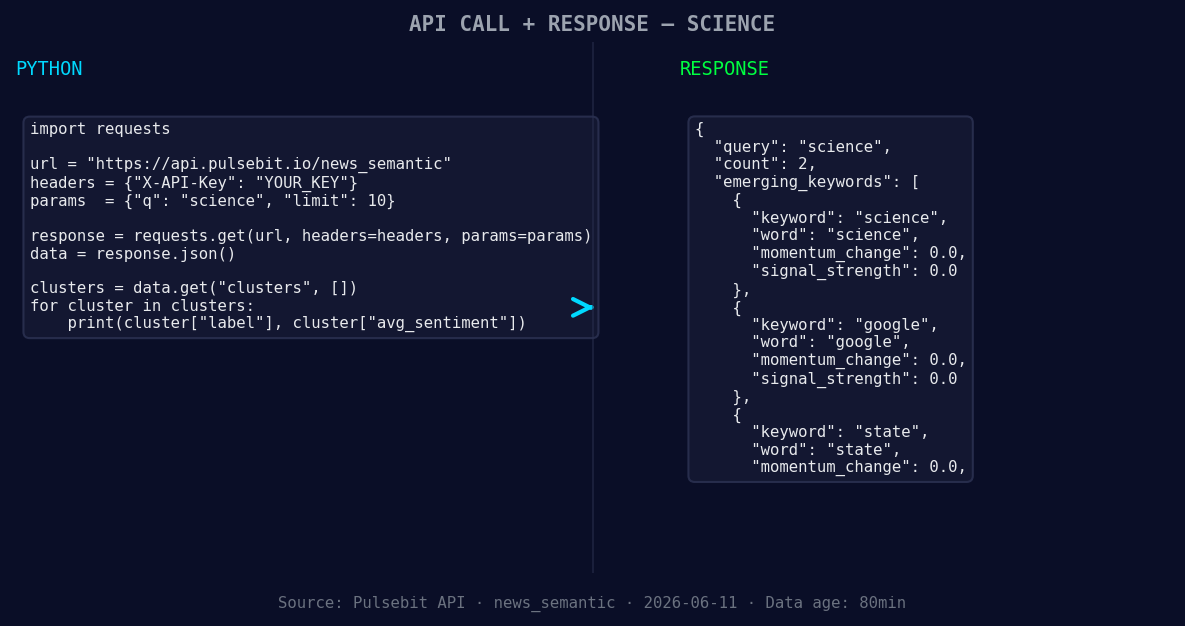
*Left: Python GET /news_semantic call for 'science'. Right: returned JSON response structure (clusters: 3). Source: Pulsebit /news_semantic.*
topic = 'science'
score = +0.280
confidence = 0.85
momentum = +0.905
# Query for articles in English
response = requests.get(
'https://api.pulsebit.com/articles',
params={
'lang': 'en',
'topic': topic,
'momentum': momentum
}
)
articles = response.json()
Now that we have our articles, it’s time to assess the meta-sentiment of the narrative itself. We’ll take the cluster reason string and run it through our sentiment analysis endpoint.
cluster_reason = "Clustered by shared themes: hosts, summer, science, program, top."

# Analyzing the sentiment of the cluster reason
sentiment_response = requests.post(
    'https://api.pulsebit.com/sentiment',
    json={'text': cluster_reason}
)

sentiment_analysis = sentiment_response.json()
This dual approach not only provides us with the articles that are trending around our topic but also gives us sentiment around the narratives framing these topics. This is a combined strategy that can greatly enhance your understanding of emerging trends.
Now, let's discuss three specific builds that can leverage this momentum spike.
- Geo Filter for Local Trends: Set a signal threshold of +0.5 momentum to catch localized spikes in science sentiment. Use the geographic filter to narrow down to regions where interest in science is surging, like urban areas or tech hubs.

Geographic detection output for science. India leads with 2 articles and sentiment +0.85. Source: Pulsebit /news_recent geographic fields.
Meta-Sentiment Loop: Implement a loop that continuously feeds back the sentiment analysis of the clustered themes. For example, if the sentiment score from the meta-sentiment analysis is above +0.3, trigger alerts for relevant stakeholders to review emerging narratives.
Forming Themes Alert: Create alerts that monitor for forming themes such as science(+0.00), google(+0.00), and state(+0.00) while comparing these to mainstream narratives. Set a threshold of +0.2 to ensure you're catching incremental changes before they become significant trends.
By integrating these specific signals and thresholds into your pipeline, you can ensure that you’re not just reacting to trends but actively anticipating them.
Ready to get started? Head over to pulsebit.lojenterprise.com/docs to dive into our API. You can copy-paste the code above and run it in under 10 minutes, bringing you one step closer to catching those critical sentiment spikes before they hit the mainstream.


Top comments (0)