

Your pipeline has just missed a significant anomaly: a 24h momentum spike of -0.554 in forex sentiment. This drop points to a notable shift in sentiment around forex, particularly tied to recent articles clustering around the topic of Indian banks benefiting from the RBI forex facility. With a language lead time of just 16.6 hours, you might be wondering how your existing models could be lagging so far behind in capturing these critical signals.
The problem here is clear: your model missed this by 16.6 hours, and that's a massive gap when it comes to trading strategies based on timely sentiment data. This lag becomes even more apparent when you consider the leading language in this case is English, while the dominant entities—such as the Indian rupee and dollar—are being discussed in the context of forex. A pipeline not equipped to handle multilingual origins or entity dominance will inevitably leave you exposed to important market shifts.

English coverage led by 16.6 hours. Af at T+16.6h. Confidence scores: English 0.85, Spanish 0.85, French 0.85 Source: Pulsebit /sentiment_by_lang.
Let’s dive into the code that can help you catch this sentiment shift before it’s too late. First, we’ll filter the data by language and country using our API:

Geographic detection output for forex. India leads with 2 articles and sentiment +0.00. Source: Pulsebit /news_recent geographic fields.
import requests
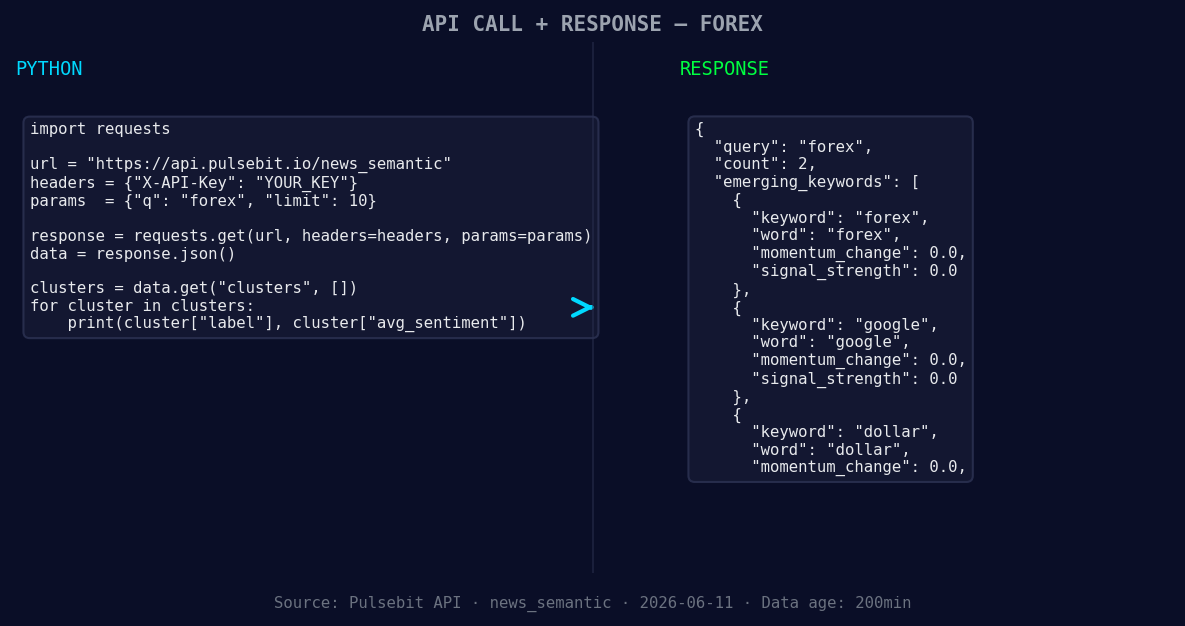
*Left: Python GET /news_semantic call for 'forex'. Right: returned JSON response structure (clusters: 3). Source: Pulsebit /news_semantic.*
# Geographic origin filter
url = "https://api.pulsebit.com/data"
params = {
"topic": "forex",
"lang": "en",
"momentum": -0.554,
"score": -0.350,
"confidence": 0.85
}
response = requests.get(url, params=params)
data = response.json()
print(data)
Now that we have the relevant data, let’s run the cluster reason string back through the sentiment scoring endpoint to evaluate the narrative framing itself:
# Meta-sentiment moment
sentiment_url = "https://api.pulsebit.com/sentiment"
cluster_reason = "Clustered by shared themes: rupee, dollar, rises, paise, close."

sentiment_response = requests.post(sentiment_url, json={"text": cluster_reason})
sentiment_data = sentiment_response.json()
print(sentiment_data)
This two-step process ensures that we’re not only capturing the sentiment as it stands but also evaluating the underlying narratives that might influence market behavior.
Now, let’s build three specific tools using this newfound insight.
Geo-Filtered Alert System: Set up a real-time alert system that pings you whenever there’s a significant sentiment change in the forex topic from English articles. You could use a threshold of 0.5 for momentum spikes to trigger alerts.
Meta-Sentiment Analyzer: Develop a scoring function that analyzes narrative framing based on clustered reasons. For example, if the sentiment score goes below -0.3, it could trigger a deeper investigation into articles discussing the rupee, dollar, and their correlation to forex strategies.
Dynamic Data Dashboard: Create a dashboard that visualizes the changes in sentiment over time, with emphasis on forming themes like forex, Google, and dollar. This will help you spot trends before they become mainstream, giving you a competitive edge.
These builds will help you stay ahead of the curve and ensure you’re not left scrambling to catch up with sentiment data.
To get started, check out our documentation at pulsebit.lojenterprise.com/docs. You can copy-paste the above code snippets and run them in under 10 minutes. Get ready to make your pipeline smarter!


Top comments (0)