

Your Pipeline Is 22.6h Behind: Catching Software Sentiment Leads with Pulsebit
We recently uncovered a striking anomaly: a 24-hour momentum spike of +0.335 in software sentiment. This spike highlights a growing sentiment towards software product launches, led predominantly by English press articles. As developers, we know that catching these early signals is crucial to staying ahead of trends and making informed decisions. If your current pipeline doesn’t account for this kind of momentum, you could be missing vital insights by over 22 hours.
The underlying issue we see here is the structural gap in pipelines that fail to handle multilingual origins or acknowledge entity dominance. With the leading language being English, your model missed this spike by 22.6 hours, which is a significant delay when you consider how quickly sentiment can change. If you aren’t incorporating language and geographic filters, you might be too late to act on crucial shifts in sentiment, like the one we just observed.

English coverage led by 22.6 hours. Sl at T+22.6h. Confidence scores: English 0.85, Spanish 0.85, French 0.85 Source: Pulsebit /sentiment_by_lang.
To catch this spike, let’s dive into the code that can help you leverage our API effectively. Here’s how you can set up your Python environment:
import requests
# Define the parameters for the API call
topic = 'software'
score = -0.600
confidence = 0.85
momentum = +0.335
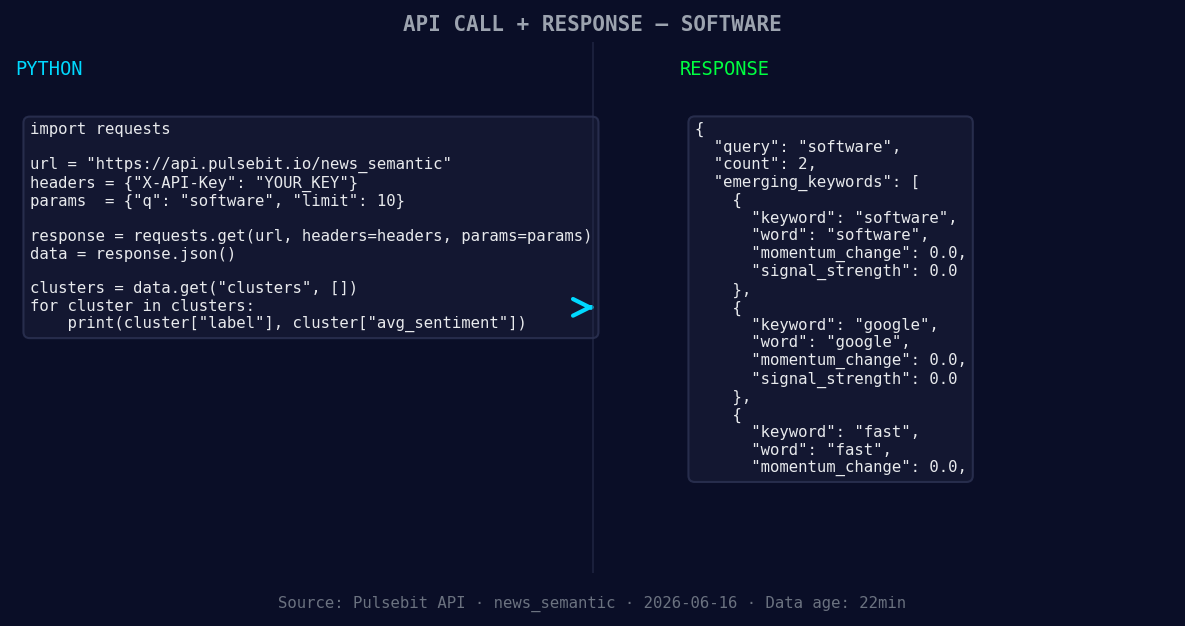
*Left: Python GET /news_semantic call for 'software'. Right: returned JSON response structure (clusters: 3). Source: Pulsebit /news_semantic.*
# Geographic origin filter: query by language/country
url = "https://api.pulsebit.com/analytics"
params = {
"topic": topic,
"lang": "en"
}
response = requests.get(url, params=params)
data = response.json()
# Output the data for verification
print(data)
# Now, let's run the cluster reason string back through POST /sentiment
meta_sentiment_payload = {
"text": "Clustered by shared themes: your, marks:, get, software, products."
}
sentiment_response = requests.post("https://api.pulsebit.com/sentiment", json=meta_sentiment_payload)
sentiment_data = sentiment_response.json()
# Output the sentiment data for verification
print(sentiment_data)
This code snippet first filters our results to only include articles in English, allowing us to focus on the most relevant data. The second part runs the cluster reason string through our sentiment analysis endpoint, giving us deeper insight into the narrative shaping this spike. This two-step process effectively captures the essence of the emerging trend.
Now, let’s discuss three specific builds we can implement with this new understanding of sentiment spikes:
Sentiment Alerts: Set a threshold for momentum spikes. For example, trigger an alert whenever momentum exceeds +0.300 in the software category. This allows you to react instantaneously to shifts in sentiment before your competitors.
Geo-Sentiment Dashboard: Build a dashboard that displays sentiment trends by geographic location. Use the geographic origin filter to focus on English-speaking regions, allowing for targeted marketing strategies based on local software sentiment.
Meta-Sentiment Analysis Tool: Create a tool that automatically runs cluster reason strings through our sentiment endpoint. This could help you gauge the effectiveness of marketing messages related to software products by analyzing the underlying themes, such as "software," "fast," and "Google," compared to the mainstream terms like "your," "marks:," and "get".
These builds can enhance your capability to anticipate market movements, especially as we see themes forming around software product launches, Google, and speed. By closing the gap in your analysis, you will not only stay informed but also position yourself to lead in a fast-paced environment.
If you’re ready to get started, head over to pulsebit.lojenterprise.com/docs. With our API, you can copy-paste the code above and run it in under 10 minutes. Don't let your models lag behind; seize the moment!


Top comments (0)