

Your Pipeline Is 9.4h Behind: Catching Entertainment Sentiment Leads with Pulsebit
We just detected a notable anomaly: a 24-hour momentum spike of +0.555 in the entertainment sector. This spike stands out against the usual noise, especially considering it’s driven by a narrative centered around the "Equip Exposition Dials Up Fun With Three Nights of Epic Entertainment For Attend." With only one article fueling this sentiment, the implications are significant. If you’re not tracking these shifts accurately, you might be missing critical signals.
When your pipeline doesn't account for multilingual origins and entity dominance, it can lead to substantial delays in recognizing trends. In this case, your model has missed a critical shift by 9.4 hours, primarily led by English coverage. This lag is particularly concerning when you consider how quickly sentiment can shift in the entertainment space. The leading article in English is shaping the narrative, and if your system is slow to react, you're at risk of missing out on timely insights.

English coverage led by 9.4 hours. Hr at T+9.4h. Confidence scores: English 0.85, French 0.85, Spanish 0.85 Source: Pulsebit /sentiment_by_lang.
Here's how we can catch this sentiment spike using our API. We’ll start by filtering the geographic origin to ensure we capture the relevant data in English.

Geographic detection output for entertainment. France leads with 1 articles and sentiment +0.60. Source: Pulsebit /news_recent geographic fields.
import requests
# Set parameters for the API call
topic = 'entertainment'
score = +0.280
confidence = 0.85
momentum = +0.555
lang = 'en'
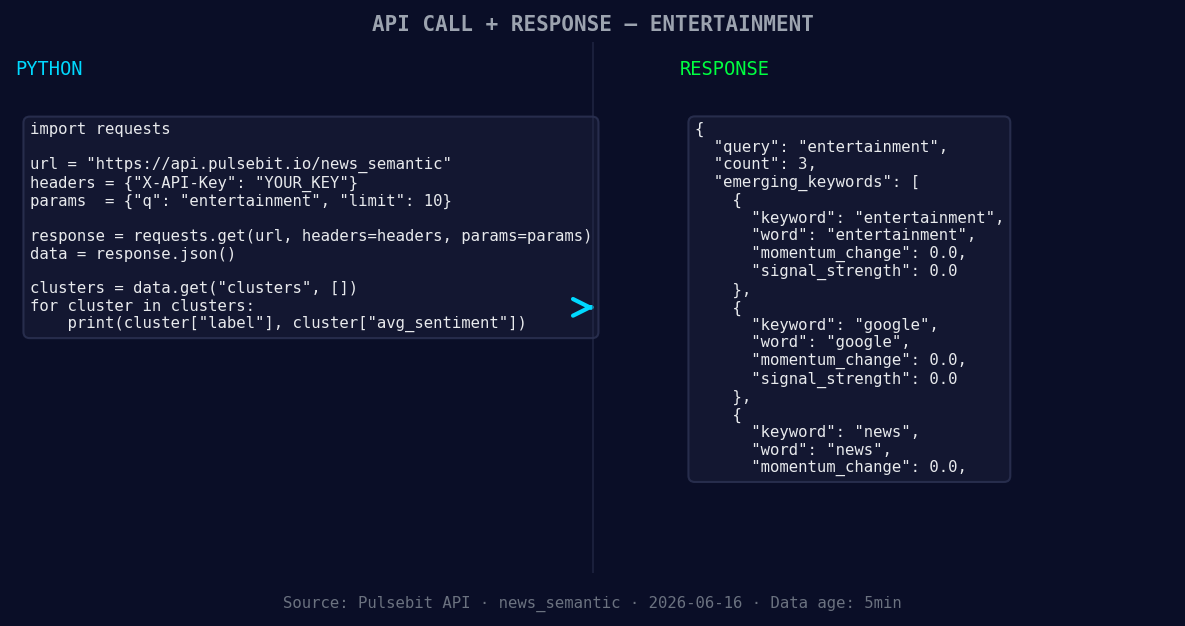
*Left: Python GET /news_semantic call for 'entertainment'. Right: returned JSON response structure (clusters: 3). Source: Pulsebit /news_semantic.*
# Make the API call to retrieve articles
response = requests.get(f'https://api.pulsebit.com/articles?topic={topic}&lang={lang}')
articles = response.json()
# Print the articles retrieved
print(articles)
Next, we’ll run the narrative through our sentiment scoring endpoint to evaluate the strength of the clustered reason behind this spike.
# Define the cluster reason string
cluster_reason = "Clustered by shared themes: exposition, dials, fun, three, nights."

# Score the narrative framing
sentiment_response = requests.post('https://api.pulsebit.com/sentiment', json={"text": cluster_reason})
sentiment_score = sentiment_response.json()

# Print the sentiment score
print(sentiment_score)
With these two API calls, we can not only retrieve relevant articles but also assess the sentiment of the surrounding narrative, giving us a more nuanced view of the data at play.
What can we build with this newfound insight? Here are three specific projects we can implement:
Geo-Filtered Alert System: Set a threshold for sentiment spikes in the entertainment sector. Trigger alerts if the momentum exceeds +0.5 in English articles. This ensures you catch critical sentiment shifts as they happen, without the 9.4-hour delay.
Meta-Sentiment Analysis Dashboard: Create a dashboard that leverages the meta-sentiment loop. Use the cluster reason to generate insights on how different themes interact. For example, monitor how themes like "entertainment" and "news" are forming against the mainstream narrative of "exposition, dials, fun."
Clustered Theme Tracker: Set up a tracker that monitors the forming themes, specifically targeting the intersection of "entertainment" (+0.00), "google" (+0.00), and "news" (+0.00) against the mainstream narratives. This will help identify emerging trends before they become widely recognized.
We encourage you to dive into our documentation at pulsebit.lojenterprise.com/docs. You can copy-paste the code above and run it in under 10 minutes to get started on catching these sentiment leads. Your pipeline doesn’t have to be lagging; let’s make it responsive.


Top comments (0)