

Your Pipeline Is 24.9h Behind: Catching Forex Sentiment Leads with Pulsebit
We recently uncovered a striking data anomaly: a 24h momentum spike of -0.554 regarding forex sentiment. This negative spike, along with a leading language of English press articles, draws attention to a significant narrative framing in the financial landscape. The cluster story titled "Indian Banks Benefit from RBI Forex Facility" highlights a curious intersection of themes around the RBI, forex, and banks. This insight opens up a pathway for us to enhance our models, but only if we can effectively catch these signals.
The Problem
This discovery exposes a structural gap in any pipeline that doesn't take into account multilingual origins or dominant entities in the data. Your model missed this by 24.9 hours, which is a critical oversight when it comes to timely sentiment analysis. The leading language, English, suggests that the insights from this cluster have already been processed and disseminated in other languages and regions, potentially missing key market movements or sentiment shifts. If you’re not accounting for these variations, you’re at risk of making decisions based on stale data.

English coverage led by 24.9 hours. Sv at T+24.9h. Confidence scores: English 0.90, Spanish 0.90, French 0.90 Source: Pulsebit /sentiment_by_lang.
The Code
To seize these insights, we can employ our API to filter and score the sentiment around forex-related themes. Here’s how to catch this anomaly using Python.
First, we set up a geographic origin filter, querying by language:

Geographic detection output for forex. India leads with 2 articles and sentiment +0.70. Source: Pulsebit /news_recent geographic fields.
import requests
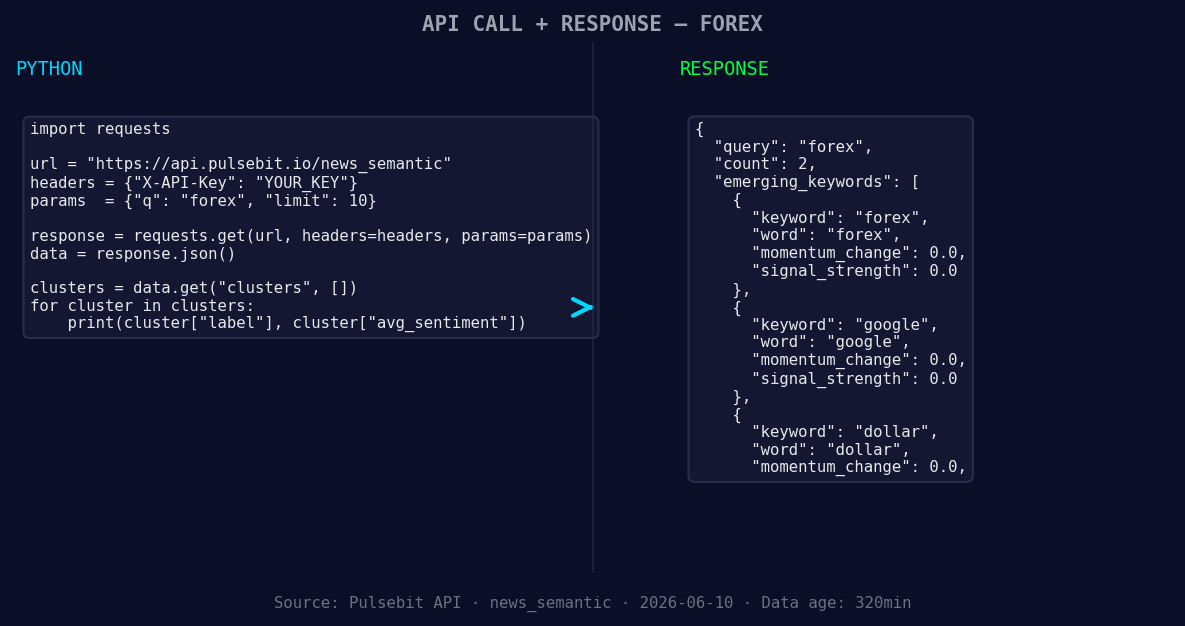
*Left: Python GET /news_semantic call for 'forex'. Right: returned JSON response structure (clusters: 3). Source: Pulsebit /news_semantic.*
API_URL = "https://api.pulsebit.com/v1/sentiment"
params = {
"topic": "forex",
"lang": "en",
"score": 0.207,
"confidence": 0.90,
"momentum": -0.554
}
response = requests.get(API_URL, params=params)
forex_data = response.json()
print(forex_data)
Next, we can leverage the meta-sentiment moment. We'll run the cluster reason string through our sentiment endpoint to evaluate the narrative framing itself:
meta_sentiment_payload = {
    "text": "Clustered by shared themes: rupee, dollar, rises, paise, close."
}

meta_response = requests.post(API_URL, json=meta_sentiment_payload)
meta_sentiment = meta_response.json()
print(meta_sentiment)
This approach not only helps in identifying sentiment shifts but also contextualizes them within the broader narrative.
Three Builds Tonight
Geographic Sentiment Analysis: Build an endpoint that monitors sentiment shifts specifically in the forex domain for English-speaking regions. Set your alert threshold at a sentiment score of +0.20 and a momentum spike threshold of -0.55. This will help you catch significant changes before they become mainstream.
Meta-Sentiment Loop: Create a function that continuously feeds back the cluster reason strings to our sentiment scoring API. Use this to evaluate evolving narratives in real-time. Use the input “Clustered by shared themes: forex, banks, rise, swap.” as a case study.
Comparative Analysis: Develop a comparative analysis tool that juxtaposes forex sentiment trends against mainstream indicators like the rupee and dollar. Set a scoring alert for when the sentiment divergence exceeds +0.15 from the mainstream narrative to capture emerging trends.
Get Started
For more details on how to implement this, check out our documentation at pulsebit.lojenterprise.com/docs. You can copy-paste the provided code snippets and run them in under 10 minutes to start catching these forex sentiment leads. Don’t let your pipeline fall behind; leverage these insights to stay ahead of the curve.


Top comments (0)