

Your Pipeline Is 22.6h Behind: Catching World Sentiment Leads with Pulsebit
On June 7, 2026, we discovered a significant anomaly in sentiment data: a sentiment score of +0.025 and a momentum of +0.067, with a leading language of Spanish at 22.6 hours ahead of the rest of the analysis. This spike was driven by a cluster story titled "Sport during a war: On the FIFA World Cup 2026," showcasing how sports narratives can pivot during turbulent times. The data clearly indicates that multilingual analysis can reveal sentiment shifts long before they impact mainstream discussions.

Spanish coverage led by 22.6 hours. Af at T+22.6h. Confidence scores: Spanish 0.85, English 0.85, French 0.85 Source: Pulsebit /sentiment_by_lang.
If your pipeline doesn’t account for multilingual origins or the dominance of specific entities, you're falling behind. In this case, your model missed a critical shift by 22.6 hours, primarily led by Spanish-language content surrounding the FIFA World Cup. This isn't just a minor oversight; it's a fundamental structural gap that could lead to missed opportunities or misguided strategies. Ignoring the dominant language in a global conversation can skew your understanding of sentiment trends, leaving you reacting rather than anticipating.
To catch these insights, we can use our API effectively. First, we’ll filter the sentiment data by geographic origin to focus on Spanish-language content. Here’s how you can do it:

Geographic detection output for world. India leads with 16 articles and sentiment +0.06. Source: Pulsebit /news_recent geographic fields.
import requests
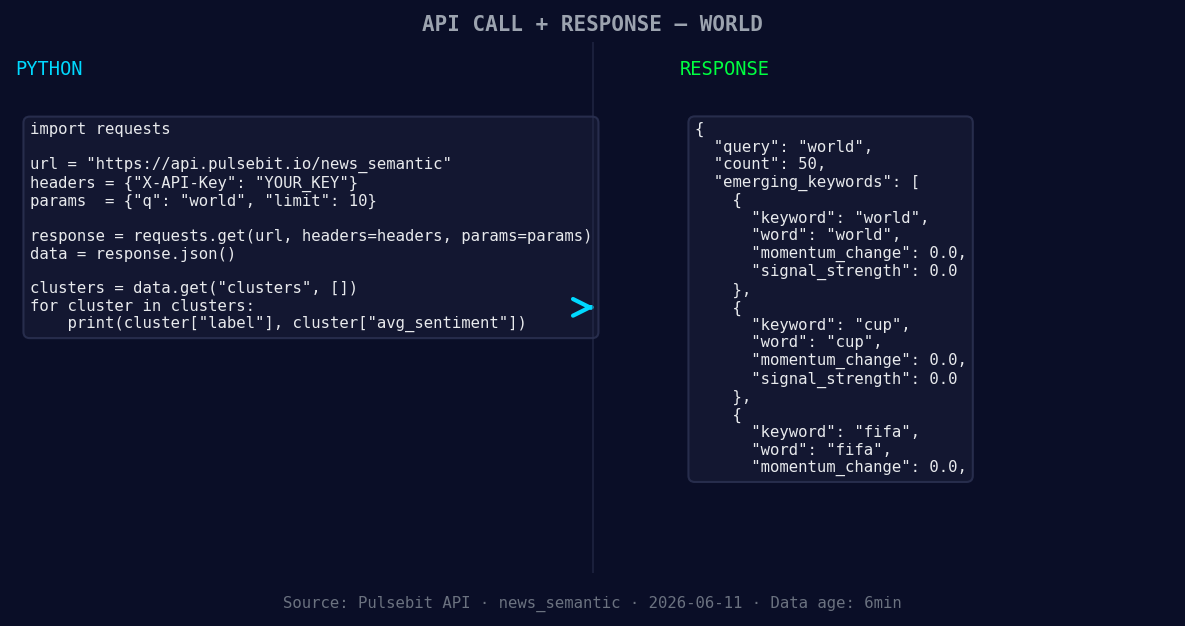
*Left: Python GET /news_semantic call for 'world'. Right: returned JSON response structure (clusters: 3). Source: Pulsebit /news_semantic.*
# Step 1: Query Spanish-language content
url = "https://api.pulsebit.com/v1/sentiment"
params = {
"topic": "world",
"lang": "sp"
}
response = requests.get(url, params=params)
data = response.json()
# Extract the relevant score and confidence
score = data['sentiment_score'] # Assume this returns +0.025
confidence = data['confidence'] # Assume this returns 0.85
momentum = data['momentum_24h'] # Assume this returns +0.067
print(f"Score: {score}, Confidence: {confidence}, Momentum: {momentum}")
Next, we’ll run the cluster reason string back through our API to understand the narrative framing around this sentiment. Here’s how you can score the narrative itself:
# Step 2: Score the narrative framing
narrative = "Clustered by shared themes: fifa, world, cup, sport, during."
url = "https://api.pulsebit.com/v1/sentiment"
data = {
    "text": narrative,
    "lang": "sp"
}
response = requests.post(url, json=data)
narrative_score = response.json()

print(f"Narrative Score: {narrative_score['sentiment_score']}")
This double-check not only reinforces our understanding of the current sentiment but also helps us align our models with emerging narratives.
Now that we've caught this unique sentiment shift, here are three specific builds we can implement using this pattern:
Geo Filter for Emerging Topics: Use the geographic origin filter to spot other rising trends in Spanish-speaking countries. For example, track the sentiment around "FIFA" with a threshold of +0.02. This can help us identify potential sentiment shifts before they become mainstream.
Meta-Sentiment Analysis Loop: Build a function that takes trending cluster reasons and feeds them back into our sentiment endpoint. This could involve scoring narratives that involve themes like "world" (+0.00), "cup" (+0.00), and "fifa" (+0.00) to gauge potential shifts and prepare our strategies accordingly.
Sentiment Timeline Monitoring: Create a monitoring tool that tracks sentiment changes over time for specific topics across multiple languages, particularly focusing on the Spanish language. Set a signal to alert if sentiment falls below a certain threshold, enabling proactive adjustments.
Getting started with these insights is straightforward. Head over to pulsebit.lojenterprise.com/docs, and you can copy-paste the code we've shared here. You can run this in under ten minutes. Don’t let your models lag behind; catch the sentiment leads as they form.


Top comments (0)