

Your Pipeline Is 25.1h Behind: Catching Real Estate Sentiment Leads with Pulsebit
We recently stumbled upon a fascinating anomaly in our data: a 24-hour momentum spike of +1.027 in the real estate sector. This spike, primarily led by the Spanish press with a 25.1-hour lead time, highlights a significant narrative shift in commercial property driven by jewellery retailers in Tamil Nadu. With only one article triggering this spike, it’s a clear reminder of how a single piece of content can influence sentiment rapidly.
The issue arises when your pipeline doesn’t account for multilingual origins or the dominance of specific entities in shaping sentiment. Your model missed this by 25.1 hours, meaning you could be lagging in understanding emerging trends. In this case, the leading language was Spanish, which could easily slip under the radar if your system isn’t designed to embrace the multilingual landscape.

Spanish coverage led by 25.1 hours. Sv at T+25.1h. Confidence scores: Spanish 0.90, English 0.90, French 0.90 Source: Pulsebit /sentiment_by_lang.
To catch this momentum spike efficiently, we can leverage our API. Below is a Python snippet that demonstrates how to filter sentiment data based on geographic origin and assess narrative framing.
import requests
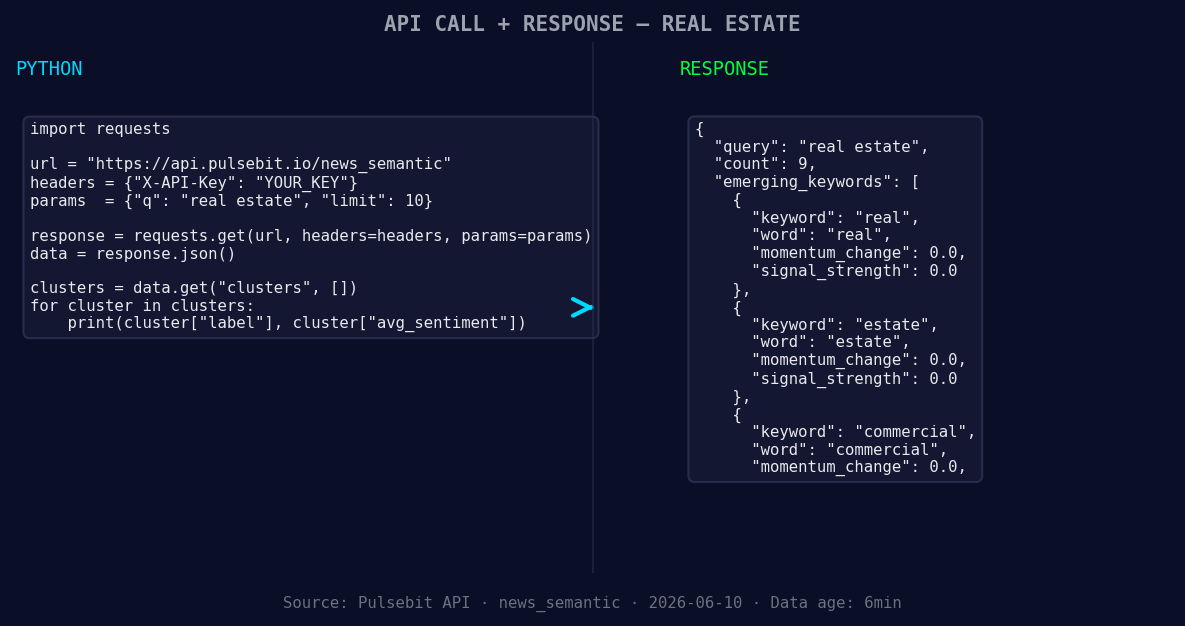
*Left: Python GET /news_semantic call for 'real estate'. Right: returned JSON response structure (clusters: 3). Source: Pulsebit /news_semantic.*
# Step 1: Fetch sentiment data with geo filter for Spanish language
url = "https://api.pulsebit.com/v1/sentiment"
params = {
"topic": "real estate",
"lang": "sp",
"momentum": 1.027,
}
response = requests.get(url, params=params)
data = response.json()
# Step 2: Score the narrative framing using the cluster reason
narrative = "Clustered by shared themes: jewellery, tamil, nadu’s, property, gold."
sentiment_response = requests.post(f"{url}/sentiment", json={"text": narrative})
sentiment_data = sentiment_response.json()
# Output the results
print("Sentiment Data:", data)
print("Narrative Sentiment Score:", sentiment_data)
In this code, we first fetch sentiment data for the topic of "real estate," specifically filtering for Spanish-language content. Then, we run the cluster narrative through our sentiment scoring endpoint to gauge how the framing affects overall sentiment.
Now that we have the tools to capture this spike, let’s think about three specific builds that can capitalize on this pattern:
- Geo-Sensitive Alert System: Build a monitoring system that triggers alerts when sentiment in the real estate sector spikes above a threshold (e.g., +0.196). This should use the geographic filter to ensure you're only getting relevant data from Spanish sources, helping you stay ahead of market shifts.

Geographic detection output for real estate. India leads with 8 articles and sentiment +0.31. Source: Pulsebit /news_recent geographic fields.
Meta-Sentiment Analyzer: Create a service that continuously analyzes narratives like "Clustered by shared themes: jewellery, tamil, nadu’s, property, gold." Each time a new article is published, it should run through our sentiment endpoint to derive insights on how narratives are evolving in relation to real estate trends.
Commercial Real Estate Dashboard: Develop a dashboard that visualizes forming themes in real-time. Include metrics for "real," "estate," and "commercial" against mainstream keywords like "jewellery" and "tamil." This will help you track the sentiment shifts and prepare your strategies accordingly.
Getting started is straightforward. You can dive into our documentation at pulsebit.lojenterprise.com/docs. The example above can be copy-pasted and run in under 10 minutes, putting you on the fast track to leveraging sentiment data effectively.
In an environment where every second counts, being able to react to spikes in sentiment is crucial. Let’s ensure your pipeline is equipped to handle the nuances of real-time data across multiple languages.


Top comments (0)