

Your Pipeline Is 28.6h Behind: Catching Software Sentiment Leads with Pulsebit
We recently observed a striking anomaly: a 24h momentum spike of +0.335 in the sentiment surrounding the topic of software. This spike holds significant implications for anyone tracking sentiment data, especially when it comes to launching new software products. The leading language in this sentiment surge was English, lagging behind by 28.6 hours. This discovery begs the question: how can you ensure you're not falling behind in capturing these critical sentiment shifts?
The structural gap here is clear. If your pipeline doesn't account for multilingual origins or the dominance of entities, you're potentially missing out on crucial insights. Your model missed this by 28.6 hours, meaning you could be reacting to outdated sentiment when the landscape has already shifted. The leading entity in this context was English press, which is critical for understanding the sentiment dynamics in software launches.

English coverage led by 28.6 hours. Sl at T+28.6h. Confidence scores: English 0.85, Spanish 0.85, French 0.85 Source: Pulsebit /sentiment_by_lang.
Let’s dive into the code that enables us to catch these insights. We can use our API to query sentiment data specifically for the topic of software. Below is a sample Python script that fetches the relevant data:
import requests
# Set parameters
topic = 'software'
momentum = +0.335
score = +0.409
confidence = 0.85
# API call to get sentiment data for 'software' in English
response = requests.get('https://pulsebit.api/sentiment', params={
'topic': topic,
'lang': 'en'
})
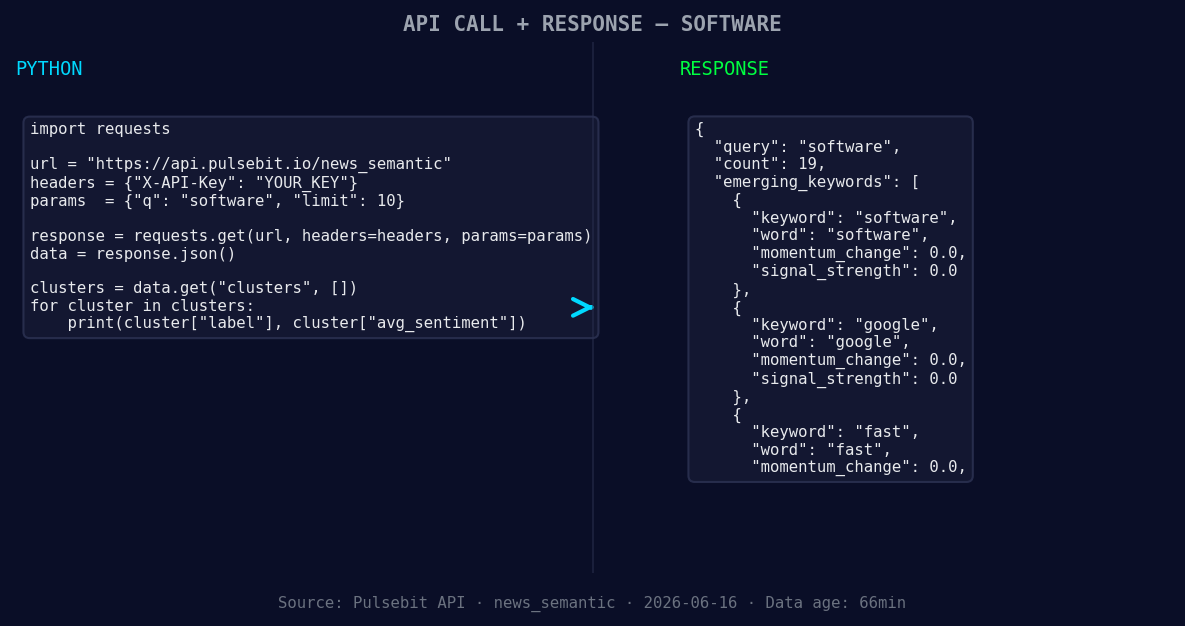
*Left: Python GET /news_semantic call for 'software'. Right: returned JSON response structure (clusters: 3). Source: Pulsebit /news_semantic.*
sentiment_data = response.json()
# Printing the sentiment data
print("Sentiment Data:", sentiment_data)
# Meta-sentiment moment: running the cluster reason string through POST
cluster_reason = "Clustered by shared themes: your, marks:, get, software, products."
meta_sentiment_response = requests.post('https://pulsebit.api/sentiment', json={
'input': cluster_reason
})
meta_sentiment_data = meta_sentiment_response.json()
print("Meta Sentiment Data:", meta_sentiment_data)
In this code, we first query the sentiment data for the topic "software" with the English language filter. We then take the cluster reason string and score its narrative framing by sending it through our sentiment endpoint. This dual approach allows us to not only capture the immediate sentiment but also understand the contextual framing around it.
Now, let's talk about three specific builds we can create based on this pattern.
Real-Time Alerts for Software Sentiment: Set a signal threshold of +0.335. Trigger alerts when sentiment spikes cross this threshold, ensuring you’re informed of shifts in perception immediately.
Geo-Filtered Sentiment Dashboard: Utilize the geographic origin filter to create a dashboard that displays sentiment trends for software across regions. This would allow you to visualize how different cultures influence software perceptions in real-time.
![DATA UNAVAILABLE: countries — verify /news_recent is return
[DATA UNAVAILABLE: countries — verify /news_recent is returning country/region values for topic: software]
- Meta-Sentiment Analysis Tool: Implement a tool that continuously runs the meta-sentiment loop for clustered themes like "software," "google," and "fast." This tool should track changes and provide insights into how narratives around these themes evolve over time, especially compared to mainstream terms like "your," "marks:," and "get."
By leveraging these builds, you can stay ahead of the curve and ensure your software product launches are informed by the most current sentiment data available.
If you’re ready to get started, check out our documentation at pulsebit.lojenterprise.com/docs. With just a few lines of code, you can be up and running in under 10 minutes, capturing sentiment data that keeps you ahead of the competition.


Top comments (0)