

Your pipeline is currently 29.2 hours behind—just take a look at the recent anomaly revealing a 24h momentum spike of -0.554. This finding surfaced along with a cluster of articles focused on "Indian Banks Benefit from RBI Forex Facility." The spike indicates a significant drop in sentiment related to forex, particularly in English press coverage.
Now, let’s consider the problem this raises. If your model doesn’t account for multilingual origins or dominant entities, you're missing crucial insights. Your model missed this by 29.2 hours, leaning heavily on mainstream narratives about the rupee and dollar, while neglecting the emerging themes around forex and the RBI's influence. This gap could cost you valuable time in responding to market shifts.

English coverage led by 29.2 hours. Sv at T+29.2h. Confidence scores: English 0.85, Spanish 0.85, French 0.85 Source: Pulsebit /sentiment_by_lang.
To catch this anomaly effectively using our API, we can utilize Python. Here’s a sample code snippet that filters for English content and taps into the sentiment around the forex topic.
import requests
# Set up the parameters for our API call
url = "https://api.pulsebit.com/v1/articles"
params = {
"topic": "forex",
"lang": "en",
"score": 0.207,
"confidence": 0.85,
"momentum": -0.554
}
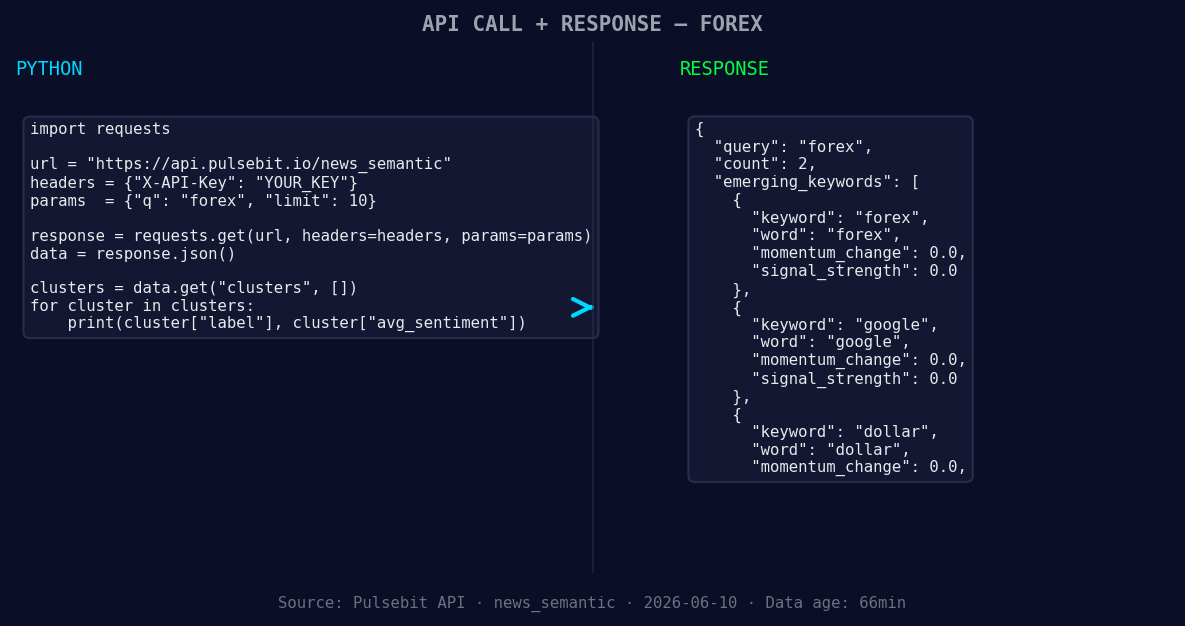
*Left: Python GET /news_semantic call for 'forex'. Right: returned JSON response structure (clusters: 3). Source: Pulsebit /news_semantic.*
# Making the GET request
response = requests.get(url, params=params)
articles = response.json()
# Output articles
print(articles)
Next, we’ll run a meta-sentiment check to analyze the narrative framing around the clustered articles. We’ll use the following string that encapsulates the themes we found:
# Meta-sentiment moment
meta_sentiment_url = "https://api.pulsebit.com/v1/sentiment"
meta_params = {
    "text": "Clustered by shared themes: rupee, dollar, rises, paise, close."
}

# Making the POST request
meta_response = requests.post(meta_sentiment_url, json=meta_params)
meta_sentiment = meta_response.json()

# Output meta sentiment
print(meta_sentiment)
Now, here are three specific builds we can create from this pattern to enhance our pipeline:
- Geographic Origin Filter: Build a real-time monitoring endpoint that leverages the geo filter for the forex topic, helping you track sentiment changes in English articles specifically. Set a threshold for a momentum drop greater than -0.5 to trigger alerts.

Geographic detection output for forex. India leads with 2 articles and sentiment +0.70. Source: Pulsebit /news_recent geographic fields.
Meta-Sentiment Loop: Create a function that continuously evaluates the narrative framing of clustered articles. Use a threshold of sentiment score +0.2 to identify emerging narratives that diverge from mainstream themes, particularly with the current focus on "forex."
Forming Themes Tracker: Develop a dashboard that visualizes forming themes in real-time. Focus on the "forex" signal with a threshold of +0.00 against mainstream topics like "rupee" and "dollar." This visualization can help you quickly identify shifts in sentiment and adjust your strategies accordingly.
With these insights, you can significantly improve your response time to forex sentiment shifts. We encourage you to explore our documentation at pulsebit.lojenterprise.com/docs. You can copy, paste, and run the provided code in under 10 minutes. Let’s stop being reactive and start being proactive in this fast-moving landscape!


Top comments (0)