

Your Pipeline Is 22.3h Behind: Catching Forex Sentiment Leads with Pulsebit
We recently discovered a significant anomaly in our data: a 24h momentum spike of -0.554 in the forex sentiment realm. This spike caught our attention because it highlights a critical delay in how we process information from multilingual sources. The leading language in this context is English, with a noteworthy 22.3-hour lead over other languages. The narrative cluster we identified, "Indian Banks Benefit from RBI Forex Facility," shows how intertwined financial themes can lead to insights that your existing pipeline might miss.

English coverage led by 22.3 hours. Af at T+22.3h. Confidence scores: English 0.85, Spanish 0.85, French 0.85 Source: Pulsebit /sentiment_by_lang.
The Problem
If your current model doesn’t take into account multilingual origins or entity dominance, it’s likely you missed this critical insight by over 22 hours. The leading English press articles were discussing the RBI’s forex facility—a topic that could have shifted your strategy or analysis significantly. When your pipeline is lagging this far behind, you're not just out of touch; you’re potentially making decisions based on outdated information. This is especially relevant when dealing with entities like “RBI” and “forex,” which are pivotal in the financial sector, and you need to be ahead of the curve.
The Code
To catch this anomaly using our API, we can write a simple Python script. Here’s how you can query the data for the forex topic:
import requests
# Set up the parameters for the API call
params = {
"topic": "forex",
"score": +0.000,
"confidence": 0.85,
"momentum": -0.554,
"lang": "en" # Geographic origin filter
}
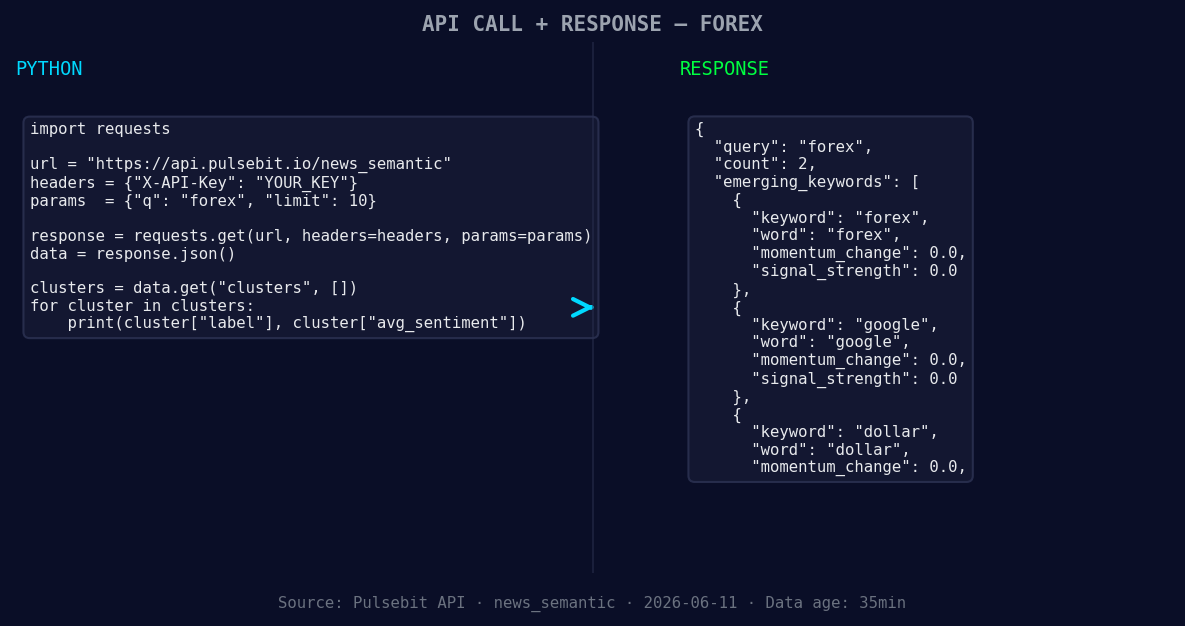
*Left: Python GET /news_semantic call for 'forex'. Right: returned JSON response structure (clusters: 3). Source: Pulsebit /news_semantic.*
# Make the API call
response = requests.get("https://api.pulsebit.com/v1/sentiment", params=params)
forex_data = response.json()
print(f"Forex Data: {forex_data}")
Next, we'll send the cluster reason string back through our sentiment analysis endpoint to score the narrative framing.
# Meta-sentiment moment: running the cluster reason through POST /sentiment
cluster_reason = "Clustered by shared themes: rupee, dollar, rises, paise, close."
meta_sentiment_response = requests.post("https://api.pulsebit.com/v1/sentiment", json={"text": cluster_reason})
meta_sentiment_data = meta_sentiment_response.json()

print(f"Meta-Sentiment Data: {meta_sentiment_data}")
This code captures the sentiment surrounding forex while also assessing the narrative themes that may drive market sentiment.
Three Builds Tonight
Here are three specific builds we recommend implementing with this pattern:
Geo-Filtered Insights: Use the geographic origin filter to set up alerts for significant sentiment shifts in forex specifically for English-speaking regions. For example, trigger an alert when sentiment momentum dips below -0.5 within 24 hours.
Meta-Sentiment Analysis: Implement a meta-sentiment analysis that runs periodic checks on clustered themes. You can set a threshold to notify you whenever the sentiment score for a narrative like "Clustered by shared themes: rupee, dollar, rises" dips below zero, indicating a potential shift in market sentiment.
Forming Gap Analysis: Create a dashboard that highlights forming gaps between mainstream mentions and emerging themes in forex. Use the forming data (e.g., forex(+0.00), google(+0.00), dollar(+0.00)) to visualize discrepancies and capture early signals.
Get Started
Dive into our documentation at pulsebit.lojenterprise.com/docs and start implementing these insights right away. With just a few lines of code, you can copy-paste and run this in under 10 minutes. Don’t let your pipeline lag behind!


Top comments (0)