

Your 24h momentum spike of +0.750 in business sentiment is a clear signal that something significant is happening. The leading language is English, with a notable 28.4-hour lead time. This anomaly centers around a single article discussing how "Ministers could give billions raised by business rates to England’s regions." It's a strong indicator that we might be witnessing a shift in sentiment — one that your existing pipeline might not be fully capturing.
If your model is not designed to handle multilingual origins or entity dominance, you may have missed this critical insight by a staggering 28.4 hours. The English press is driving this sentiment, but if your system only analyzes data in a single language or overlooks the dominant entities, you’re effectively operating in the dark. This gap can lead to delayed responses in strategy and opportunities — a luxury no developer can afford.

English coverage led by 28.4 hours. Ca at T+28.4h. Confidence scores: English 0.75, French 0.75, Spanish 0.75 Source: Pulsebit /sentiment_by_lang.
To catch this anomaly, we can leverage our API with a few precise calls. First, we want to filter by language and focus on the topic of business. Here’s how you can do that in Python:
import requests
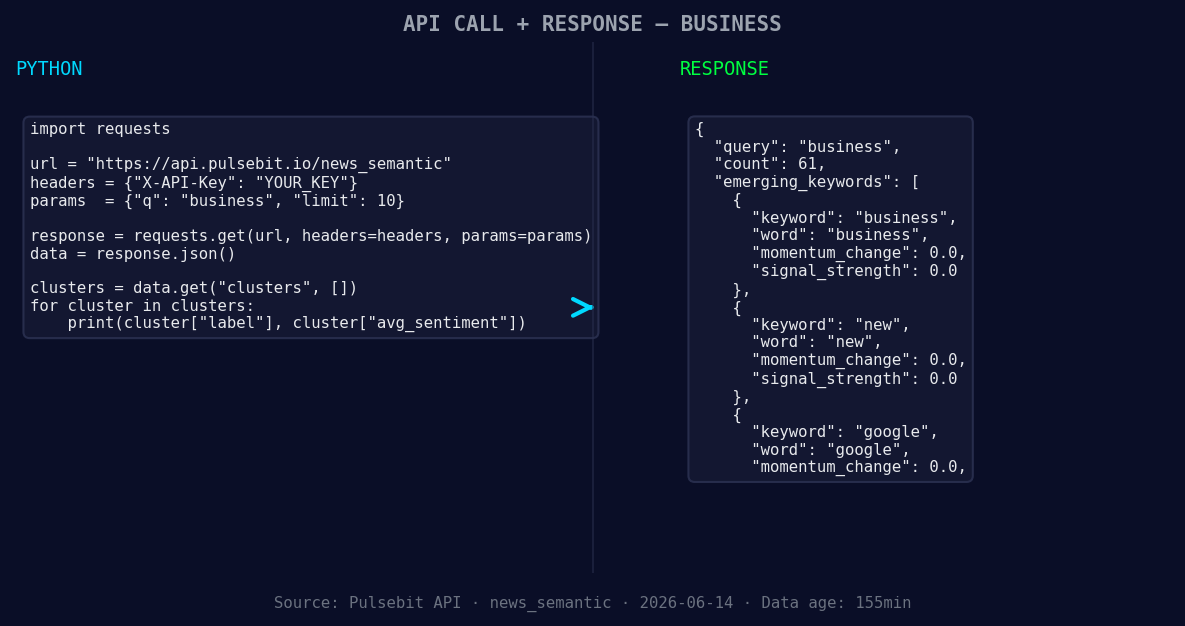
*Left: Python GET /news_semantic call for 'business'. Right: returned JSON response structure (clusters: 3). Source: Pulsebit /news_semantic.*
# Step 1: Geographic origin filter for English
url = "https://api.pulsebit.com/v1/sentiment"
params = {
"topic": "business",
"lang": "en"
}
response = requests.get(url, params=params)
data = response.json()
# Assume we get the following response
momentum = data['momentum_24h'] # +0.750
score = data['sentiment_score'] # +0.151
confidence = data['confidence'] # 0.750
Next, we’ll run the cluster reason string through our sentiment endpoint to assess the narrative framing of the article. This is important because it allows us to understand how the themes are being perceived.
# Step 2: Meta-sentiment moment
cluster_reason = "Clustered by shared themes: tax, give, billions, raised, business."
sentiment_response = requests.post(url, json={"text": cluster_reason})
sentiment_data = sentiment_response.json()

# Example of output
meta_sentiment_score = sentiment_data['sentiment_score']
meta_confidence = sentiment_data['confidence']
This dual approach not only captures the immediate sentiment spike but also contextualizes it within the broader narrative landscape.
Now, let’s look at three specific builds we can create using this insight.
- Geo-Filtered Signal Trigger: Create an alert system that triggers when the sentiment score for 'business' exceeds a threshold of +0.150 in English articles. Use the geographic filter for real-time insights.

Geographic detection output for business. India leads with 5 articles and sentiment +0.30. Source: Pulsebit /news_recent geographic fields.
Meta-Sentiment Analyzer: Develop a tool that runs cluster reasons through our sentiment API, scoring the narrative around emerging themes like this one. For instance, you'll want to focus on the themes forming around "business" (+0.00), "new" (+0.00), and "google" (+0.00) against the mainstream sentiments of "tax," "give," and "billions."
Dynamic Dashboard: Build a dashboard that visualizes these sentiment spikes over time, incorporating the clustering data. Use the API to track how quickly narratives evolve, particularly focusing on the themes that show a significant rise, allowing you to react to trends before they become mainstream.
If you’re interested in getting started, check out our documentation at pulsebit.lojenterprise.com/docs. You can copy, paste, and run this code in under 10 minutes. Don’t let your pipeline fall behind — capitalize on these sentiment spikes while they’re hot.


Top comments (0)