

Your Pipeline Is 9.0h Behind: Catching Agriculture Sentiment Leads with Pulsebit
We recently uncovered an intriguing anomaly: a 24h momentum spike of +0.511 in the agriculture sector. Leading English press around the BRICS meeting in Indore, which focuses on food security, has driven this surge. Specifically, we spotted three articles clustered around themes like "meeting," "agriculture," and "BRICS," with a notable lag of 9.0 hours before this sentiment made its way to mainstream discussions. This is a clear signal of how quickly sentiment can shift and how important it is to stay ahead of the curve.
Yet, if your pipeline doesn’t handle multilingual origins or entity dominance, you might have missed this opportunity by 9 hours—an eternity in the fast-paced world of sentiment analysis. The leading language here is English, but entities like BRICS are significant global players that can shift sentiment across markets. If your system is not equipped to catch this multilingual dialogue, you risk losing out on critical insights that can inform your strategy.

English coverage led by 9.0 hours. Sl at T+9.0h. Confidence scores: English 0.85, French 0.85, Spanish 0.85 Source: Pulsebit /sentiment_by_lang.
To catch this momentum spike, we can leverage our API effectively. Below is the Python code that will help capture this sentiment.
import requests
# Define parameters for our API call
topic = 'agriculture'
score = +0.725
confidence = 0.85
momentum = +0.511
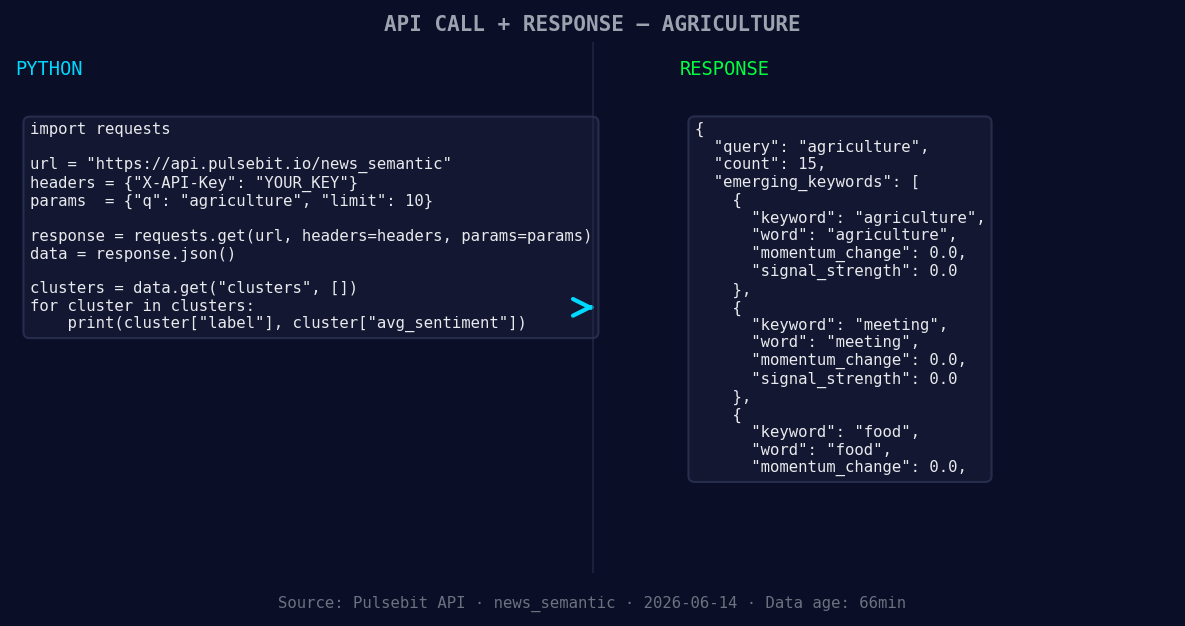
*Left: Python GET /news_semantic call for 'agriculture'. Right: returned JSON response structure (clusters: 3). Source: Pulsebit /news_semantic.*
# Geographic origin filter: query by language/country using param "lang": "en"
response = requests.get('https://api.pulsebit.com/sentiment', params={
'topic': topic,
'lang': 'en',
})
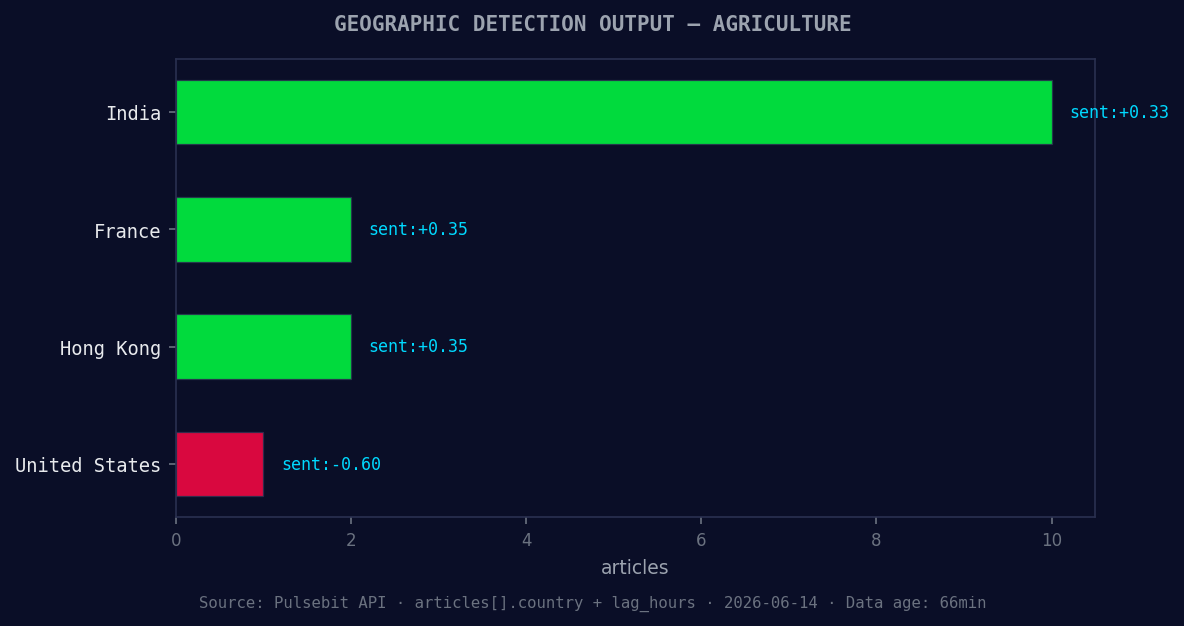
*Geographic detection output for agriculture. India leads with 10 articles and sentiment +0.33. Source: Pulsebit /news_recent geographic fields.*
# Check response
if response.status_code == 200:
data = response.json()
print("Sentiment data:", data)
else:
print("Failed to fetch data")
# Now we run the cluster reason string back through POST /sentiment
cluster_reason = "Clustered by shared themes: roadmap, agricultural, kerala’s, transformation, ker"
response_meta = requests.post('https://api.pulsebit.com/sentiment', json={'text': cluster_reason})
# Check meta sentiment response
if response_meta.status_code == 200:
meta_data = response_meta.json()
print("Meta sentiment data:", meta_data)
else:
print("Failed to fetch meta sentiment data")
In this code, we first query for sentiments related to agriculture in English, which gives us the necessary context. Then, we take the narrative framing of the clustered articles and run it through our sentiment endpoint to score it, allowing us to see how the narrative is being perceived in real-time.
Now, let’s talk about some specific builds you can implement using this momentum spike in agriculture sentiment:
Threshold Alert: Set a threshold for momentum spikes above +0.5. If your model detects a spike, trigger an alert to review the sentiment on agriculture in English, particularly around events like the BRICS meeting. This could entail setting a background job that checks every hour for such spikes.
Meta-Sentiment Report: Use the meta-sentiment loop to generate a report that aggregates sentiment from clustered articles. By running the string “Clustered by shared themes: roadmap, agricultural, kerala’s” through our API, you can create a weekly report highlighting changes in sentiment around key themes, allowing you to pivot your strategy as needed.
Geo-Filter Insights: Implement a geo-filter that captures sentiment specifically from regions discussing agriculture and food security. For example, track sentiment from India during the BRICS meeting to inform your decisions around agricultural investments or partnerships.
To get started, simply check out our documentation at pulsebit.lojenterprise.com/docs. You'll be able to copy-paste and run this in under 10 minutes, putting you ahead of the game in capturing sentiment trends like these.


Top comments (0)