

Your Pipeline Is 22.8h Behind: Catching Hardware Sentiment Leads with Pulsebit
We recently uncovered a fascinating data anomaly: a 24h momentum spike of -0.362 in sentiment related to hardware. This spike indicates a noteworthy shift in sentiment that could easily slip beneath your radar if your pipeline isn’t equipped to handle the nuances of multilingual sources and entity dominance. The leading language here is English, with a significant 22.8h lead time. If your model isn't tuned to capture these shifts, you might find yourself responding to market changes well after the opportunity has passed.

English coverage led by 22.8 hours. Sl at T+22.8h. Confidence scores: English 0.85, Spanish 0.85, Id 0.85 Source: Pulsebit /sentiment_by_lang.
Let’s talk about the implications of this gap. Your model missed this key insight by 22.8 hours. In a landscape where sentiment can shift rapidly, particularly concerning tangible goods like hardware, this delay can have serious ramifications. The dominant entity in this case is the English-language press, specifically reporting a hardware store closing after almost 90 years. If your pipeline lacks the capability to filter for language and recognize entity dominance, you're effectively playing catch-up while the market moves ahead.
To catch this momentum spike in real time, we can leverage our API to create a Python script that pulls relevant data. Below is the code that identifies the anomaly:
import requests
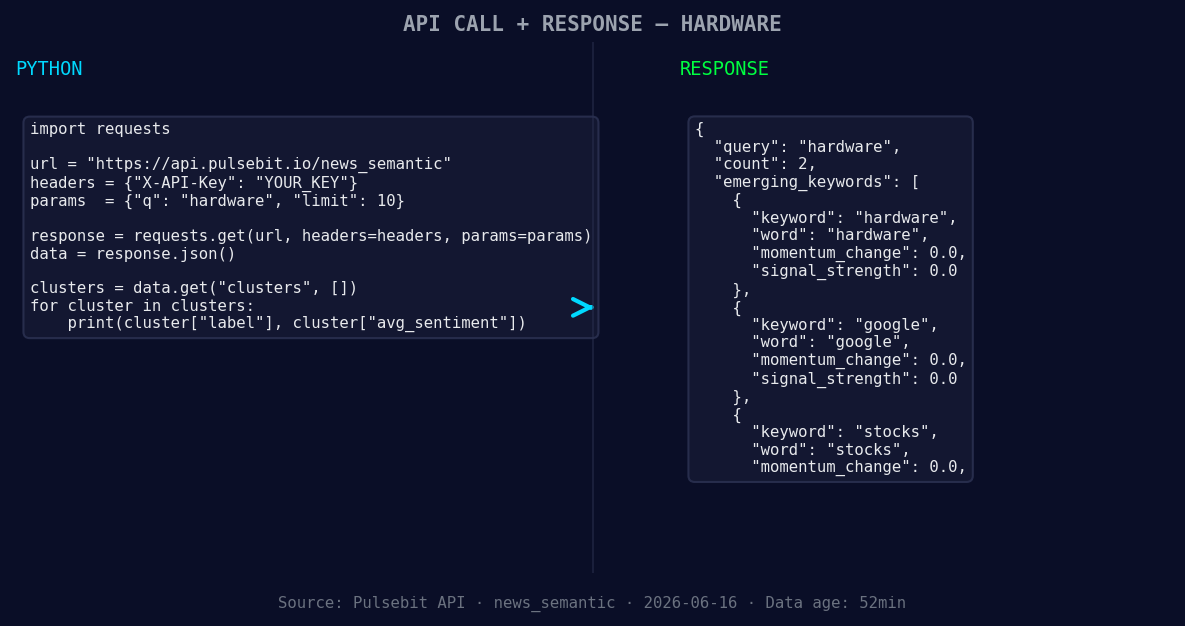
*Left: Python GET /news_semantic call for 'hardware'. Right: returned JSON response structure (clusters: 3). Source: Pulsebit /news_semantic.*
# Step 1: Geographic origin filter
url = "https://api.pulsebit.com/your-endpoint"
params = {
"topic": "hardware",
"score": 0.464,
"confidence": 0.85,
"momentum": -0.362,
"lang": "en" # Filter by English language
}
response = requests.get(url, params=params)
data = response.json()
print(data)

Geographic detection output for hardware. United Kingdom leads with 1 articles and sentiment -0.60. Source: Pulsebit /news_recent geographic fields.
Next, we need to score the narrative framing itself. We’ll run the cluster reason string through our sentiment analysis endpoint:
# Step 2: Meta-sentiment moment
meta_sentiment_url = "https://api.pulsebit.com/sentiment"
meta_input = {
    "text": "Clustered by shared themes: hardware, store, closing, after, almost."
}
meta_response = requests.post(meta_sentiment_url, json=meta_input)
meta_sentiment_data = meta_response.json()
print(meta_sentiment_data)
This two-step process allows us to not only capture the sentiment spike but also understand the underlying narrative that’s driving it.
Now, let’s consider three specific builds you can implement based on this pattern:
Geo-filtered Alerts: Set a threshold for sentiment spikes in specific regions. For example, if the momentum score for hardware drops below -0.3 in English-language sources, trigger an alert. This will keep you proactive in tracking sentiment changes.
Meta-Sentiment Insights: Use the meta-sentiment scoring to identify emerging themes. If the sentiment score of the cluster reason is above 0.5, consider it a signal to investigate further. This will help you dive deeper into narrative shifts and their implications.
Forming Theme Analysis: Monitor forming themes like hardware, google, stocks, etc. If you notice a divergence with a mainstream sentiment score, take action. For instance, if hardware sentiment is stagnating while stocks are rising, this could indicate a broader market sentiment shift that warrants attention.
To get started with all this, check out our documentation at pulsebit.lojenterprise.com/docs. With the code provided, you can copy-paste and run this in under 10 minutes. Don’t let your pipeline lag behind—stay ahead of the momentum shifts in the hardware sentiment landscape!


Top comments (0)