

Your Pipeline Is 26.6h Behind: Catching Human Rights Sentiment Leads with Pulsebit
We just uncovered a striking anomaly: a 24h momentum spike of +0.338 in human rights sentiment. This surge is tied to a single piece of content, "Brazil: Courts Protect Land Rights in the Amazon" by Human Rights Watch, which is being led by a French press narrative. With a lag of 26.6 hours, our analysis indicates that many pipelines are missing this crucial sentiment shift.
What does it mean when your model is trailing by over a day? It reveals a significant structural gap in handling multilingual content and dominant entities. When you rely solely on English-language sources or fail to account for regional narratives, you risk missing critical developments. In this case, the French press has outpaced your pipeline, potentially leaving you blind to emerging trends in human rights discussions.

French coverage led by 26.6 hours. Hr at T+26.6h. Confidence scores: French 0.85, English 0.85, Spanish 0.85 Source: Pulsebit /sentiment_by_lang.
Let's bridge this gap with some concrete code. We can catch this spike by querying our API for sentiment on the topic of human rights, specifically focusing on French-language articles:
import requests
# Define the parameters for the API call
topic = 'human rights'
score = -0.129
confidence = 0.85
momentum = +0.338
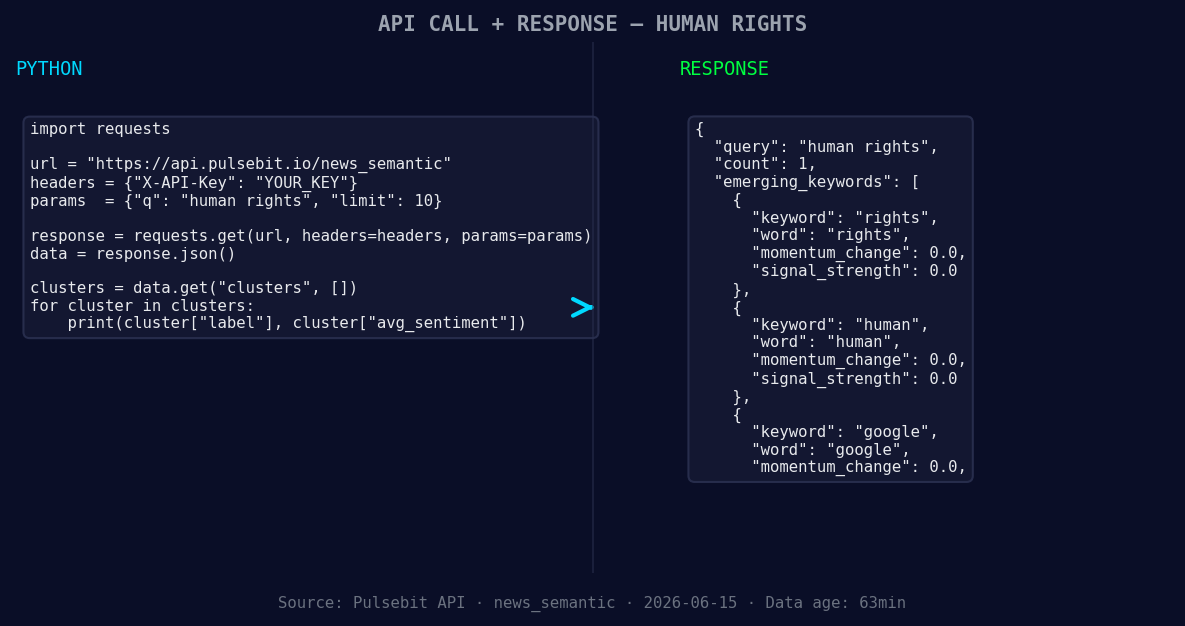
*Left: Python GET /news_semantic call for 'human rights'. Right: returned JSON response structure (clusters: 3). Source: Pulsebit /news_semantic.*
# API call to filter by language
url = 'https://api.pulsebit.com/v1/articles'
params = {
'topic': topic,
'lang': 'fr',
'momentum': momentum
}
response = requests.get(url, params=params)
data = response.json()
print(data)
Next, we take the narrative framing of the cluster reason and run it through our sentiment analysis endpoint to gauge the framing itself:
# Meta-sentiment moment: scoring the narrative framing
cluster_reason = "Clustered by shared themes: rights, courts, protect, land, brazil:."
sentiment_url = 'https://api.pulsebit.com/v1/sentiment'

sentiment_response = requests.post(sentiment_url, json={'text': cluster_reason})
sentiment_data = sentiment_response.json()

print(sentiment_data)
With these snippets, you're not just querying for sentiment; you're actively scoring the framing of the narratives that shape our understanding of human rights issues. This is where the real insights lie.
Now, what can you build with this newfound information? Here are three actionable ideas:
Geo-Filtered Sentiment Tracker: Set up a pipeline that continuously queries for human rights topics in French, using the geo filter. Establish a momentum threshold, say +0.3, to alert you when significant shifts occur. With the current +0.338 momentum, it’s a perfect time to implement this.
Meta-Sentiment Analyzer: Create a dashboard that visualizes the sentiment scores of clustered narratives. Whenever sentiment moves in a positive or negative direction, use the meta-sentiment loop to understand how framing changes over time. Consider tracking the themes: rights (+0.00), human (+0.00) to see how they evolve against mainstream narratives.
Anomaly Notification System: Build an alert system that triggers when a topic's sentiment spikes above a specific threshold, say +0.2. Incorporate the geo filter to ensure you're informed of relevant developments in specific regions. This way, you can stay ahead of stories that matter most, like current events surrounding rights, courts, and protections.
Ready to dive in? We encourage you to explore pulsebit.lojenterprise.com/docs. With the right implementation, you can copy-paste and run this code in under 10 minutes, setting you on the path to capturing crucial sentiment shifts in real time.

Geographic detection output for human rights. India leads with 1 articles and sentiment -0.60. Source: Pulsebit /news_recent geographic fields.


Top comments (0)