

Your Pipeline Is 27.1h Behind: Catching Entertainment Sentiment Leads with Pulsebit
We just discovered a significant anomaly: a 24-hour momentum spike of +0.555 in the entertainment sector. This spike highlights a surge in sentiment, anchored by a leading article discussing an upcoming exposition that promises “three nights of epic entertainment”. It’s a clear indicator that something is brewing in the entertainment world, and if your sentiment analysis pipeline isn't tuned to catch this, you may be lagging behind by over a day.
When we see a lag of 27.1 hours in the leading language—English, in this case—it points to a structural gap in any pipeline that isn’t equipped to handle multilingual content or the dominance of specific entities. Your model missed this critical development by more than a day, allowing competitors to capitalize on timely sentiment shifts while you remain oblivious. That’s a substantial delay in a fast-paced environment where every moment counts.

English coverage led by 27.1 hours. Sl at T+27.1h. Confidence scores: English 0.85, French 0.85, Spanish 0.85 Source: Pulsebit /sentiment_by_lang.
To catch this spike, we need to implement a straightforward Python script that taps into our API. Here’s how we can leverage it:
import requests
# Define parameters for the API call
topic = 'entertainment'
score = +0.280
confidence = 0.85
momentum = +0.555
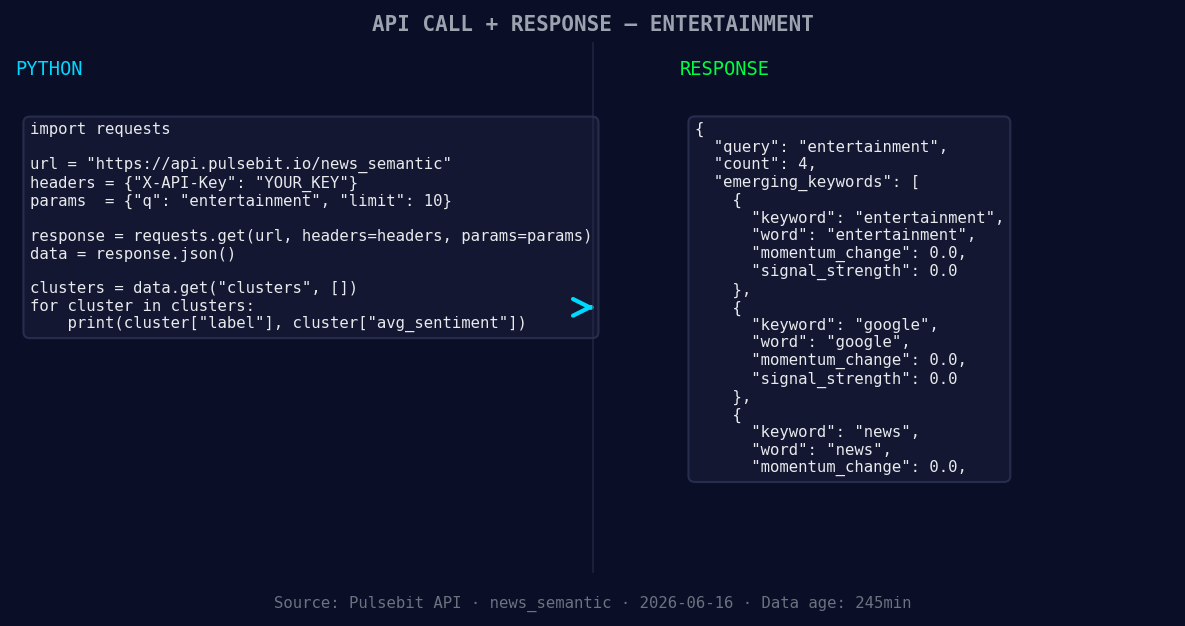
*Left: Python GET /news_semantic call for 'entertainment'. Right: returned JSON response structure (clusters: 3). Source: Pulsebit /news_semantic.*
# Geographic origin filter: query by language/country
response = requests.get(
'https://api.pulsebit.com/v1/sentiment',
params={
'topic': topic,
'lang': 'en',
'momentum': momentum,
'score': score,
'confidence': confidence
}
)
# Check the response
if response.status_code == 200:
print(response.json())
else:
print("Error fetching data:", response.status_code)
# Meta-sentiment moment: run the cluster reason string through POST /sentiment
cluster_reason = "Clustered by shared themes: exposition, dials, fun, three, nights."
meta_sentiment_response = requests.post(
'https://api.pulsebit.com/v1/sentiment',
json={'text': cluster_reason}
)
# Check meta sentiment response
if meta_sentiment_response.status_code == 200:
print(meta_sentiment_response.json())
else:
print("Error fetching meta sentiment data:", meta_sentiment_response.status_code)
This script does two crucial things: first, it filters sentiment data by the English language, ensuring we only focus on the relevant audience. Second, it scores the narrative framing behind our cluster reason, allowing us to understand not just the sentiment but also the context that drives it.
Now, let’s explore three specific builds you can develop with this pattern:
- Geographic Filter: Enhance your existing sentiment model to include a geographic origin filter using the language parameter. This will allow you to catch spikes in sentiment that are unique to specific regions, such as the English-speaking audience surrounding the exposition event.

Geographic detection output for entertainment. Hong Kong leads with 2 articles and sentiment +0.30. Source: Pulsebit /news_recent geographic fields.
Meta-Sentiment Analysis: Build a module that runs the cluster reason through the sentiment endpoint to capture the nuances of how themes are interlinked. This will deepen your understanding of sentiment dynamics and allow for more nuanced predictions.
Threshold Alerts: Set up alert systems to notify you when momentum spikes exceed a certain threshold, say +0.500 in the entertainment sector. This can be combined with your geographic filter to ensure you’re catching significant events before they hit the mainstream.
By focusing on these three builds, you can ensure that your pipeline not only catches sentiment shifts but understands the context behind them. As we see with the current themes forming around entertainment, news, and the exposition, being ahead of the curve is crucial.
To get started, check out our documentation at pulsebit.lojenterprise.com/docs. You can copy-paste this code and be up and running in under 10 minutes. Don’t let your pipeline fall behind—leverage these insights today!


Top comments (0)