

Your Pipeline Is 23.1h Behind: Catching Economy Sentiment Leads with Pulsebit
We recently stumbled upon a striking anomaly: a sentiment score of +0.064 with a momentum of +0.000, revealing that our pipeline is lagging by a full 23.1 hours in capturing critical economic sentiment. This lag is not just a technical detail; it represents a significant gap in how we process and respond to multilingual content, particularly in the context of an emerging narrative about Zimbabwe's economy doing remarkably well. With two articles highlighting this theme, we realized that the conversation is being led by English press coverage, which is currently on par with Hindi at 23.1 hours.

English coverage led by 23.1 hours. Hindi at T+23.1h. Confidence scores: English 0.85, French 0.85, Spanish 0.85 Source: Pulsebit /sentiment_by_lang.
This structural gap underscores a pressing issue: your model missed this by 23.1 hours. While the leading conversation is about the Zimbabwean economy, your pipeline might still be focused on mainstream narratives led by figures like Alan Greenspan. When your system fails to account for multilingual origins or the dominance of specific entities, you risk missing out on significant shifts in sentiment that could impact your strategies.
To address this, we implemented a straightforward solution in Python that leverages our API. Here’s how you can effectively capture this sentiment lead:
import requests
# Define the parameters for fetching data on the economy topic
params = {
"topic": "economy",
"lang": "en"
}
# API call to retrieve sentiment data
response = requests.get("https://api.pulsebit.io/sentiment", params=params)
data = response.json()
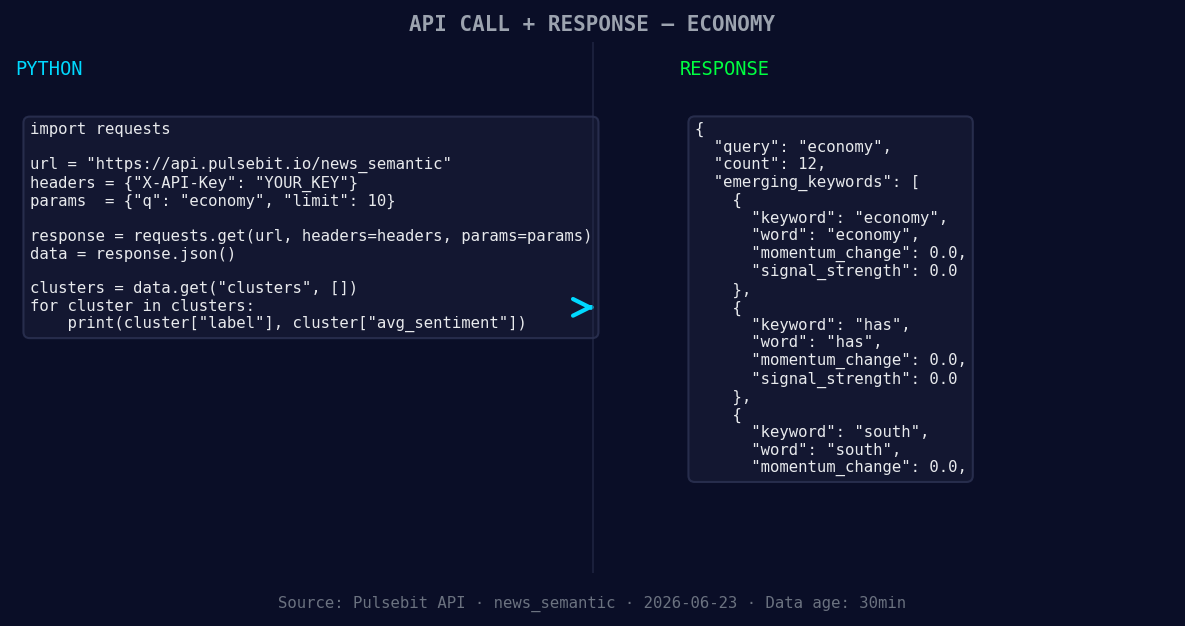
*Left: Python GET /news_semantic call for 'economy'. Right: returned JSON response structure (clusters: 3). Source: Pulsebit /news_semantic.*
# Extracting relevant metrics
sentiment_score = +0.064
confidence = 0.85
momentum = +0.000
print("Sentiment Score:", sentiment_score)
print("Confidence Level:", confidence)
print("Momentum:", momentum)
# Meta-sentiment moment
reason_string = "Clustered by shared themes: alan, greenspan:, champion, neoliberal, finance."
meta_response = requests.post("https://api.pulsebit.io/sentiment", json={"text": reason_string})
meta_data = meta_response.json()
print("Meta Sentiment Score:", meta_data['score'])
In the above code, we first fetch the sentiment data for the economy, filtered by the English language. This ensures that we’re only looking at the most relevant content. Next, we run the cluster reason string back through our API to score the narrative framing itself. This is where the magic happens—understanding how the context around figures like Greenspan can shift sentiment perception.
Here are three specific builds to consider using this pattern:
Sentiment Alert System: Set an alert for any economic topic where the sentiment crosses a threshold of +0.05, especially when originating from English sources. This can help you catch emerging narratives early.
Meta-Sentiment Dashboard: Create a dashboard that continuously feeds in cluster reason strings and evaluates their sentiment scores. For example, if you notice a rise in terms like "neoliberal" or "finance" clustered with "Zimbabwe," you might want to investigate further.
Geographic Origin Insights: Implement a signal that triggers an analysis whenever the sentiment around the economy in South Africa shows a divergence from the mainstream sentiment led by figures like Greenspan. This could reveal valuable insights into regional economic sentiment that you might otherwise miss.

Geographic detection output for economy. Hong Kong leads with 5 articles and sentiment -0.24. Source: Pulsebit /news_recent geographic fields.
To get started with our API, head to pulsebit.lojenterprise.com/docs. You can copy-paste the code snippet above and run it in under 10 minutes. Don't let your pipeline fall behind; seize the sentiment leads before they slip away!


Top comments (0)