

Your pipeline has just missed a critical signal: a 24h momentum spike of +0.392. This specific anomaly hints at a surge in sentiment around commodities, particularly in the context of oil prices — noteworthy given the backdrop of geopolitical tensions in the Hormuz Strait. The leading language in this sentiment is English, with a 24.4-hour lead time against the sentiment score. If you’re not capturing this in real-time, you’re behind by nearly a full day on a significant narrative shift.
This gap reveals a fundamental issue in your pipeline. If your model doesn't account for multilingual content or dominant entities, you're likely missing crucial signals. Your model missed this by 24.4 hours. The English press, dominating the conversation around oil prices, has a direct influence on market sentiment. If your system is running on a purely historical dataset without considering current linguistic or thematic shifts, you're looking at stale data while the world moves forward.

English coverage led by 24.4 hours. Sq at T+24.4h. Confidence scores: English 0.80, Italian 0.80, Spanish 0.80 Source: Pulsebit /sentiment_by_lang.
Here's how we can catch this momentum spike using our API. The first step is to filter the data by language and geographic origin to ensure we're capturing the relevant sentiment. Below is an example of how to do this in Python:

Geographic detection output for commodities. India leads with 1 articles and sentiment +0.85. Source: Pulsebit /news_recent geographic fields.
import requests
# Define the parameters for the API call
params = {
"topic": "commodities",
"lang": "en",
}
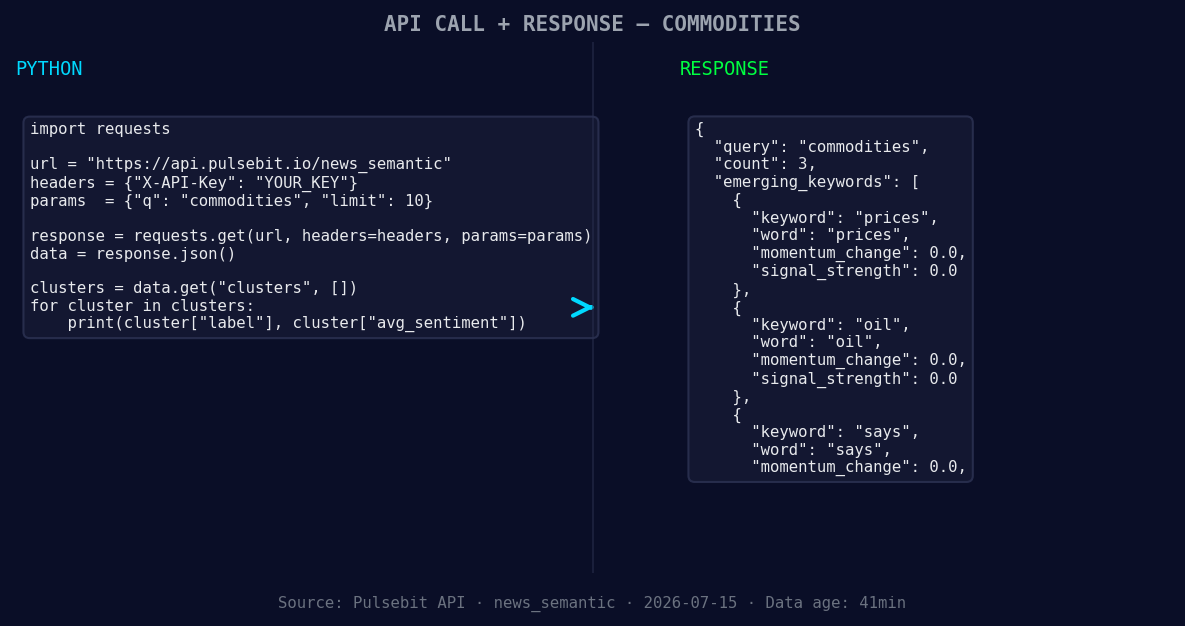
*Left: Python GET /news_semantic call for 'commodities'. Right: returned JSON response structure (clusters: 2). Source: Pulsebit /news_semantic.*
# Make the API call to fetch the sentiment data
response = requests.get("https://api.pulsebit.com/sentiment", params=params)
# Assuming the response is in JSON format
data = response.json()
momentum = data.get("momentum_24h", 0)
score = data.get("sentiment_score", 0)
confidence = data.get("confidence", 0)
print(f"Momentum: {momentum}, Score: {score}, Confidence: {confidence}")
Next, we want to run our cluster reason string through another endpoint to analyze the narrative framing:
# Define the cluster reason for sentiment analysis
cluster_reason = "Clustered by shared themes: prices, oil, hormuz, says, supply."

# Make the POST request to the sentiment endpoint
response_meta = requests.post("https://api.pulsebit.com/sentiment", json={"text": cluster_reason})

# Assuming the response also contains a relevant sentiment score
meta_data = response_meta.json()
meta_sentiment_score = meta_data.get("sentiment_score", 0)

print(f"Meta Sentiment Score: {meta_sentiment_score}")
With this setup, we can dive deeper into three actionable builds based on the sentiment data we just captured:
Geo-Specific Alert System: Create a notification system that triggers when sentiment momentum exceeds +0.4 in the English language. This will allow you to stay ahead of fluctuations in the oil market before they hit mainstream channels.
Meta-Sentiment Analyzer: Build a function that continually assesses the narrative framing of articles. By scoring the cluster reason string, you can gauge how sentiment themes evolve, allowing you to dynamically adjust your model’s parameters based on emerging narratives.
Forming Themes Dashboard: Develop a dashboard that visualizes forming themes around crucial topics like "prices" and "oil." Use the API to track sentiment changes in real-time, ensuring you're not only aware of mainstream trends but also of subtle shifts that could indicate emerging risks or opportunities.
We’ve uncovered a significant delay in sentiment awareness around commodities. If you’re ready to integrate these insights, you can hit the ground running. Check out our documentation at pulsebit.lojenterprise.com/docs. You can copy-paste this code and have it running in under 10 minutes. Don’t let your pipeline lag behind; start capturing real-time sentiment today.


Top comments (0)