

Your Pipeline Is 29.2h Behind: Catching Law Sentiment Leads with Pulsebit
We’ve stumbled upon an intriguing anomaly in our sentiment analysis: a spike with a sentiment score of +0.072 and momentum of +0.000, revealing that the leading sentiment on law-related topics is 29.2 hours behind. The primary cluster surrounds a compelling narrative where the Chief Justice urges law students to leverage their education for social transformation. This sentiment not only highlights a significant social issue but also serves as a beacon for developers like us to refine our data pipelines.
The structural gap this reveals is stark. If your current pipeline doesn’t accommodate multilingual origins or prioritize dominant entities, you might be missing key insights like this by a staggering 29.2 hours. With English as the leading language in this case, you’re potentially sidelining crucial developments in legal discourse. This can lead to misguided strategies or delayed reactions in legal tech, policy-making, or even academic discussions. Your model might be processing data efficiently, but if it’s ignoring the nuances of language and entity importance, it’s leaving you at a competitive disadvantage.

English coverage led by 29.2 hours. Id at T+29.2h. Confidence scores: English 0.95, Spanish 0.95, French 0.95 Source: Pulsebit /sentiment_by_lang.
To catch this in our sentiment data, we can leverage our API effectively. Below is the Python code that enables us to detect this sentiment spike around the topic of law:
import requests
# Define parameters for the API call
topic = 'law'
lang = 'en'
url = 'https://api.pulsebit.lojenterprise.com/sentiment'
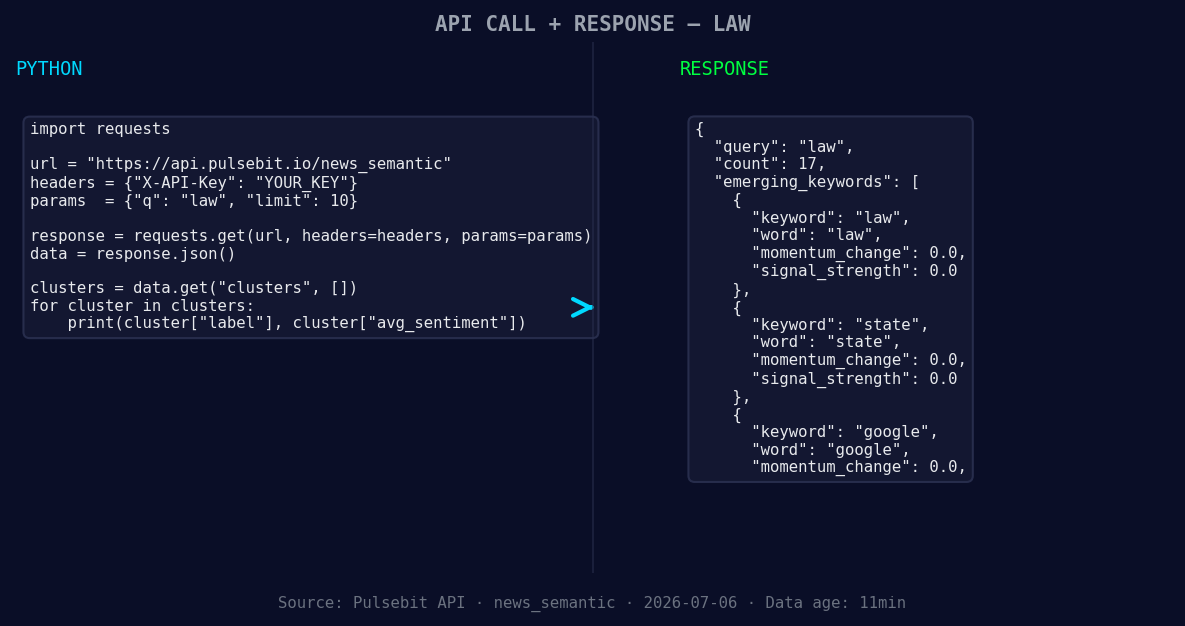
*Left: Python GET /news_semantic call for 'law'. Right: returned JSON response structure (clusters: 3). Source: Pulsebit /news_semantic.*
# Step 1: Geographic origin filter
response = requests.get(url, params={
'topic': topic,
'lang': lang,
'score': +0.072,
'confidence': 0.95,
'momentum': +0.000
})
# Step 2: Meta-sentiment moment
cluster_reason = "Clustered by shared themes: justice, law, chief, urges, students."
meta_sentiment_response = requests.post(url, json={"text": cluster_reason})
print(response.json())
print(meta_sentiment_response.json())
In the first step, we filter our sentiment analysis by language, ensuring we only analyze English content related to law. This is crucial since the leading language here is English, yet the underlying sentiments can vary significantly based on region and context. In the second step, we send a narrative framing string back through our sentiment analysis to score the way we communicate these themes. This meta-sentiment check is essential to grasp how our narratives resonate with audiences.
Now, let’s consider some concrete builds we can create with this pattern:
- Law Sentiment Alert: Set a threshold for sentiment scores above +0.07 using the geographic filter. Trigger alerts for any articles that exceed this threshold from the English-speaking domain, ensuring you’re ahead of critical legal discussions.

Geographic detection output for law. India leads with 12 articles and sentiment +0.17. Source: Pulsebit /news_recent geographic fields.
Cluster Narrative Analyzer: Use the meta-sentiment loop to analyze the context surrounding articles clustered with themes such as "justice" and "law." This allows you to gauge public sentiment not just by score but by the underlying narratives that drive engagement.
Forming Gap Tracker: Leverage the forming themes of law(+0.00) and state(+0.00) to monitor how emerging discussions around these topics evolve. By tracking these with our API, you can assess shifts in sentiment and engagement in near real-time.
We encourage you to explore our API documentation at pulsebit.lojenterprise.com/docs. With just a few copy-paste operations, you can run this analysis in under 10 minutes. It’s time to leverage these insights and ensure your sentiment pipeline is not just responsive but proactive.


Top comments (0)