

Your pipeline just missed a significant opportunity: a 24h momentum spike of +0.345 in the realm of education sentiment. This spike is not just a number; it reflects a burgeoning interest around a specific narrative: "Legal education will be modernised: Kerala Chief Minister." With the leading language being English, capturing this sentiment promptly could have given you a competitive edge.
Imagine your model is operating under the impression that it’s up-to-date, yet it’s lagging 28.5 hours behind the trending news. By failing to account for the rapid shifts in sentiment, particularly those shaped by dominant entities like the Kerala Chief Minister, you risk missing key insights. This is especially true in multilingual contexts where nuances can shift dramatically. Your setup likely overlooks important signals simply due to timing and language alignment.

English coverage led by 28.5 hours. Et at T+28.5h. Confidence scores: English 0.85, Spanish 0.85, French 0.85 Source: Pulsebit /sentiment_by_lang.
Let’s look at how to catch this kind of sentiment spike efficiently. We can start with a simple query to filter the data by language, focusing on English content. Here’s the Python code that accomplishes this:
import requests
# Set up the API endpoint and parameters
url = "https://api.pulsebit.com/v1/sentiment"
params = {
"topic": "education",
"lang": "en"
}
# Make the API call
response = requests.get(url, params=params)
data = response.json()
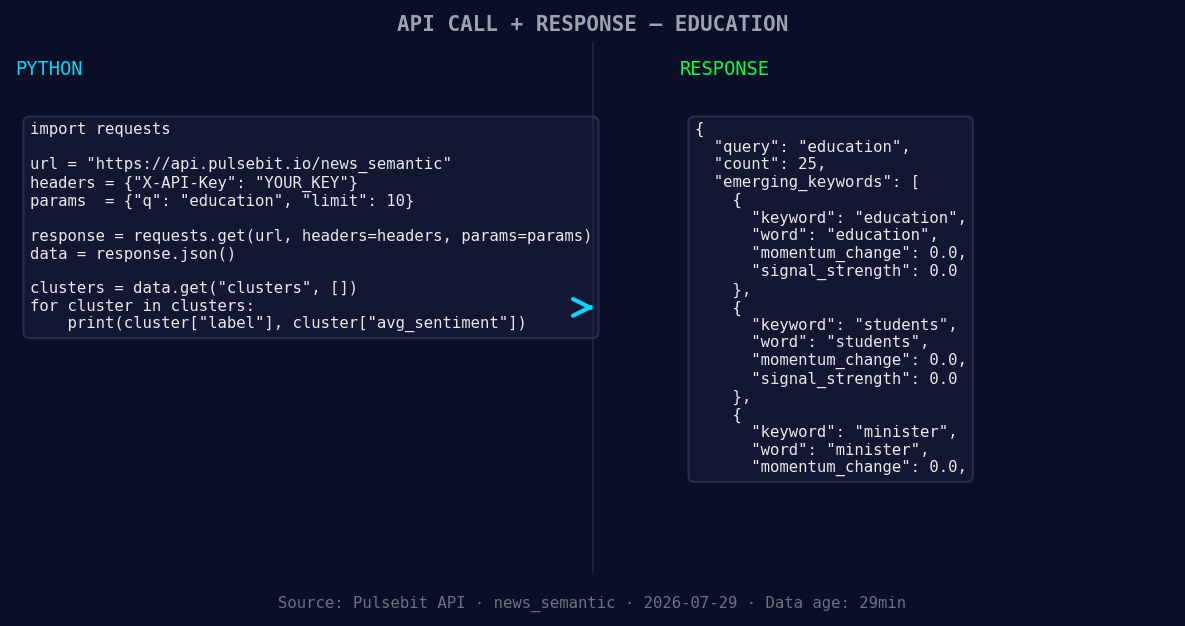
*Left: Python GET /news_semantic call for 'education'. Right: returned JSON response structure (clusters: 3). Source: Pulsebit /news_semantic.*
# Output the received data
print(data)
This code snippet filters our sentiment analysis to only include English-language articles, allowing us to hone in on the relevant discourse around education. Now, let’s score the narrative framing itself by using the cluster reason string:
# Define the cluster reason string
cluster_reason = "Clustered by shared themes: legal, education, kerala, chief, minister."

# Set up the sentiment scoring API call
score_url = "https://api.pulsebit.com/v1/sentiment"
score_payload = {
    "text": cluster_reason,
    "confidence": 0.85
}

# Make the POST request to score the narrative
score_response = requests.post(score_url, json=score_payload)
narrative_score = score_response.json()

# Output the narrative score
print(narrative_score)
Here we’re sending the cluster reason through our sentiment scoring endpoint to understand how the narrative is framed based on the specific themes we’ve identified. This is crucial for context as it allows for better decision-making based on sentiment around particular topics.
Now, with this newfound ability to capture and score sentiment effectively, consider these three builds to enhance your pipeline:
- Geographic Origin Filter: Use the English language filter to create alerts for sentiment spikes specifically in the education sector. Set a threshold of momentum greater than +0.3 to trigger notifications.

Geographic detection output for education. India leads with 20 articles and sentiment +0.14. Source: Pulsebit /news_recent geographic fields.
Meta-Sentiment Loop: Develop a function that automatically scores narrative framings around clustered themes. Any sentiment score above +0.05 should be flagged for further analysis, especially when tied to key figures like the Kerala Chief Minister.
Forming Themes Tracker: Implement a monitoring system that watches for emerging themes like education, students, and minister-related discussions. When these form with a score of +0.00 against mainstream topics, trigger a deeper dive analysis to harvest insights.
By implementing these strategies, you’ll not only capture data faster but also extract actionable insights that can drive your decision-making process.
Get started at pulsebit.lojenterprise.com/docs. You can copy-paste and run the above code in under 10 minutes, opening up new avenues for your sentiment analysis pipeline.


Top comments (0)