

Your Pipeline Is 27.4h Behind: Catching Defence Sentiment Leads with Pulsebit
We recently uncovered an intriguing anomaly: a 24h momentum spike of +0.335 in the topic of defence. This spike signals a significant shift in sentiment, led primarily by English press coverage, which has a 27.4-hour lead time. If you’re not tuned in to these dynamics, you could be missing critical insights that could influence your strategies.
The Problem
This momentum spike reveals a glaring structural gap in any sentiment analysis pipeline that fails to account for multilingual origins or the dominance of specific entities. Your model might have missed this sentiment shift by 27.4 hours due to its reliance on a single language or entity. In our case, the leading language is English, and the topic centers around the intricate ties between India and the U.S. in defence technology. Ignoring these nuances can lead to missed opportunities and outdated insights.

English coverage led by 27.4 hours. Sq at T+27.4h. Confidence scores: English 0.90, Spanish 0.90, Sv 0.90 Source: Pulsebit /sentiment_by_lang.
The Code
To capture this momentum spike effectively, we can use our API to filter by language and run a meta-sentiment analysis on the clustered narrative. Here’s how you can do it in Python:
import requests
# Define parameters for the initial query
params = {
"topic": "defence",
"score": -0.220,
"confidence": 0.90,
"momentum": +0.335,
"lang": "en" # Geographic origin filter
}
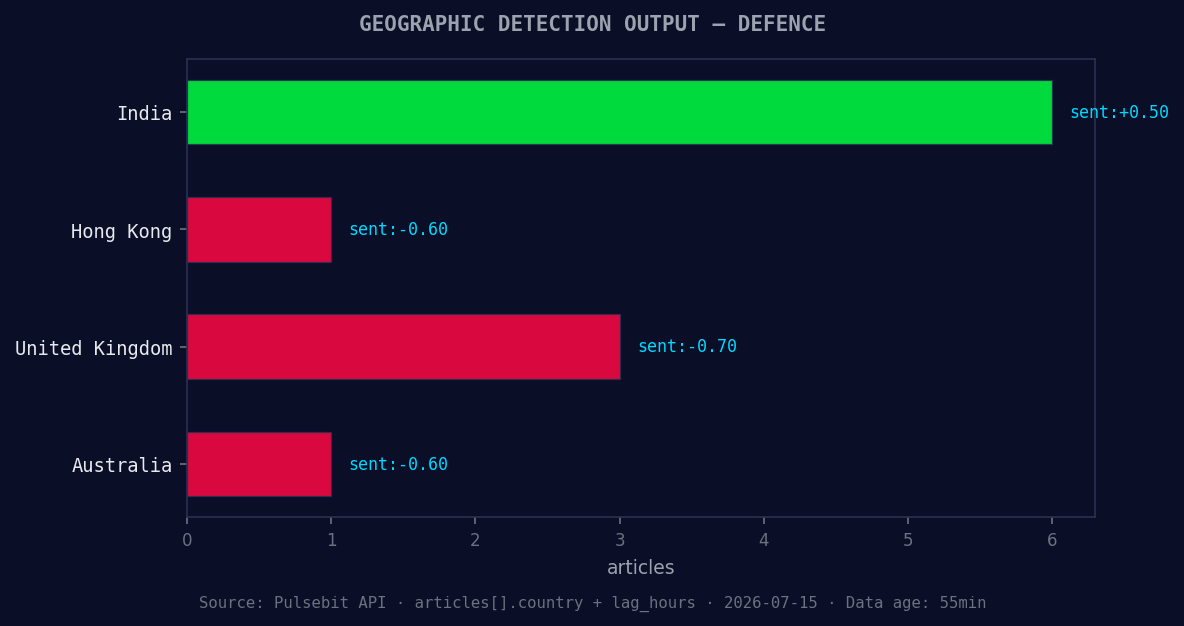
*Geographic detection output for defence. India leads with 6 articles and sentiment +0.50. Source: Pulsebit /news_recent geographic fields.*
# API call to fetch articles related to defence in English
response = requests.get('https://api.pulsebit.com/articles', params=params)
articles = response.json()
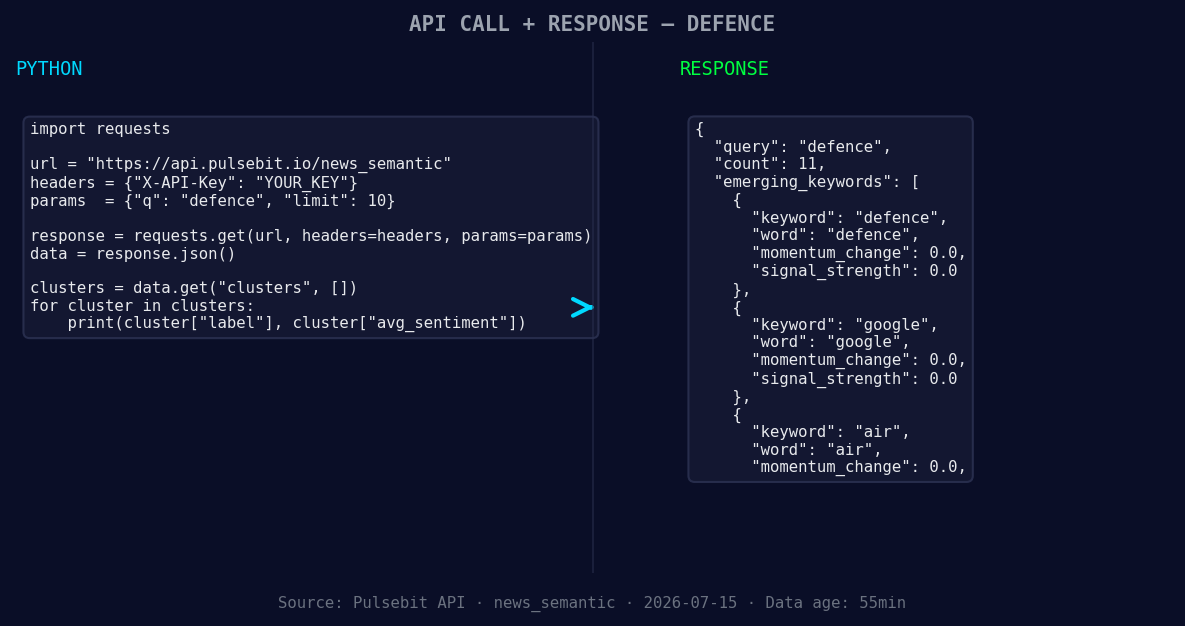
*Left: Python GET /news_semantic call for 'defence'. Right: returned JSON response structure (clusters: 3). Source: Pulsebit /news_semantic.*
# Example cluster reason string for meta-sentiment analysis
cluster_reason = "Clustered by shared themes: defence, technology, india-u, ties, big."
# POST request for meta-sentiment scoring
meta_sentiment_response = requests.post('https://api.pulsebit.com/sentiment', json={"text": cluster_reason})
meta_sentiment_score = meta_sentiment_response.json()
print("Articles:", articles)
print("Meta Sentiment Score:", meta_sentiment_score)
In this code, we first filter for articles related to "defence" in English. The next step is running the cluster reason string through our sentiment analysis endpoint to evaluate the narrative framing, which is crucial for understanding the context behind the spike.
Three Builds Tonight
With the insights gathered, here are three specific builds you can implement to capitalize on this momentum:
Geo-Filtered Alerts: Set up an alert system that triggers when sentiment momentum for "defence" exceeds a threshold of +0.3 in English-speaking regions. This will allow you to stay ahead of sentiment shifts.
Meta-Sentiment Dashboard: Create a dashboard that visualizes the meta-sentiment scores for clustered narratives like the one about India-U.S. defence ties. Implement a threshold of -0.2 for alerts, indicating a need for deeper analysis.
Sentiment Drift Analyzer: Develop a script to analyze forming themes such as "defence," "google," and "air" against mainstream topics like "technology" and "india-u." Use a trigger when sentiment momentum for any of these themes is greater than +0.1 and diverges from mainstream sentiment.
Get Started
Dive into our documentation at pulsebit.lojenterprise.com/docs. You can copy-paste and run this in under 10 minutes, ensuring you're not left behind in the fast-paced world of sentiment analysis.


Top comments (1)
The 27.4-hour lead time of English press coverage in the defence topic is quite fascinating, and it highlights the importance of considering multilingual origins and entity dominance in sentiment analysis pipelines. I've worked on similar projects where language and geographic filters played a crucial role in capturing nuanced shifts in sentiment. The provided Python code using the Pulsebit API is a great example of how to implement these filters and run a meta-sentiment analysis. One potential improvement could be to incorporate additional natural language processing techniques, such as named entity recognition or topic modeling, to further enhance the context and accuracy of the sentiment analysis. How do you think the inclusion of such techniques could impact the detection of sentiment shifts in the defence topic?