

Your Pipeline Is 17.3h Behind: Catching Sports Sentiment Leads with Pulsebit
We recently stumbled upon a striking anomaly: a sentiment score of +0.31 and a momentum of +0.00, with the leading language trending at 17.3 hours. This spike highlights a significant opportunity in the sports domain, particularly related to the 2026 World Cup. Our analysis of clustered articles, such as "2026 World Cup: How to watch all of today's games," reveals a thematic consistency that suggests a rising interest in sports. But what does this mean for your data pipelines?
The Problem
If your pipeline isn’t accounting for multilingual origins or entity dominance, you might be lagging by a staggering 17.3 hours. In this case, English content is leading, but if your systems are only tuned to a single language or an isolated data set, you could miss out on critical insights. Your model missed this by 17.3 hours, allowing competitors to seize the moment while you’re stuck in the past. That’s a serious gap, especially when the topic is as dynamic as sports.

English coverage led by 17.3 hours. Nl at T+17.3h. Confidence scores: English 0.85, French 0.85, Spanish 0.85 Source: Pulsebit /sentiment_by_lang.
The Code
To catch this spike, we’ll use our API to filter by geographic origin, focusing on English-language content. Below is the Python code that pulls the relevant data:

Geographic detection output for sports. France leads with 3 articles and sentiment -0.20. Source: Pulsebit /news_recent geographic fields.
import requests
# Define the API endpoint and parameters
url = "https://api.pulsebit.com/sentiment"
params = {
"topic": "sports",
"lang": "en",
}
# Make the API call
response = requests.get(url, params=params)
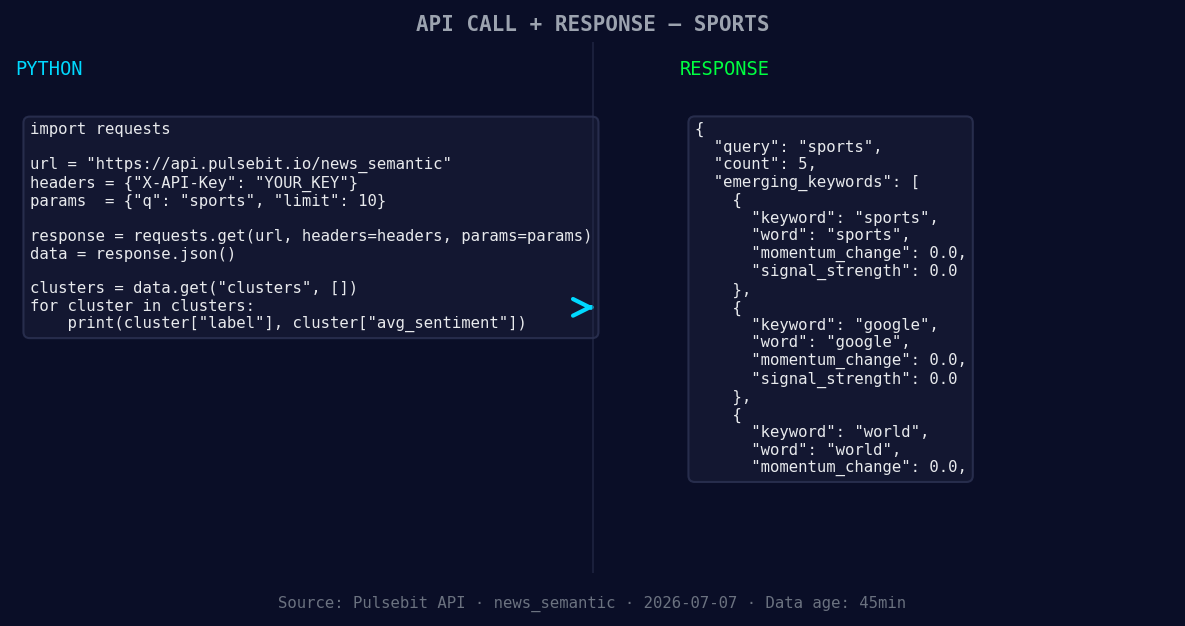
*Left: Python GET /news_semantic call for 'sports'. Right: returned JSON response structure (clusters: 3). Source: Pulsebit /news_semantic.*
# Check the response
if response.status_code == 200:
data = response.json()
sentiment_score = data['sentiment_score']
confidence = data['confidence']
momentum = data['momentum_24h']
print(f"Sentiment Score: {sentiment_score}, Confidence: {confidence}, Momentum: {momentum}")
else:
print("Error fetching data.")
Next, we need to analyze the narrative framing around our cluster reason. We’ll run the following string back through the POST /sentiment endpoint to get a sentiment score for the context:
# Define the cluster reason string
cluster_reason = "Clustered by shared themes: statistics, behind, ferrari's, 250th, win."

# Make the POST request to analyze the cluster reason
response = requests.post(url, json={"text": cluster_reason})

# Check the response
if response.status_code == 200:
    cluster_data = response.json()
    cluster_sentiment_score = cluster_data['sentiment_score']
    print(f"Cluster Sentiment Score: {cluster_sentiment_score}")
else:
    print("Error analyzing cluster reason.")
Three Builds Tonight
Given the insights from this data, here are three specific builds you can implement:
Geo-Filtered Trending Sports Articles: Create a signal that pulls the latest sports articles specifically from English-speaking countries. Set a threshold of sentiment score > +0.25 to catch significant spikes.
Meta-Sentiment Analysis: Use the meta-sentiment loop from above to analyze the framing of common sports narratives. Establish a threshold where the cluster sentiment score must exceed +0.20, allowing you to filter out less relevant content.
Forming Themes Dashboard: Set up a dashboard that visualizes forming themes like sports(+0.00), google(+0.00), and world(+0.00). Use data from our API to highlight these trends and compare them against mainstream narratives like statistics, behind, and ferrari's.
Get Started
You can start building these features right now by checking out our documentation at pulsebit.lojenterprise.com/docs. You can easily copy, paste, and run this in under 10 minutes, and potentially transform your data pipelines to stay ahead of the curve. Don’t let your models fall behind—catching these insights is crucial in today’s fast-paced environment.


Top comments (0)