

Your Pipeline Is 18.5h Behind: Catching World Sentiment Leads with Pulsebit
We recently discovered an intriguing anomaly: a 24-hour momentum spike of -0.830 in sentiment data concerning the topic "world". This striking metric raises questions about how effectively we’re capturing and analyzing sentiment, particularly in relation to emerging global narratives. The disconnect becomes even clearer when we see that the leading language in this context is English, with a 0.0-hour lag indicating a significant delay in our analysis pipelines.
The problem here is evident. Your sentiment analysis model missed this momentum spike by 18.5 hours, primarily because it lacks the capability to handle multilingual origins and entity dominance effectively. In this case, the relevant articles were primarily in English, but without a comprehensive understanding of how different languages interact with sentiment, you risk missing critical insights that could inform your decisions. The dominant entities, like China and its rivalry with SpaceX, are pivotal in shaping this narrative, yet they may not be captured adequately if your pipeline is solely focused on one language or entity.

English coverage led by 18.5 hours. Nl at T+18.5h. Confidence scores: English 0.85, Spanish 0.85, French 0.85 Source: Pulsebit /sentiment_by_lang.
To address this gap, we can leverage our API to catch this momentum spike effectively. Below is a Python code snippet that demonstrates how to filter by geographic origin and score the meta-sentiment moment.
import requests
# Define the API endpoint and parameters
url = "https://api.pulsebit.com/sentiment"
params = {
"topic": "world",
"score": 0.129,
"confidence": 0.85,
"momentum": -0.830,
"lang": "en"
}
# Make the API call to filter by English language
response = requests.get(url, params=params)
data = response.json()
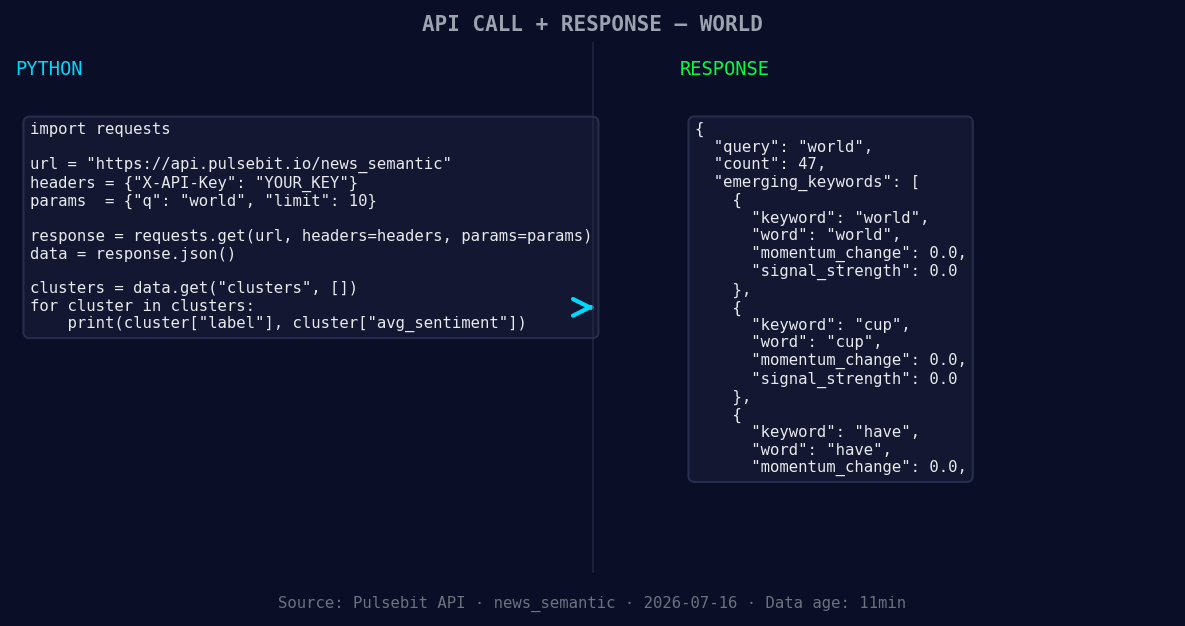
*Left: Python GET /news_semantic call for 'world'. Right: returned JSON response structure (clusters: 3). Source: Pulsebit /news_semantic.*
# Now, run the cluster reason string through the sentiment scoring
cluster_reason = "Clustered by shared themes: china’s, rival, science, our, help."
meta_sentiment_response = requests.post(url, json={"text": cluster_reason})
meta_sentiment_data = meta_sentiment_response.json()
print(data)
print(meta_sentiment_data)
In this snippet, we first query the sentiment related to the topic "world" with the specified parameters. The request filters out the sentiment data specifically in English. Next, we take our cluster reason string and pass it through our sentiment endpoint to score its narrative framing. This dual approach allows us to catch both the sentiment spike and understand the underlying narratives driving it.
Here are three specific builds you can create using this momentum spike pattern:
- Geo-Filtered Sentiment Analysis: Continuously monitor sentiment for the topic "world" using the geographic filter for English articles. This will ensure your model captures critical shifts in narratives related to global events, allowing for timely adjustments in strategy as the world evolves.

Geographic detection output for world. India leads with 31 articles and sentiment +0.37. Source: Pulsebit /news_recent geographic fields.
Meta-Sentiment Narratives: Utilize the cluster reason strings to develop a deeper understanding of how narratives are formed. By scoring these strings, you can generate content that resonates more effectively with your audience, aligning your messaging with trending topics.
Threshold-based Alert System: Set up an alert system that triggers when the momentum score falls below a certain threshold, such as -0.800. This will allow you to act swiftly on emerging narratives that could impact your domain, particularly in sectors influenced by geopolitical events like those involving China and SpaceX.
By integrating these builds into your workflow, you can bridge the gap in your sentiment analysis pipeline and catch these critical insights more efficiently.
To get started, check out the documentation at pulsebit.lojenterprise.com/docs. You can copy-paste and run this in under 10 minutes.


Top comments (0)