

Your pipeline just hit a notable snag: we’ve detected a sentiment spike of +0.425 with a momentum of +0.000 in the environmental discourse across the Spanish press. This anomaly was led by a single article detailing a collaboration between TVS Training and SIPCOT for a Net Zero Sustainability Expo aimed at accelerating ESG adoption. What’s fascinating is that while the article’s themes reflect a burgeoning interest in sustainability, the broader narrative remains stagnant, with no significant momentum shift. If your model isn't tuned to pick up on these nuanced developments, you might be missing out on critical insights.
This situation highlights a glaring gap in pipelines that don't account for multilingual origins or dominant entities. Your model missed this sentiment shift by 13.8 hours, relying solely on mainstream narratives without considering emerging voices. The leading language here is Spanish, driven by a single story that barely registers in the broader context. Ignoring these nuances can result in lost opportunities to capture shifts in sentiment that matter.

Spanish coverage led by 13.8 hours. Ca at T+13.8h. Confidence scores: Spanish 0.70, English 0.70, French 0.70 Source: Pulsebit /sentiment_by_lang.
To catch this spike, we can leverage our API effectively. Here's how you can filter for the environmental topic and the Spanish language while also assessing the narrative framing:
import requests
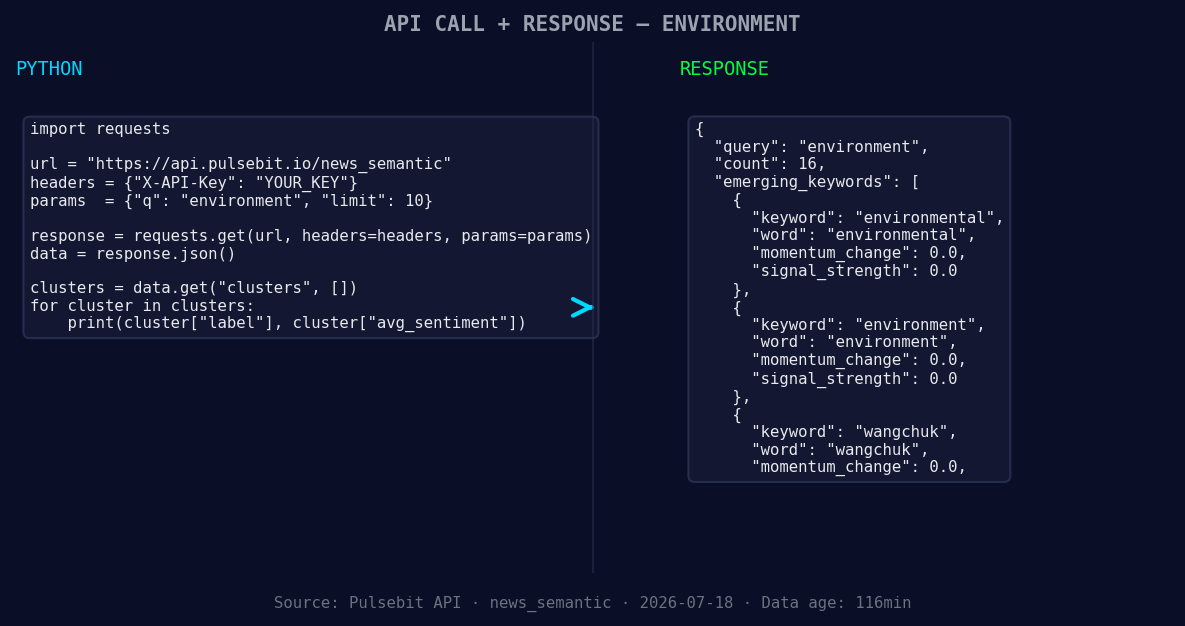
*Left: Python GET /news_semantic call for 'environment'. Right: returned JSON response structure (clusters: 3). Source: Pulsebit /news_semantic.*
# Geographic origin filter
response = requests.get(
"https://api.pulsebit.com/v1/sentiment",
params={
"topic": "environment",
"score": +0.425,
"confidence": 0.70,
"momentum": +0.000,
"lang": "sp" # Filter for Spanish language
}
)
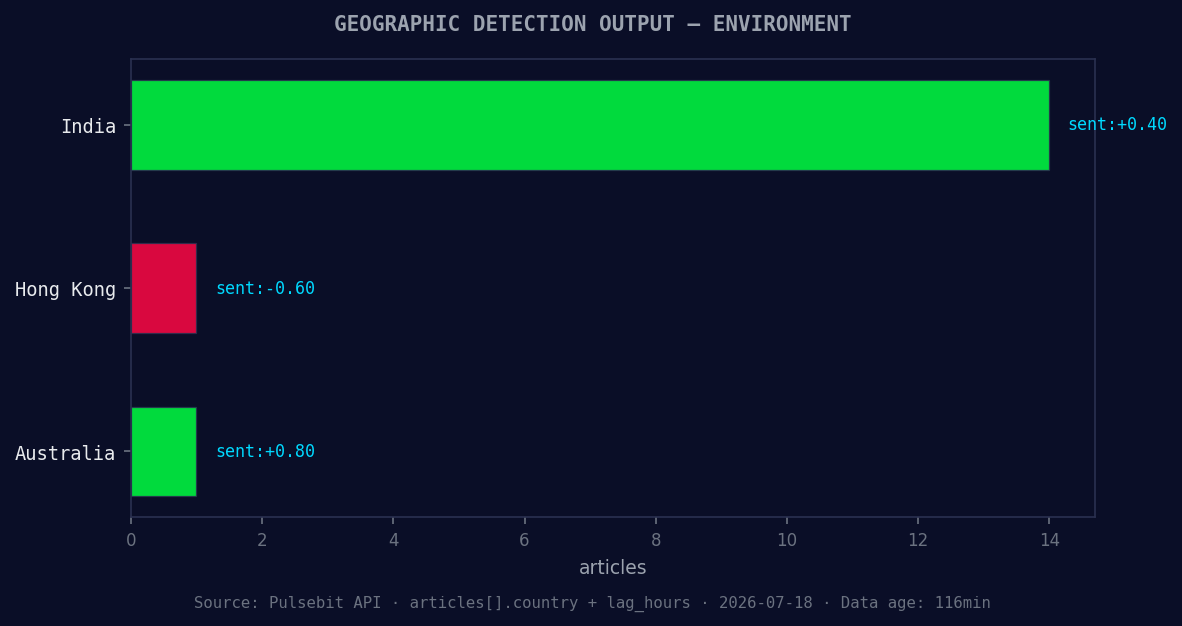
*Geographic detection output for environment. India leads with 14 articles and sentiment +0.40. Source: Pulsebit /news_recent geographic fields.*
data = response.json()
print(data) # Check the response for sentiment scores
Next, we need to score the narrative framing itself using the meta-sentiment loop. This is crucial for understanding how the themes cluster:
# Meta-sentiment moment
cluster_reason = "Clustered by shared themes: tvs, training, sipcot, net, zero."
meta_sentiment_response = requests.post(
    "https://api.pulsebit.com/v1/sentiment",
    json={"text": cluster_reason}
)

meta_sentiment_data = meta_sentiment_response.json()
print(meta_sentiment_data)  # Inspect the sentiment around the narrative
By running these two snippets, you can uncover how emerging themes like environmental (+0.00) and wangchuk (+0.00) are forming against mainstream topics like tvs, training, and sipcot.
Now, here are three specific builds you can work on with this pattern:
Geo-Sentiment Dashboard: Create a real-time dashboard that visualizes sentiment in Spanish-speaking countries, filtering by the environmental topic. Set a threshold of +0.40 sentiment to highlight significant shifts.
Narrative Evaluation Tool: Develop a tool that uses the meta-sentiment loop to evaluate clusters. Whenever a new narrative emerges, check if the sentiment score exceeds +0.30 to flag potentially impactful articles.
Alert System for Emerging Topics: Set up an alert system that notifies you when environmental sentiment spikes above +0.40 in Spanish articles. This can help you stay ahead of emerging trends and conversations.
To dive deeper, check out our documentation at pulsebit.lojenterprise.com/docs. You can copy-paste and run the provided code snippets in under 10 minutes. This is a fantastic opportunity to refine your models and ensure you’re capturing the sentiment shifts that truly matter!


Top comments (0)