

Your Pipeline Is 22.8h Behind: Catching Defence Sentiment Leads with Pulsebit
We recently stumbled upon a striking anomaly: a 24h momentum spike of +0.416 in the defence sentiment. This spike isn't just a number; it represents an emerging narrative that could redefine the landscape of Canada-India relations in the defence sector. It’s interesting to note that the English press is leading this surge with a 22.8-hour head start, leaving other entities scrambling to catch up.
But what does this mean for your data pipeline? If your model lacks the capability to handle multilingual origins or dominant entities, you might miss critical shifts like this one. In this case, your model missed the boat by a staggering 22.8 hours, sidelining a significant narrative about Canada-India defence collaboration. Without addressing these gaps, you’re leaving insights on the table, potentially jeopardizing your decision-making process.

English coverage led by 22.8 hours. Nl at T+22.8h. Confidence scores: English 0.85, Spanish 0.85, French 0.85 Source: Pulsebit /sentiment_by_lang.
To catch this momentum spike, let’s dive into the code. We’ll start by querying our API to filter by the English language, focusing on the topic of defence. Here’s how to do that:
import requests
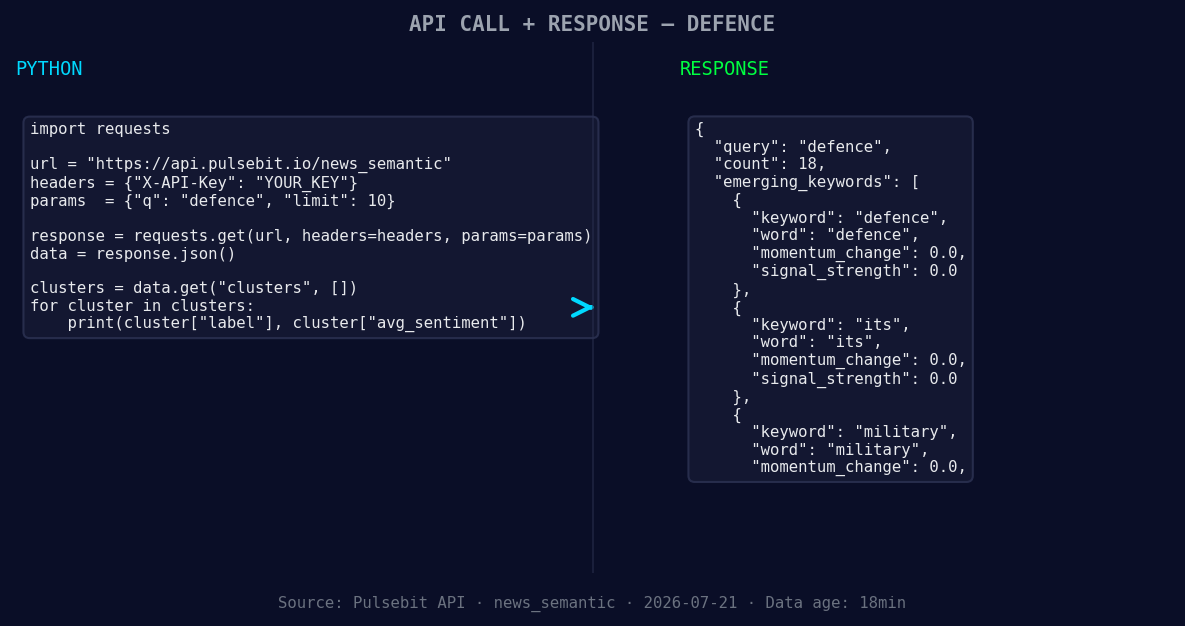
*Left: Python GET /news_semantic call for 'defence'. Right: returned JSON response structure (clusters: 3). Source: Pulsebit /news_semantic.*
url = "https://api.pulsebit.io/v1/sentiment"
params = {
"topic": "defence",
"lang": "en"
}
response = requests.get(url, params=params)
data = response.json()
Now that we’ve got our data, let’s analyze the narrative framing. We’ll use the meta-sentiment moment by running the cluster reason string through our sentiment endpoint. This helps us score how the themes interconnect:
meta_sentiment_payload = {
    "text": "Clustered by shared themes: defence, canada-india, collaboration, secure, future"
}

meta_sentiment_response = requests.post(url, json=meta_sentiment_payload)
meta_sentiment_data = meta_sentiment_response.json()
This is where things get interesting. By running the cluster narrative through our sentiment analysis, we can gauge the underlying sentiment and understand how to position our responses accordingly.
Now that we’ve outlined the mechanics, let’s discuss three specific builds we can implement tonight based on this pattern.
- Geographic Origin Filter: Set up a signal that automatically alerts you when sentiment momentum exceeds +0.4 in the defence sector, filtered by English language articles. This will help you catch stories like the Canada-India collaboration before they trend.

Geographic detection output for defence. Hong Kong leads with 8 articles and sentiment +0.39. Source: Pulsebit /news_recent geographic fields.
Meta-Sentiment Loop: Create a dashboard that tracks the sentiment of clustered narratives. For instance, monitor the emerging themes like "defence," "its," and "military" to see if they gain traction against mainstream narratives. Set a threshold to trigger alerts when sentiment shifts by more than 0.1 towards the positive.
Forming Themes Tracker: Build a query that continuously assesses the forming themes around defence. You can use the forming scores (like defence(+0.00), its(+0.00), military(+0.00)) as indicators of potential market movements, adjusting your strategies based on real-time data.
For more detailed instructions, check out our documentation at pulsebit.lojenterprise.com/docs. The best part? You can copy-paste this code and start running it in under 10 minutes. Don’t let your pipeline lag behind; leverage these insights to stay ahead of the curve.


Top comments (0)