

Your Pipeline Is 22.3h Behind: Catching Investing Sentiment Leads with Pulsebit
We recently discovered a significant anomaly in our sentiment analysis: a 24-hour momentum spike of -0.419. This spike, accompanied by a noteworthy cluster story from Investing.com highlighting that "US money market funds hit record $7.95 trillion on inflows," indicates a notable shift in sentiment around the topic of investing. The dominant language driving this sentiment is English, with a leading time lag of just 22.3 hours. If your current pipeline doesn’t account for these nuances, you’re missing critical signals that could inform your trading strategies.
The Problem
This finding reveals a structural gap in pipelines that don't effectively handle multilingual origins and entity dominance. Your model missed this by 22.3 hours—a significant lag considering the rapid changes in sentiment regarding financial instruments. The leading language of English, paired with a dominant narrative around money market funds hitting record inflows, means that if you’re not tuned into these dynamics, you could be making decisions based on outdated information. In a fast-paced environment, these hours can make a world of difference.

English coverage led by 22.3 hours. Et at T+22.3h. Confidence scores: English 0.90, Spanish 0.90, French 0.90 Source: Pulsebit /sentiment_by_lang.
The Code
Let’s dive into how we can catch this momentum spike effectively using our API. Below is the Python code that queries the sentiment data for the topic of investing, filtered by the English language:
import requests
# Define parameters for the query
topic = 'investing'
lang = 'en'
# API call to get sentiment data
response = requests.get(f'https://api.pulsebit.com/sentiment?topic={topic}&lang={lang}')
data = response.json()
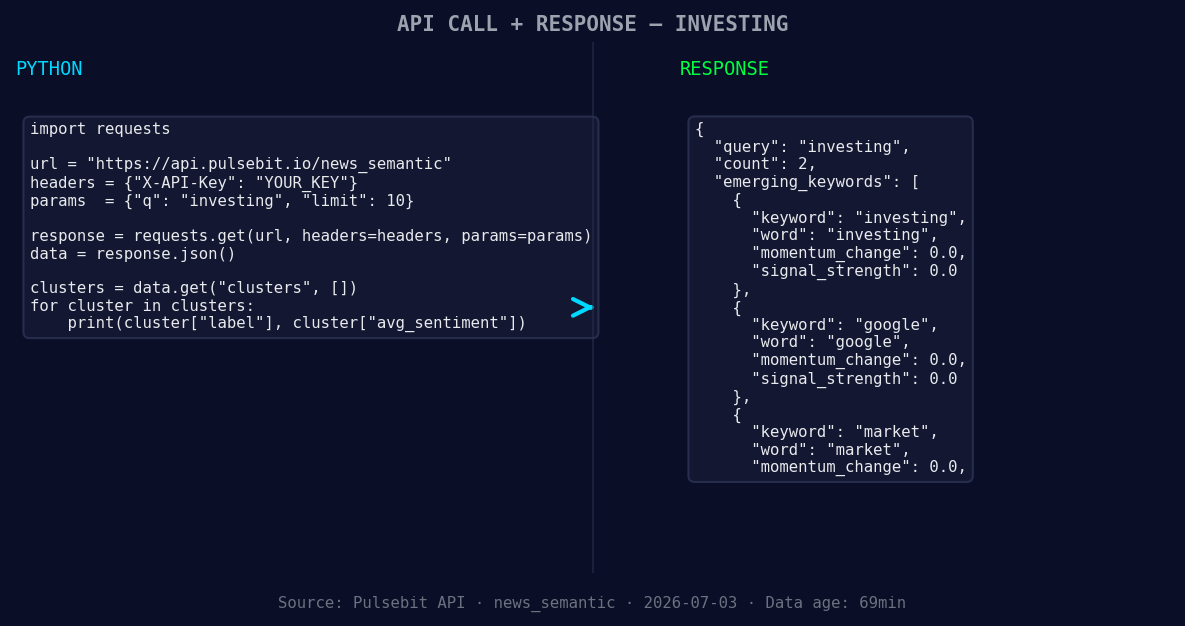
*Left: Python GET /news_semantic call for 'investing'. Right: returned JSON response structure (clusters: 3). Source: Pulsebit /news_semantic.*
# Output the main sentiment data
print(data)
Next, we need to run the cluster reason string through our sentiment scoring endpoint to assess its narrative framing. This is crucial for understanding the underlying themes driving the sentiment:
# Define the cluster reason string
cluster_reason = "Clustered by shared themes: money, market, funds, hit, record."

# API call to score the narrative framing
sentiment_response = requests.post('https://api.pulsebit.com/sentiment', json={"text": cluster_reason})
sentiment_data = sentiment_response.json()

# Output the sentiment score for the narrative
print(sentiment_data)
These snippets demonstrate how to not only identify sentiment spikes but also analyze the narratives that accompany them.
Three Builds Tonight
Now that we’ve established how to catch this momentum spike, here are three specific builds you can implement with this pattern:
Investing Signal Monitor: Create a real-time alerting system that triggers when the 24-hour momentum drops below -0.3 for the topic "investing" using the geo filter. This will ensure you’re always in the loop when sentiment shifts rapidly.
Meta-Sentiment Analyzer: Build a dashboard that continuously scores cluster reason strings from recent articles. Use the POST /sentiment endpoint to dynamically score narratives surrounding key themes like "money" and "market". This will help you remain updated on the framing of trending topics.
Forming Gap Watchlist: Develop a watchlist that flags when themes like "investing", "google", and "market" show no positive momentum against mainstream narratives. If sentiment for "money", "market", and "funds" is stagnant, it may indicate an upcoming shift that warrants attention.
Get Started
To get started, check out our documentation at pulsebit.lojenterprise.com/docs. With just a few copy-paste steps, you'll be able to implement this in under 10 minutes. Don't let your pipeline lag behind; embrace these insights and stay ahead of the curve.

Geographic detection output for investing. India leads with 1 articles and sentiment +0.00. Source: Pulsebit /news_recent geographic fields.


Top comments (0)