

Your pipeline just missed a significant anomaly: a 24h momentum spike of +1.350. This spike indicates an uptick in sentiment around consumer spending amidst rising inflation. With the leading language being English, we see this surge driven by articles that clustered around the themes of “Consumer Spending Surges with High Inflation.” The challenge is clear: if your model isn't equipped to handle multilingual data or recognize dominant entities effectively, it could be lagging behind critical insights by over 25 hours.

English coverage led by 25.2 hours. No at T+25.2h. Confidence scores: English 0.85, Spanish 0.85, French 0.85 Source: Pulsebit /sentiment_by_lang.
Imagine your pipeline missing this key moment by 25.2 hours due to a structural gap. This is a glaring issue if your analysis neglects the nuances of language or the importance of entity dominance. In this case, the English press is leading the conversation, and overlooking this could result in missed opportunities in understanding how inflation is shaping consumer behavior.
Let’s dive into the code to catch this momentum spike effectively. We’ll set our topic to 'inflation', with a score of +0.128, a confidence level of 0.85, and our momentum recorded at +1.350. To ensure our query captures the right data, we filter by language, specifically English, as follows:
import requests
# Define the API endpoint and parameters
url = "https://api.pulsebit.lojenterprise.com/sentiment"
params = {
"topic": "inflation",
"lang": "en"
}
# Make the API call
response = requests.get(url, params=params)
data = response.json()
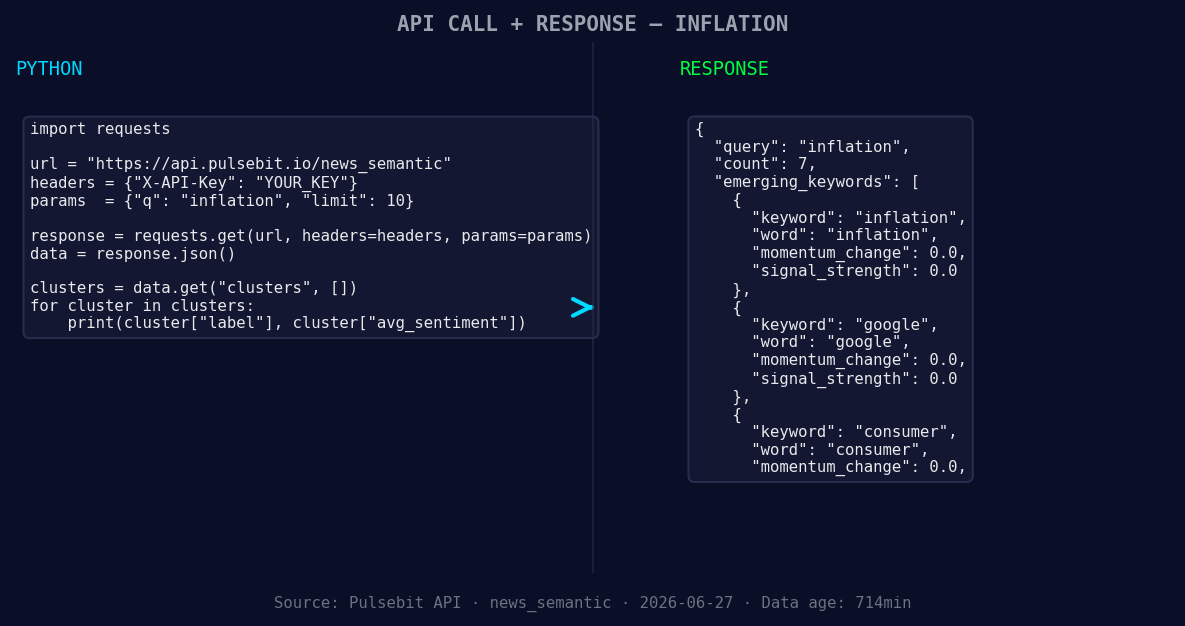
*Left: Python GET /news_semantic call for 'inflation'. Right: returned JSON response structure (clusters: 3). Source: Pulsebit /news_semantic.*
# Print the response for debugging
print(data)
Now that we have our data, we want to analyze the sentiment framing of the story. We’ll loop back to the cluster reason string to score the narrative itself. The input string here is: "Clustered by shared themes: stocks, value, inflation, worth, closer."
# Define the meta-sentiment endpoint and input
meta_url = "https://api.pulsebit.lojenterprise.com/sentiment"
meta_input = {
    "text": "Clustered by shared themes: stocks, value, inflation, worth, closer."
}

# Make the API call for meta sentiment
meta_response = requests.post(meta_url, json=meta_input)
meta_data = meta_response.json()

# Print the meta sentiment response
print(meta_data)
What can we build with this new insight? Here are three specific ideas:
- Geographic Sentiment Signal: Create an alert system that triggers when sentiment around inflation in English articles rises above a specific threshold, say +0.128, using the geo filter by country. This will help you stay ahead of localized consumer trends.

Geographic detection output for inflation. France leads with 1 articles and sentiment -0.60. Source: Pulsebit /news_recent geographic fields.
Meta-Sentiment Analysis Tool: Develop a dashboard that visualizes how different narratives cluster around inflation. Use our meta-sentiment scoring to analyze how framing influences public perception and sentiment.
Forming Themes Monitoring: Set up a monitoring system for forming themes around inflation, consumer behavior, and stocks. Capture when sentiment scores on these topics diverge from mainstream discussion, such as stocks or value, specifically when they show a score of +0.00.
With these actionable insights, we can optimize our analysis and react more swiftly to emerging trends. If you're ready to get started, you can copy-paste this code and run it in under 10 minutes. For more details, check out our documentation at pulsebit.lojenterprise.com/docs.


Top comments (0)