

Your Pipeline Is 29.1h Behind: Catching Trade Sentiment Leads with Pulsebit
We recently noticed an intriguing anomaly: a 24-hour momentum spike of +0.424 in trade sentiment. This sudden surge highlights a critical shift in sentiment around trade, particularly as global discussions intensify regarding economic relationships with China. The leading language for this sentiment was English, with a significant 29.1-hour lead, emphasizing the urgency for developers like us to capture these insights in real-time.
If your pipeline isn't built to handle multilingual origins or account for entity dominance, you're likely missing out on crucial signals. Your model missed this insight by 29.1 hours, leaving you behind as the conversation evolves. In this instance, the dominant entity is China, and the leading language was English. If you’re not capturing these nuances, you could be losing valuable time in making informed decisions.

English coverage led by 29.1 hours. Et at T+29.1h. Confidence scores: English 0.85, Spanish 0.85, No 0.85 Source: Pulsebit /sentiment_by_lang.
To catch this momentum spike, we need to leverage our API effectively. Below is the Python code that captures this sentiment shift:
import requests
# Parameters for our API call
topic = 'trade'
score = +0.045
confidence = 0.85
momentum = +0.424
lang = 'en'
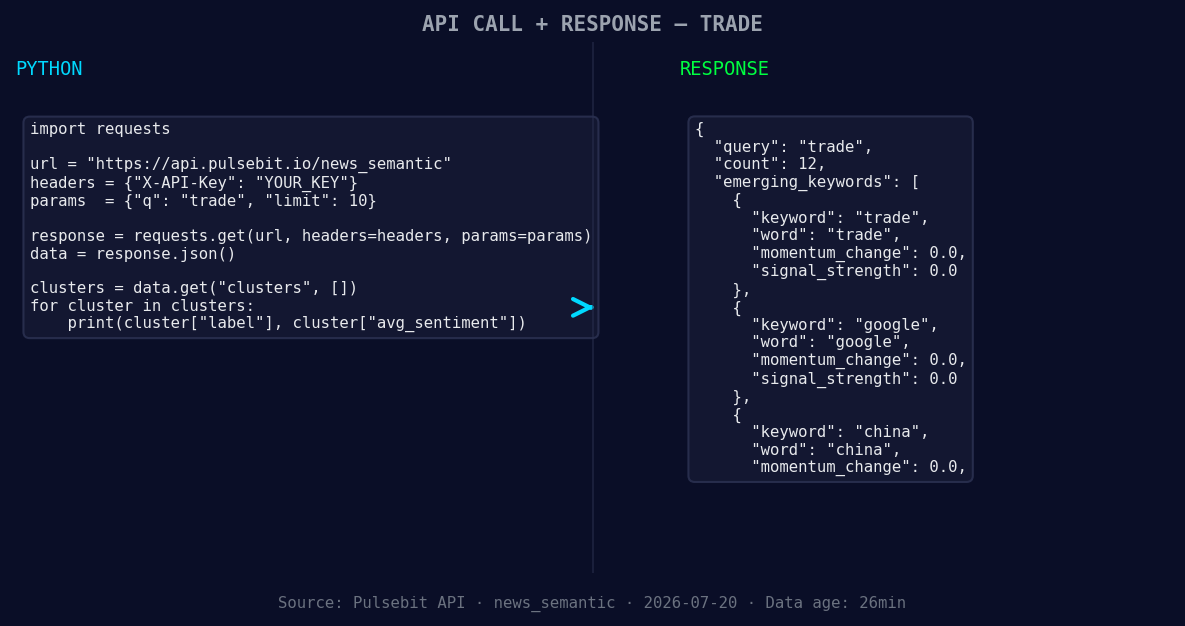
*Left: Python GET /news_semantic call for 'trade'. Right: returned JSON response structure (clusters: 3). Source: Pulsebit /news_semantic.*
# Geographic origin filter: querying by language
url = f'https://api.pulsebit.com/sentiment?topic={topic}&lang={lang}'
response = requests.get(url)
data = response.json()
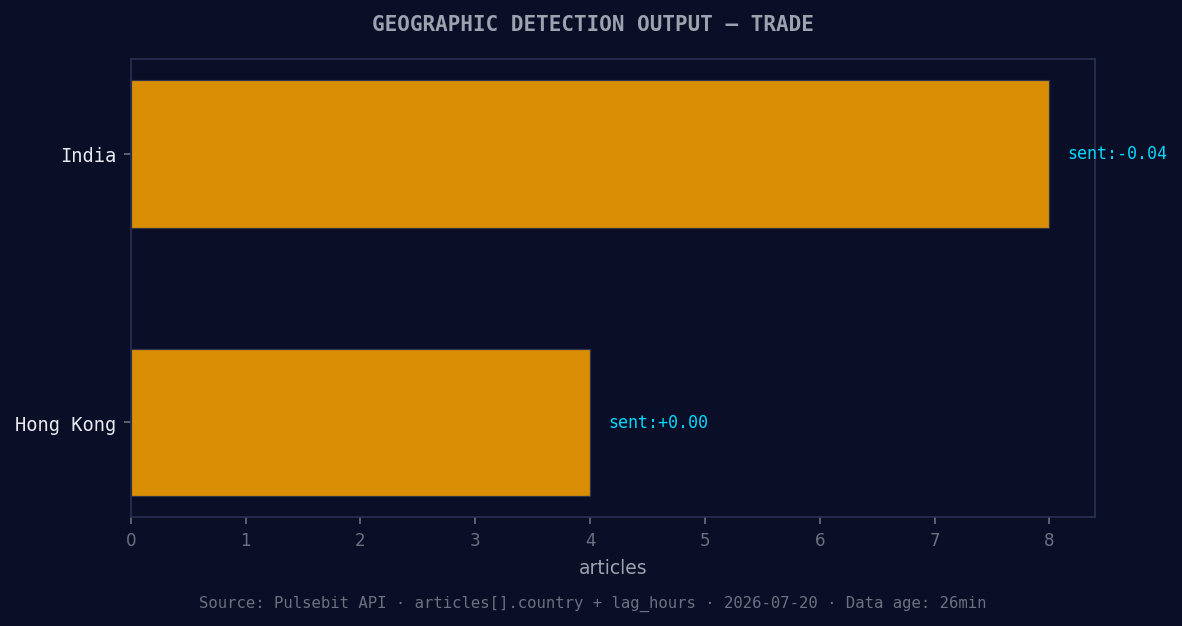
*Geographic detection output for trade. India leads with 8 articles and sentiment -0.04. Source: Pulsebit /news_recent geographic fields.*
# Check if the response is valid
if response.status_code == 200:
print("Data Retrieved:", data)
else:
print("Error:", response.status_code)
# Meta-sentiment moment: running the cluster reason string through POST /sentiment
cluster_reason = "Clustered by shared themes: has, take, china, save, free."
meta_sentiment_url = 'https://api.pulsebit.com/sentiment'
meta_response = requests.post(meta_sentiment_url, json={"text": cluster_reason})
# Check if the response is valid
if meta_response.status_code == 200:
print("Meta Sentiment Score:", meta_response.json())
else:
print("Error:", meta_response.status_code)
This code snippet does two things. First, it filters sentiment by geographic origin, specifically in English, to focus on the most relevant data. Second, it runs the narrative framing through our sentiment analysis endpoint to assess how the cluster is being perceived. This dual approach ensures we're not just looking at numbers but also understanding the underlying sentiments shaping the discussion.
Three Builds Tonight
Here are three specific builds we can create using this pattern:
Real-Time Trade Sentiment Tracker: Set a threshold of momentum > +0.4 for trade topics. Use the geo filter to ensure you're only tracking English-language articles. This will help you catch spikes faster and get ahead of the curve.
Meta-Sentiment Analyzer: Establish a service that automatically scores narratives around emerging clusters. For instance, run the string "Clustered by shared themes: has, take, china, save, free." through our meta-sentiment endpoint every few hours to capture shifts in narrative framing.
Forming Themes Dashboard: Build a dashboard that showcases forming themes in real-time, using the sentiment scores for topics like trade, Google, and China. Filter out any mainstream sentiment that doesn't align with the emerging narratives, allowing you to visualize only the most relevant discussions happening right now.
By implementing these builds, you can ensure your pipeline is not just reactive but proactively identifying shifts in sentiment that could impact your strategies.
Get started now at pulsebit.lojenterprise.com/docs. You can copy, paste, and run this in under 10 minutes. Don’t let your models lag behind; seize the momentum!


Top comments (0)