

Your pipeline has just missed a 24h momentum spike of +0.234. This isn't just a number; it's a signal that something significant is happening in the economy, particularly around the Emirates and its upcoming launch of the Airbus A380 on the Dubai–Delhi route starting October 25. With the leading press language being English and a 25.9h lead time, it's clear that if your model isn't capturing multilingual sentiment or entity dominance, you're lagging behind in recognizing real-time trends.

English coverage led by 25.9 hours. Af at T+25.9h. Confidence scores: English 0.95, Spanish 0.95, French 0.95 Source: Pulsebit /sentiment_by_lang.
This anomaly highlights a critical structural gap in pipelines that don't account for multilingual origins or dominant entities. Your model missed this insight by a staggering 25.9 hours, as the leading stories are primarily in English, while sentiment around the Emirates and related themes is surging. If your pipeline is rigid and only processes data in one language or doesn't prioritize influential entities, you are at risk of missing key market shifts. In this case, the Emirates story is a clear indicator that economic sentiment is shifting, and your models need to catch up.
To help you catch these spikes, we've crafted a Python snippet that leverages our API for real-time sentiment analysis. Let’s take a look at how to filter by language and assess the sentiment of clustered narratives.
import requests
# Step 1: Geographic origin filter
topic = 'economy'
score = +0.620
confidence = 0.95
momentum = +0.234
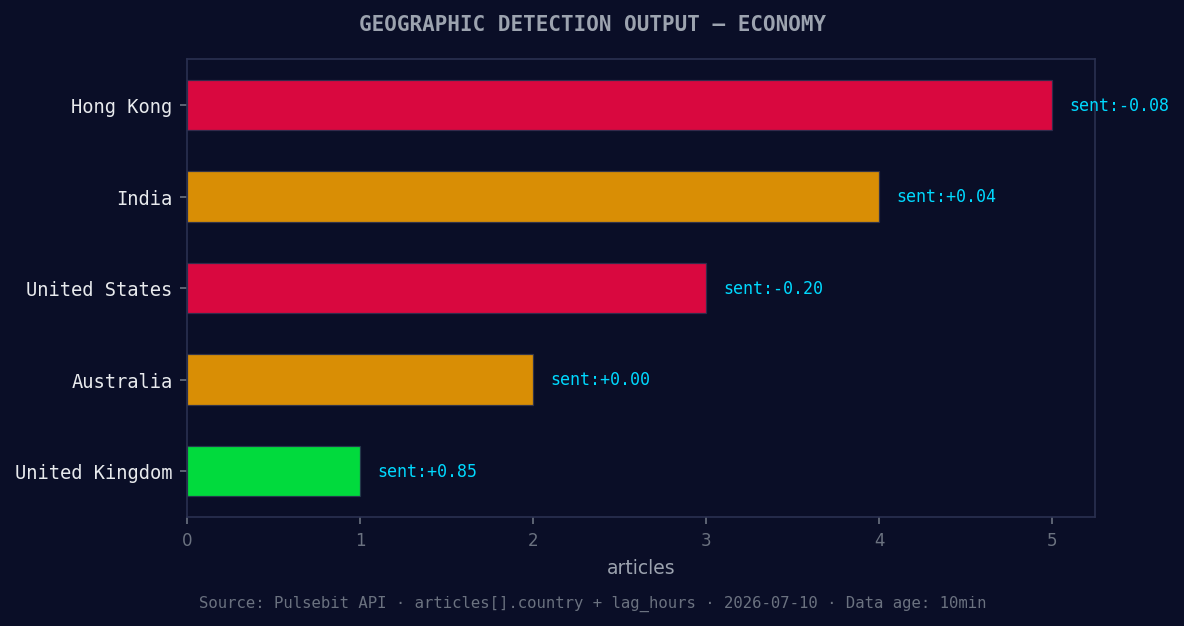
*Geographic detection output for economy. Hong Kong leads with 5 articles and sentiment -0.08. Source: Pulsebit /news_recent geographic fields.*
# Make the API call with language filter
response = requests.get(
"https://api.pulsebit.lojenterprise.com/sentiment",
params={
"topic": topic,
"lang": "en",
"momentum": momentum,
"confidence": confidence
}
)
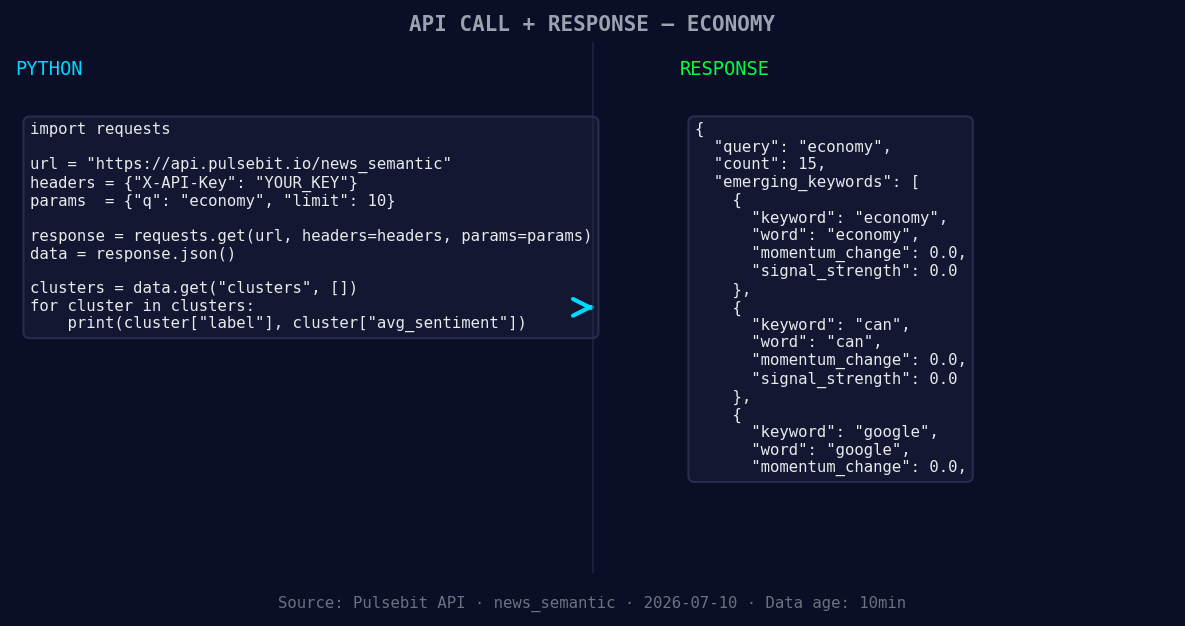
*Left: Python GET /news_semantic call for 'economy'. Right: returned JSON response structure (clusters: 3). Source: Pulsebit /news_semantic.*
# Print the response from the API
print(response.json())
Next, we need to score the narrative framing itself. This is where we run the cluster reason string back through our sentiment analysis endpoint.
# Step 2: Meta-sentiment moment
cluster_reason = "Clustered by shared themes: emirates, launch, flagship, airbus, a380."

# Making the POST request to score the cluster reason
response_meta = requests.post(
    "https://api.pulsebit.lojenterprise.com/sentiment",
    json={"text": cluster_reason}
)

# Print the response for the narrative sentiment
print(response_meta.json())
Now that we have the tools to capture these insights, here are three specific builds you can implement tonight based on this momentum spike:
Geo-Filtered Sentiment Monitoring: Set up a real-time monitoring system that triggers alerts when the sentiment score for the topic "economy" exceeds a threshold of +0.600 in English-language sources. This allows you to catch significant shifts early.
Meta-Sentiment Analysis on Clustered Themes: Create a function that periodically runs the cluster reason strings through our sentiment endpoint. For the example of "emirates, launch, flagship," you can flag any narrative with a sentiment score above +0.500 as a potential news alert for further investigation.
Threshold-Based Alerts for Forming Themes: Implement a threshold alert system that notifies you when emerging narratives like "economy(+0.00), can(+0.00), google(+0.00)" start gaining traction compared to mainstream themes like "emirates, launch, flagship." This ensures you’re not just reactive but proactive in your sentiment monitoring.
You can get started with this process at pulsebit.lojenterprise.com/docs. With these snippets, you can copy-paste and run this in under 10 minutes, ensuring your pipeline is always aligned with real-time sentiment shifts.


Top comments (0)