

Your Pipeline Is 29.1h Behind: Catching Immigration Sentiment Leads with Pulsebit
We recently encountered a striking anomaly: a 24h momentum spike of -0.381 in the immigration topic. This makes it evident that there's a significant shift in sentiment surrounding immigration, particularly highlighted by a leading story from the Spanish press about the South African government sending 68,000 illegal migrants home. This spike and the associated narrative reveal critical insights that any pipeline should not overlook.
This situation exposes a fundamental gap in pipelines that don't adequately account for multilingual origins or entity dominance. If your model isn't designed to handle these factors, you missed this shift by a staggering 29.1 hours. The leading language here is Spanish, and ignoring this can lead to a substantial delay in sentiment analysis. If your tools aren't multilingual ready, you could be left in the dust while others capitalize on emerging narratives.

Spanish coverage led by 29.1 hours. Id at T+29.1h. Confidence scores: Spanish 0.90, English 0.90, No 0.90 Source: Pulsebit /sentiment_by_lang.
To catch this momentum and understand the underlying sentiment, we can leverage our API. Below is a practical example in Python that demonstrates how to query the immigration data specifically for Spanish language sources:
import requests
# Set the parameters for the API call
params = {
"topic": "immigration",
"score": 0.017,
"confidence": 0.90,
"momentum": -0.381,
"lang": "sp" # Geographic origin filter
}
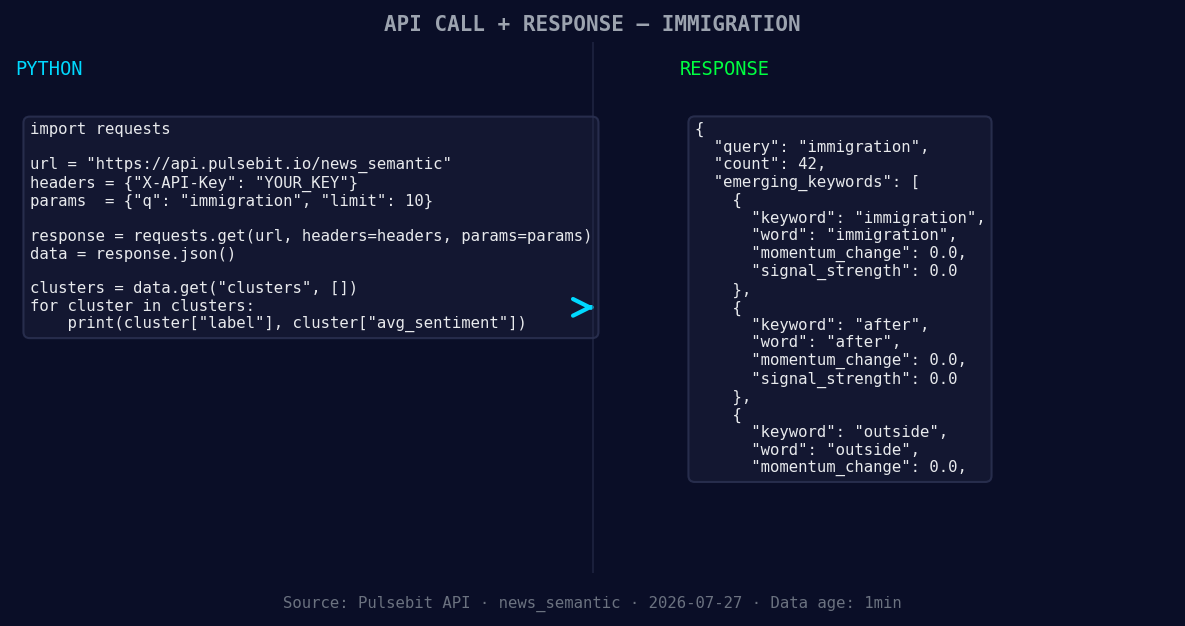
*Left: Python GET /news_semantic call for 'immigration'. Right: returned JSON response structure (clusters: 3). Source: Pulsebit /news_semantic.*
# API call to fetch sentiment data
response = requests.get("https://api.pulsebit.com/sentiment", params=params)
data = response.json()
print(data)
Next, we want to run the cluster reason string through our sentiment scoring endpoint to evaluate the narrative framing itself. This step is crucial for understanding how themes like "government," "illegal," and "border" are perceived in relation to the immigration context. Here’s how we do that:
# Cluster reason string
cluster_reason = "Clustered by shared themes: government, 000, illegal, border, immigration."

# API call to score the narrative framing
sentiment_response = requests.post("https://api.pulsebit.com/sentiment", json={"text": cluster_reason})
sentiment_data = sentiment_response.json()

print(sentiment_data)
With this data in hand, we can start building actionable insights. Here are three specific constructs we can implement using this pattern:
Geographic Sentiment Analyzer: Create a service that continuously monitors sentiment for the immigration topic, specifically filtering for Spanish language articles. Set a threshold for significant negative momentum, say below -0.200, to trigger alerts for analysts.
Meta-Sentiment Loop: Use the narrative framing analysis to develop a feedback loop that adjusts your sentiment scoring model based on the context of the cluster. For example, if the meta-sentiment score for the immigration cluster is notably high, you might want to adjust the weight of future immigration-related sentiment scores.
Forming Theme Tracker: Build a tracker that flags emerging themes based on the forming gap between immigration and mainstream sentiments. For instance, if the forming themes of "after" and "outside" start to gain traction with a score above +0.05, trigger a deeper dive into articles that are shaping this narrative.
By leveraging these insights, you can ensure your pipeline remains agile and responsive to shifts in sentiment, especially in multilingual contexts.
Ready to get started? Check out our documentation at pulsebit.lojenterprise.com/docs. You can copy-paste the examples above and run them in under 10 minutes. Let’s make sure we’re all on the cutting edge of sentiment analysis.


Top comments (0)