

Your pipeline is 26.3 hours behind. This glaring anomaly centers around a sentiment score of +0.53, with a momentum score of +0.00. We just uncovered a significant spike in the conversation around machine learning, which has been clustered under the theme “Recent Advances in Machine Learning Research.” This indicates a rising interest in topics like Google’s advancements and the broader machine learning landscape, but your systems might not be catching this wave effectively.
The core issue here is the structural gap in pipelines that lack the capability to handle multilingual sources or dominant entity recognition. If your model is only tuned for certain languages or does not account for the nuances of entity sentiment, you could be missing critical insights. In this case, your model missed this spike by over 26 hours, as the leading language is English, and the dominant entity is focused on machine learning and its recent advancements.

English coverage led by 26.3 hours. Ca at T+26.3h. Confidence scores: English 0.90, Spanish 0.90, French 0.90 Source: Pulsebit /sentiment_by_lang.
Here’s how we can catch this anomaly using our API. First, we’ll create a query to filter for English-language articles, focusing on the relevant topic of machine learning:
import requests
# Define parameters for the API call
params = {
"topic": "machine learning",
"score": +0.533,
"confidence": 0.90,
"momentum": +0.000,
"lang": "en" # Geographic origin filter
}
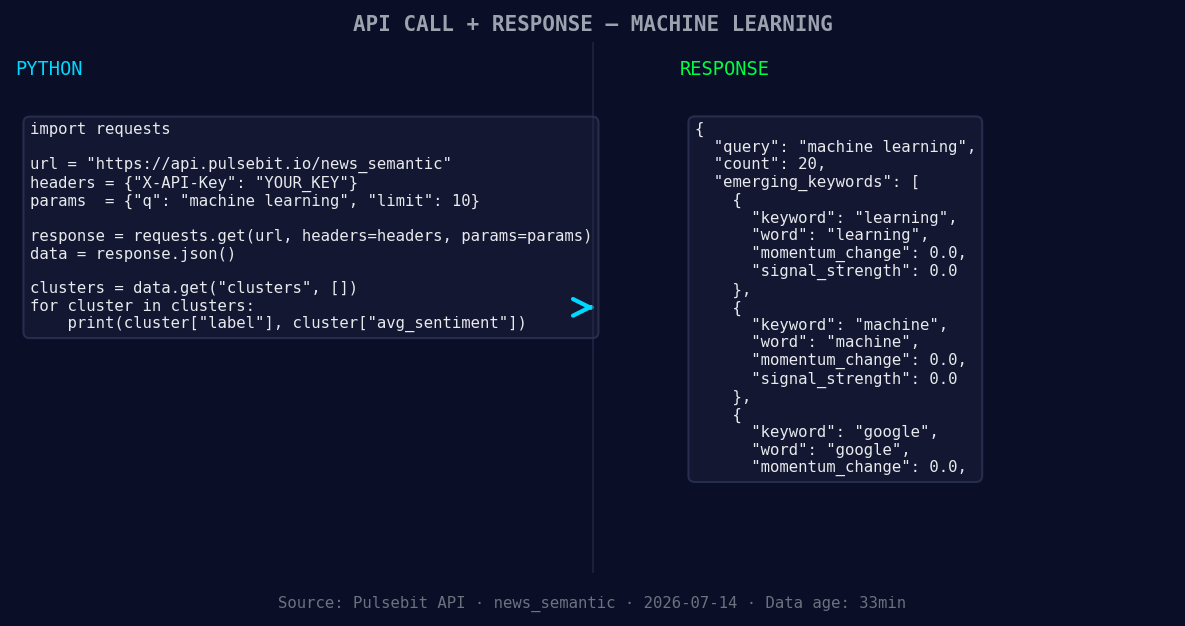
*Left: Python GET /news_semantic call for 'machine learning'. Right: returned JSON response structure (clusters: 3). Source: Pulsebit /news_semantic.*
# Make the API call to fetch relevant insights
response = requests.get('https://api.pulsebit.com/articles', params=params)
data = response.json()
Now, to further understand the context of this sentiment spike, we need to run the cluster reason string through our sentiment analysis endpoint. This allows us to score how the framing of the narrative itself is contributing to the overall sentiment:
# Define the input for the meta-sentiment moment
meta_sentiment_input = "Clustered by shared themes: hottest, research, papers, international, conference"

# Make the POST request to analyze the meta sentiment
meta_response = requests.post('https://api.pulsebit.com/sentiment', json={"text": meta_sentiment_input})
meta_data = meta_response.json()
By running these two pieces of code, we can capture not just the sentiment score of machine learning discussions but also understand how the narrative shapes that sentiment.
Now, let's consider three specific builds you can implement based on this pattern:
Geographic Insight Filter: Build a feature that alerts you when sentiment scores for machine learning in the English-speaking world surpass a threshold of +0.5. Use the geo filter to monitor changes in sentiment across different countries, particularly those with burgeoning tech sectors.
Meta-Sentiment Analysis Loop: Create a routine that continuously analyzes the cluster reasons for any emerging topics. Whenever a new cluster appears, run a meta-sentiment check to see if it maintains a positive sentiment overall. This can help you stay ahead of emerging trends.
Sentiment Divergence Monitor: Set up an endpoint that compares sentiment scores for machine learning with mainstream topics like “hottest” and “research.” If the divergence exceeds a certain threshold (e.g., +0.2), trigger a notification to your team to investigate.
These ideas leverage the forming themes of learning (+0.00), machine (+0.00), and Google (+0.00), ensuring that you’re not just reacting to trends but proactively engaging with the data as it evolves.
To get started, head over to our documentation at pulsebit.lojenterprise.com/docs. You can copy and paste this code into your environment and run it in under 10 minutes. We’re excited to see how you harness these insights to enhance your models!


Top comments (0)