

Your Pipeline Is 28.3h Behind: Catching Defence Sentiment Leads with Pulsebit
We recently discovered a noteworthy anomaly in sentiment data: a 24-hour momentum spike of +0.335 surrounding the topic of defence. As we dive into the implications of this spike, we see that the Spanish press is leading the conversation with a 28.3-hour advance, indicating a critical gap in how multilingual content is being processed. This anomaly highlights an urgent need for more robust pipelines that can handle both language and entity dominance effectively.

Spanish coverage led by 28.3 hours. No at T+28.3h. Confidence scores: Spanish 0.95, English 0.95, French 0.95 Source: Pulsebit /sentiment_by_lang.
If your model isn't equipped to handle this, it means your analytics pipeline missed this significant spike by 28.3 hours. In this case, the leading language was Spanish, coupled with the dominant entity of defence technology ties between India and the U.S. Such delays could mean missing out on critical insights that could shape strategic decisions.
Here’s how to catch such anomalies effectively using our API. First, we need to filter the sentiment data by geographic origin and language. The following Python code snippet demonstrates how to query for Spanish articles related to defence:

Geographic detection output for defence. India leads with 5 articles and sentiment +0.20. Source: Pulsebit /news_recent geographic fields.
import requests
# Define the API endpoint and parameters
url = "https://api.pulsebit.com/sentiment"
params = {
"topic": "defence",
"score": -0.262,
"confidence": 0.95,
"momentum": +0.335,
"lang": "sp" # Filter for Spanish language articles
}
# Make the API call
response = requests.get(url, params=params)
data = response.json()
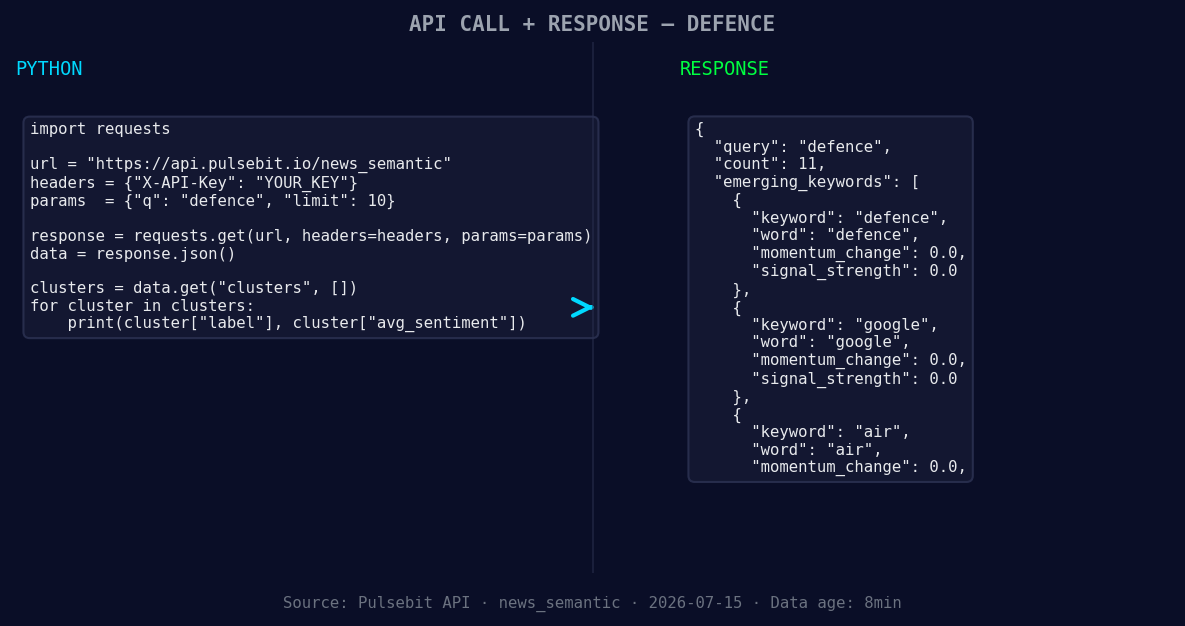
*Left: Python GET /news_semantic call for 'defence'. Right: returned JSON response structure (clusters: 3). Source: Pulsebit /news_semantic.*
print(data)
Once we have the relevant data, we can run the cluster reason string through our sentiment endpoint to analyze its narrative framing. The following snippet shows how to do that:
# Define the narrative framing input
narrative_input = "Clustered by shared themes: defence, technology, india-u, ties, big."

# Make the POST request to analyze the narrative
response_narrative = requests.post(url, json={"input": narrative_input})
narrative_score = response_narrative.json()

print(narrative_score)
This two-step process allows us to not only filter for language but also assess the sentiment surrounding relevant narratives. By integrating these methods, we can better understand emerging trends in sentiment and stay ahead of the curve.
Now that we’ve covered how to catch this spike, let’s look at three specific builds you can implement to leverage this pattern effectively:
Geo-Filtered Alerts: Set up an alert system that triggers when sentiment around defence articles in Spanish surpasses a specific threshold, say +0.3. This ensures you catch spikes in sentiment as they happen, allowing you to act quickly.
Meta-Sentiment Analysis Dashboard: Create a dashboard that visualizes the output of the meta-sentiment loop. By continuously feeding the cluster reason strings through the sentiment endpoint, you can maintain an up-to-date view of how narratives change over time, particularly for critical topics like defence.
Forming Themes Monitor: Build a signal that detects forming themes in articles related to defence, technology, and air travel. For example, track sentiment scores of +0.00 against mainstream sentiments. This can alert you when new narratives emerge, providing valuable insights into shifts in public opinion.
These builds will help enhance your understanding of sentiment dynamics and empower you to act on emerging trends effectively.
To get started, check out our documentation at pulsebit.lojenterprise.com/docs. You can copy-paste the provided code snippets and run this in under 10 minutes. Don’t miss out on valuable insights; adapt your pipeline to stay current with emerging trends!


Top comments (0)