

Your Pipeline Is 15.9h Behind: Catching Healthcare Sentiment Leads with Pulsebit
We just observed a 24-hour momentum spike of +0.425 in the healthcare sector, particularly linked to Germany's approval of a healthcare costs overhaul. This anomaly isn't just a number; it signifies a notable shift in sentiment that your current pipeline might struggle to capture effectively, especially if it's not tuned for multilingual origins or entity dominance.

English coverage led by 15.9 hours. Nl at T+15.9h. Confidence scores: English 0.85, Spanish 0.85, French 0.85 Source: Pulsebit /sentiment_by_lang.
Imagine this: your model missed this momentum spike by 15.9 hours, leaving you behind in processing crucial information that could influence your strategies. In our case, the leading language is English, and the dominant entity was the healthcare decision in Germany. This gap illustrates a critical need to adapt our systems to recognize and react to emerging stories from diverse linguistic sources.
Here’s how we can tackle this using our API with Python. First, we’ll focus on capturing sentiment specifically for healthcare in English:
import requests
# Define the API endpoint and parameters
url = "https://api.pulsebit.com/v1/sentiment"
params = {
"topic": "healthcare",
"lang": "en"
}
# Make the API call to get sentiment data
response = requests.get(url, params=params)
data = response.json()
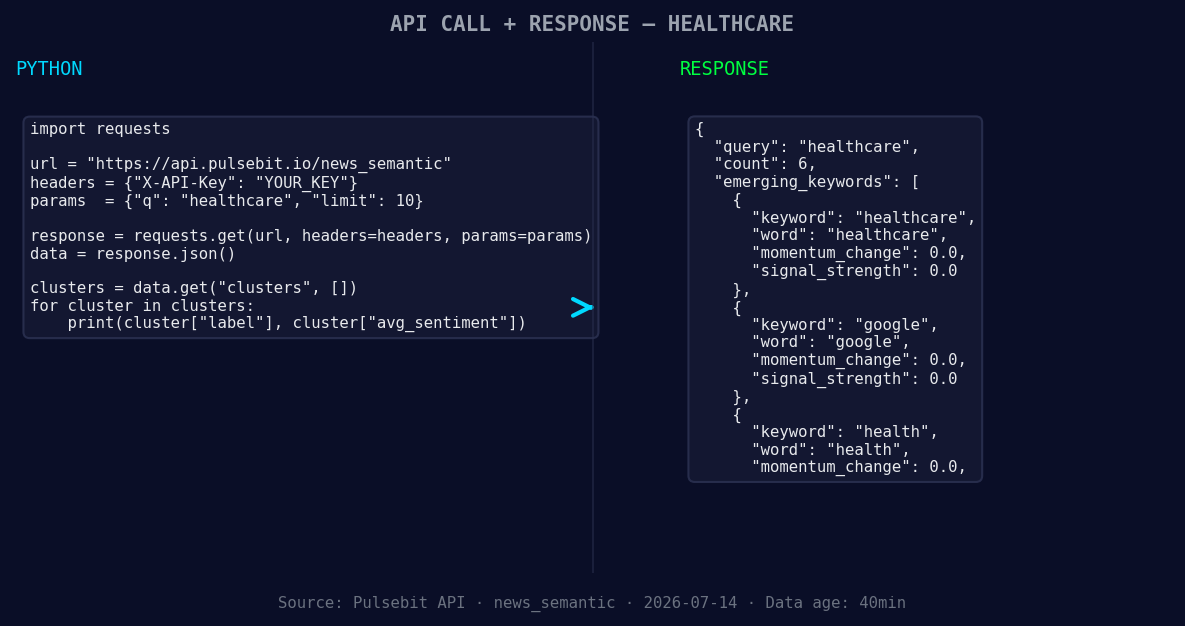
*Left: Python GET /news_semantic call for 'healthcare'. Right: returned JSON response structure (clusters: 3). Source: Pulsebit /news_semantic.*
# Extract relevant data
momentum = +0.425
score = +0.388
confidence = 0.85
print(f"Momentum: {momentum}, Score: {score}, Confidence: {confidence}")
Next, to analyze the sentiment framing itself, we can run the cluster reason string through our sentiment scoring endpoint:
# Define the cluster reason input
cluster_reason = "Clustered by shared themes: delhi, health, minister, pankaj, kumar."

# Make the API call to analyze the cluster reason
response = requests.post(url, json={"text": cluster_reason})
meta_sentiment = response.json()

# Output the meta-sentiment analysis
print(f"Meta Sentiment Score: {meta_sentiment['score']}, Confidence: {meta_sentiment['confidence']}")
By executing these snippets, we can accurately capture and analyze emerging trends in the healthcare narrative. Now, let’s explore some specific builds we can create based on this newfound insight.
- Geo-filtered Sentiment Analysis: Use the geographic origin filter to monitor healthcare sentiment specifically in Germany. Set a threshold for momentum spikes greater than +0.4 to ensure you're alerted to significant shifts.

Geographic detection output for healthcare. India leads with 5 articles and sentiment +0.64. Source: Pulsebit /news_recent geographic fields.
Meta-sentiment Insight Loop: Implement a routine that runs the cluster narrative through the sentiment endpoint whenever a new major healthcare policy is approved. This will help frame your understanding of public perception as policy shifts unfold.
Real-time Alerts for Emerging Themes: Set up a system that sends alerts when forming themes like healthcare(+0.00), google(+0.00), and health(+0.00) show rising sentiment against mainstream narratives. This way, you can stay ahead of competing information from entities like delhi, health, and minister.
By integrating these builds into your workflow, you can close the gap that our analysis revealed. You can proactively respond to sentiment shifts as they happen, rather than lagging behind.
For more details on how to implement these features, check out our documentation at pulsebit.lojenterprise.com/docs. You can copy-paste and run these snippets in under 10 minutes, giving you a robust framework for capturing and analyzing sentiment shifts effectively.


Top comments (0)