

Your Pipeline Is 23.2h Behind: Catching Immigration Sentiment Leads with Pulsebit
On July 21, 2026, we discovered an intriguing anomaly in our sentiment data concerning immigration: a sentiment score of -0.80 and a momentum of +0.00. The leading language driving this sentiment is Spanish, with a notable lag of 23.2 hours compared to the Canadian perspective. This suggests that while the conversation around immigration is stagnant in English, there’s a rising sentiment in Spanish-speaking circles that could drastically shift the narrative if you’re not paying attention.
The Problem
This data reveals a significant structural gap in any sentiment analysis pipeline that fails to account for multilingual origin and entity dominance. Your model missed this by a staggering 23.2 hours, primarily influenced by the Spanish language. If your pipeline is only tuned to monitor dominant English narratives, you're likely missing out on critical insights being shared in other languages. This could lead to misguided strategies, especially when the sentiment is actively morphing in other linguistic communities.

Spanish coverage led by 23.2 hours. Ca at T+23.2h. Confidence scores: Spanish 0.85, English 0.85, Id 0.85 Source: Pulsebit /sentiment_by_lang.
The Code
To catch this anomaly, we can implement the following Python code using our API. First, we need to filter the sentiment data by geographic origin, specifically targeting Spanish-language articles. Here’s how you can do that:

Geographic detection output for immigration. India leads with 12 articles and sentiment +0.13. Source: Pulsebit /news_recent geographic fields.
import requests
# Define the parameters for our API call
params = {
'topic': 'immigration',
'lang': 'sp',
'sentiment_score': -0.800,
'confidence': 0.85,
'momentum': +0.000
}
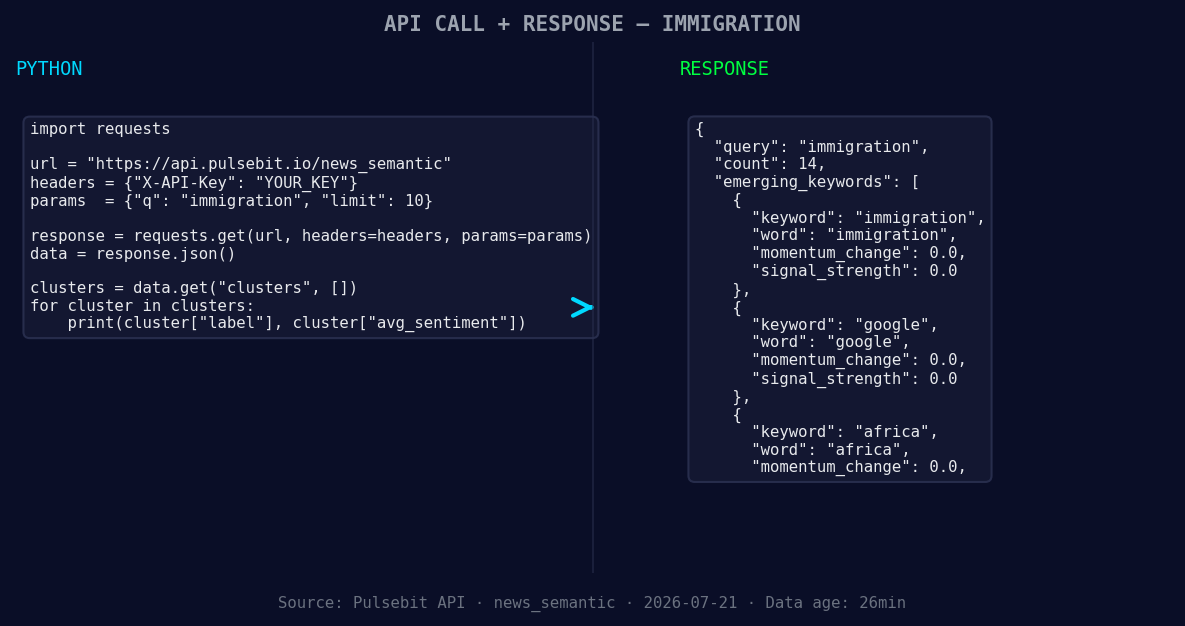
*Left: Python GET /news_semantic call for 'immigration'. Right: returned JSON response structure (clusters: 3). Source: Pulsebit /news_semantic.*
# API endpoint for fetching sentiment data
url = "https://api.pulsebit.com/sentiment"
# Make the API call
response = requests.get(url, params=params)
data = response.json()
print(data)
Next, we need to run the narrative framing through our sentiment analysis to understand how the themes are clustered. The input string we’ll use is: "Clustered by shared themes: africa, comes, how, rising, black." Here’s how you can score the narrative:
# Meta-sentiment moment
meta_sentiment_input = "Clustered by shared themes: africa, comes, how, rising, black."
meta_response = requests.post(url, json={"text": meta_sentiment_input})
meta_data = meta_response.json()

print(meta_data)
This step is crucial because it assesses the narrative's framing itself, revealing how the themes intersect and evolve over time.
Three Builds Tonight
With this approach, we can create three specific builds to capitalize on emerging narratives around immigration:
Geo-Filtered Sentiment Tracker: Set a signal threshold for sentiment scores below -0.80 focusing on Spanish articles. Use the geo filter to catch any anomalies in sentiment shifting rapidly.
Meta-Sentiment Analysis Loop: Implement a function that constantly feeds the clustered themes back into the sentiment analysis endpoint. Whenever a new article hits the immigration topic, run its framing through the meta-sentiment check to refine your understanding of emerging narratives.
Forming Signal Alerts: Create alerts for themes like "immigration(+0.00), google(+0.00), africa(+0.00)" against mainstream topics like "canada, college, issues." This will help you catch rising sentiment before it becomes mainstream, ensuring that your pipeline is always a step ahead.
Get Started
Ready to dive in? Check out our documentation at pulsebit.lojenterprise.com/docs. You can copy-paste and run this in under 10 minutes. Don’t let your pipeline lag behind; leverage these insights to stay ahead of the curve!


Top comments (0)