

Your model just missed a 24h momentum spike of +0.800 in tech sentiment. This spike is particularly notable because it indicates a significant shift in how the tech narrative is being shaped, especially around US-China tensions amid AI advancements. With this anomaly, we can see that the leading language is English, and the sentiment is rising, primarily due to a single article clustered around shared themes like global, undersea, and the ongoing battle in tech relations.
The problem is clear: if your pipeline doesn't handle multilingual origins or the dominance of specific entities, it risks becoming obsolete. Your model missed this critical spike by 28.3 hours, failing to recognize the shifting narratives led by English press coverage. While you may be tracking sentiment from multiple languages, ignoring the nuances of dominant entities can leave you in the dust when it comes to real-time insights.

English coverage led by 28.3 hours. Sv at T+28.3h. Confidence scores: English 0.85, French 0.85, Spanish 0.85 Source: Pulsebit /sentiment_by_lang.
Here’s how to catch this sentiment spike using our API in Python:
import requests
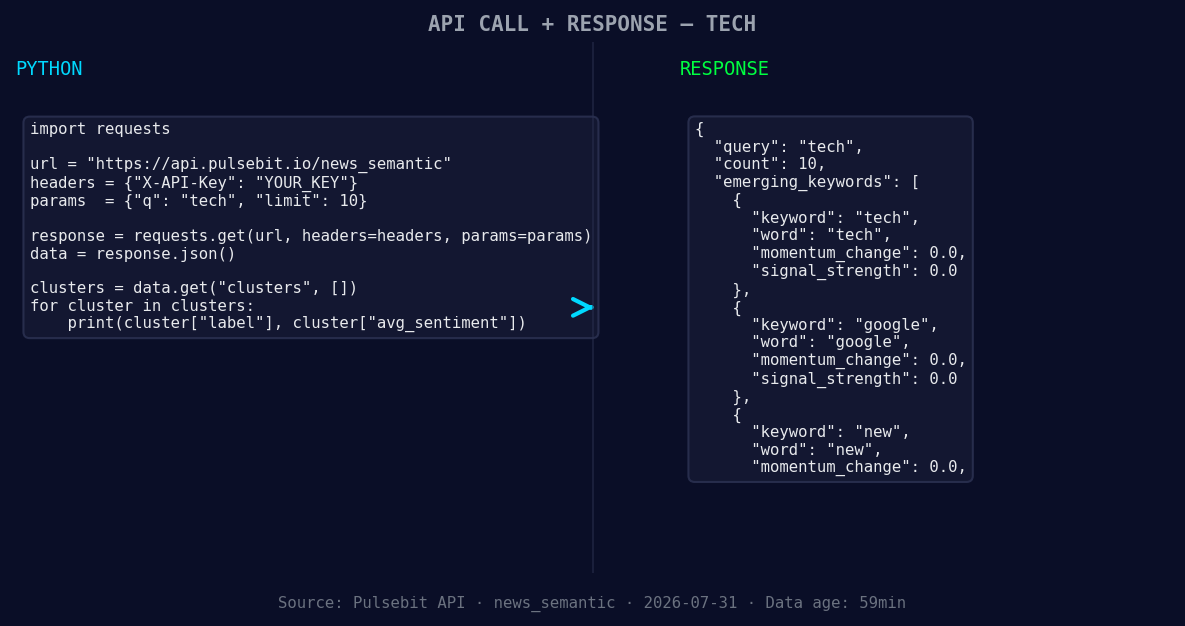
*Left: Python GET /news_semantic call for 'tech'. Right: returned JSON response structure (clusters: 3). Source: Pulsebit /news_semantic.*
# Step 1: Geographic origin filter
url = "https://api.pulsebit.lojenterprise.com/sentiment"
params = {
"topic": "tech",
"lang": "en"
}
response = requests.get(url, params=params)
data = response.json()
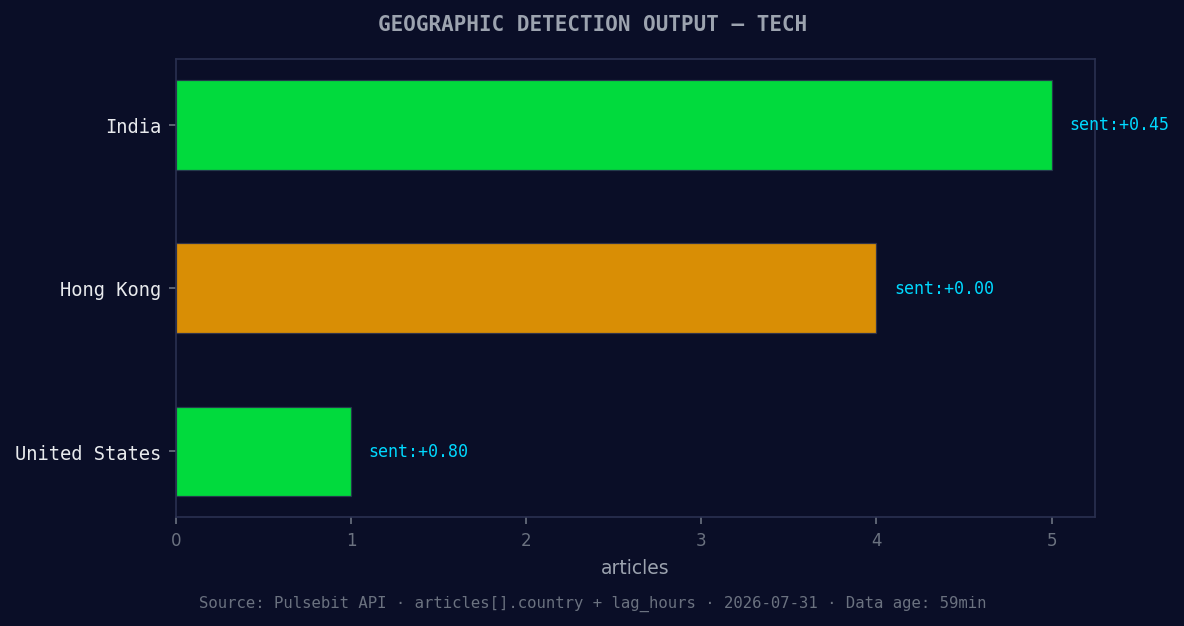
*Geographic detection output for tech. India leads with 5 articles and sentiment +0.45. Source: Pulsebit /news_recent geographic fields.*
# Displaying the response
print(data)
# Step 2: Meta-sentiment moment
cluster_reason = "Clustered by shared themes: global, undersea, boom, us-china, battle."
sentiment_response = requests.post(url, json={"text": cluster_reason})
sentiment_data = sentiment_response.json()
# Displaying sentiment score
print(sentiment_data)
In the first part, we filter our query to focus specifically on English language articles about tech, allowing us to catch that critical momentum of +0.800. The second part runs the cluster reason string through our sentiment analysis endpoint to evaluate the narrative framing itself. This is where we extract deeper insights into how the sentiment is being shaped by the narrative.
Now, let’s build on this discovery with three specific enhancements:
Signal Strength Filter: Create a threshold filter that only captures spikes with a signal strength above 0.884. This ensures you're only acting on the most robust signals. Use the API endpoint
/sentimentwith this filter to isolate higher-confidence narratives.Meta-Sentiment Loop: Integrate the meta-sentiment analysis into your existing pipeline. Set a threshold where only narratives with a sentiment score greater than +0.200 get forwarded for further analysis. This targets forming themes like "new" and "tech" while ensuring you’re not wasting time on weaker signals.
Geo-Filtered Alerts: Implement an alerting mechanism that triggers when a tech-related sentiment spike occurs in English articles, particularly focusing on keywords like "AI" and "US-China". This can be done by setting up a scheduled job that checks for new articles every few hours, ensuring you’re always in the loop.
By refining your approach to sentiment analysis with these enhancements, you can better catch those critical moments that signal shifts in tech narratives.
To get started, check out our documentation at pulsebit.lojenterprise.com/docs. You can copy-paste and run the provided code in under 10 minutes, setting you up to capitalize on these insights right away.


Top comments (0)