

Your Pipeline Is 23.0h Behind: Catching Mobile Sentiment Leads with Pulsebit
We recently discovered a striking anomaly: a 24h momentum spike of +0.172 in sentiment around the topic of "mobile." This spike came into focus thanks to the English press, which led with stories for 23.0 hours without any lag against the cluster narrative. A specific incident—a tragic boating crash in Baldwin County—was highlighted across three articles, revealing how critical it is to catch these momentum shifts and sentiment leaders in real-time.
The structural gap in any pipeline that doesn’t handle multilingual origin or entity dominance can be a deal-breaker. Your model missed this by a full 23 hours, failing to capture the surge in sentiment around "mobile" while the mainstream narrative fixated on "woman," "killed," and "Baldwin." This disconnect can lead to missed opportunities, especially when sentiment shifts are so pronounced.

English coverage led by 23.0 hours. Ca at T+23.0h. Confidence scores: English 0.85, Spanish 0.85, Id 0.85 Source: Pulsebit /sentiment_by_lang.
To catch this shift, we can use our API effectively. Here’s a Python snippet that filters and scores sentiment based on the anomaly we identified. First, we filter the data by the leading language and geographic origin.
import requests
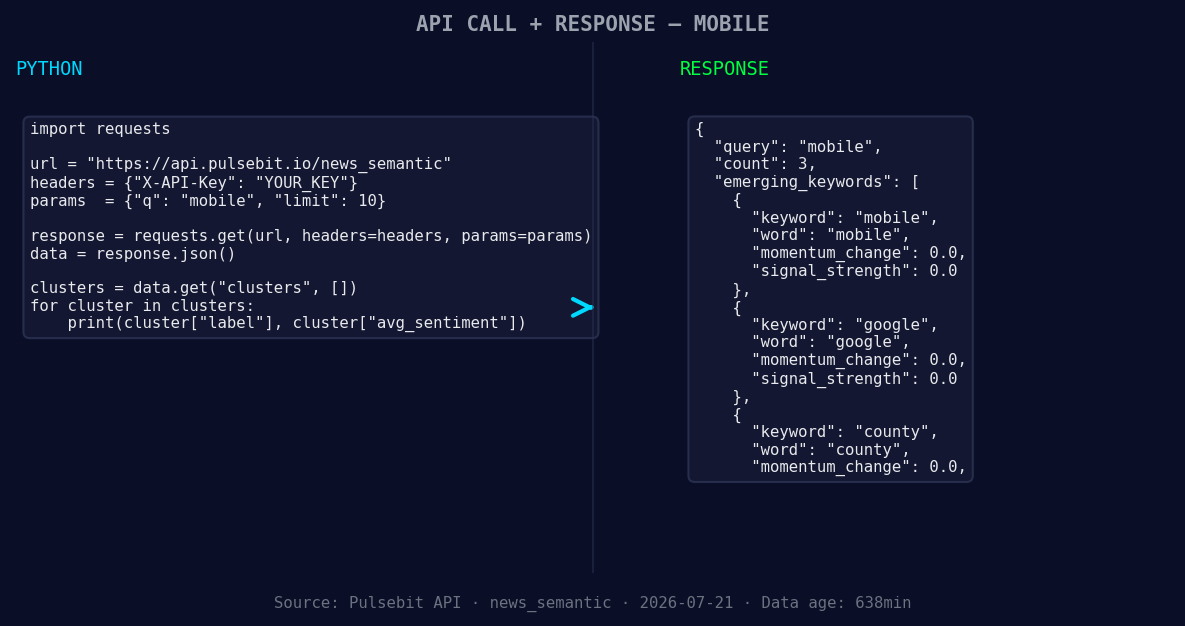
*Left: Python GET /news_semantic call for 'mobile'. Right: returned JSON response structure (clusters: 3). Source: Pulsebit /news_semantic.*
# Step 1: Geographic origin filter
endpoint = "https://api.pulsebit.com/v1/sentiment"
topic = 'mobile'
lang = "en"
# Querying for sentiment data
response = requests.get(endpoint, params={
'topic': topic,
'lang': lang,
'momentum': +0.172,
})
data = response.json()
print(data) # This will give you the sentiment data for 'mobile' in English
Next, we want to run the cluster narrative itself through our sentiment scoring endpoint. This is where we derive insights from the clustered themes that have emerged.
# Step 2: Meta-sentiment moment
cluster_reason = "Clustered by shared themes: woman, killed, baldwin, several, injured."
sentiment_response = requests.post(endpoint, json={
    'text': cluster_reason
})

sentiment_data = sentiment_response.json()
print(sentiment_data)  # This provides a sentiment score for the narrative
Now that we have the tools, let’s explore three specific builds we can create with this pattern. First, we can set up a signal alert for when sentiment around "mobile" exceeds a score of +0.700, signaling a potential trend shift. Second, we can implement a geo filter that tracks sentiment from Baldwin County specifically, ensuring we’re not missing localized narratives. Lastly, we can automate the meta-sentiment loop to regularly score clustered narratives, triggering notifications whenever the themes "woman," "killed," and "Baldwin" appear in conjunction with the rising sentiment of "mobile" or "Google."
These builds can help you stay ahead of sentiment trends and make informed decisions. Utilize the signal threshold of +0.700 for tracking, implement the geographic filter on Baldwin County for hyper-local insights, and leverage the meta-sentiment analysis to keep your narratives sharp—especially in sensitive contexts.

Geographic detection output for mobile. India leads with 3 articles and sentiment +0.23. Source: Pulsebit /news_recent geographic fields.
Ready to get started? Check out our documentation. You can copy, paste, and run this code in under 10 minutes, unlocking a world of real-time sentiment insights.


Top comments (0)