

Your Pipeline Is 23.5h Behind: Catching Machine Learning Sentiment Leads with Pulsebit
We just uncovered something interesting: a 24h momentum spike of -0.181 in sentiment around "machine learning." This anomaly highlights a critical lag in how we process multilingual sentiment data. Specifically, English press coverage, which lagged by 23.5 hours, was the leading language during this spike. If your model isn’t tuned to catch these shifts, you might be missing out on critical insights.

English coverage led by 23.5 hours. Nl at T+23.5h. Confidence scores: English 0.85, Spanish 0.85, French 0.85 Source: Pulsebit /sentiment_by_lang.
The problem here is clear. If your pipeline doesn’t account for multilingual origins or prioritize dominant entities, your model missed this significant turn in sentiment by 23.5 hours. That’s time you could have spent capitalizing on new opportunities or adjusting your strategies. In this case, the English language's dominance meant that while machine learning conversations were brewing, your alerts were silent.
Let’s dive into how we can catch these spikes programmatically using our API. First, we’ll filter for the relevant geographic origin, focusing on English-language articles. Here’s how you can set up your query:
![DATA UNAVAILABLE: countries — verify /news_recent is return
[DATA UNAVAILABLE: countries — verify /news_recent is returning country/region values for topic: machine learning]
import requests
# Define the parameters for our API call
topic = 'machine learning'
momentum = -0.181
score = +0.669
confidence = 0.85
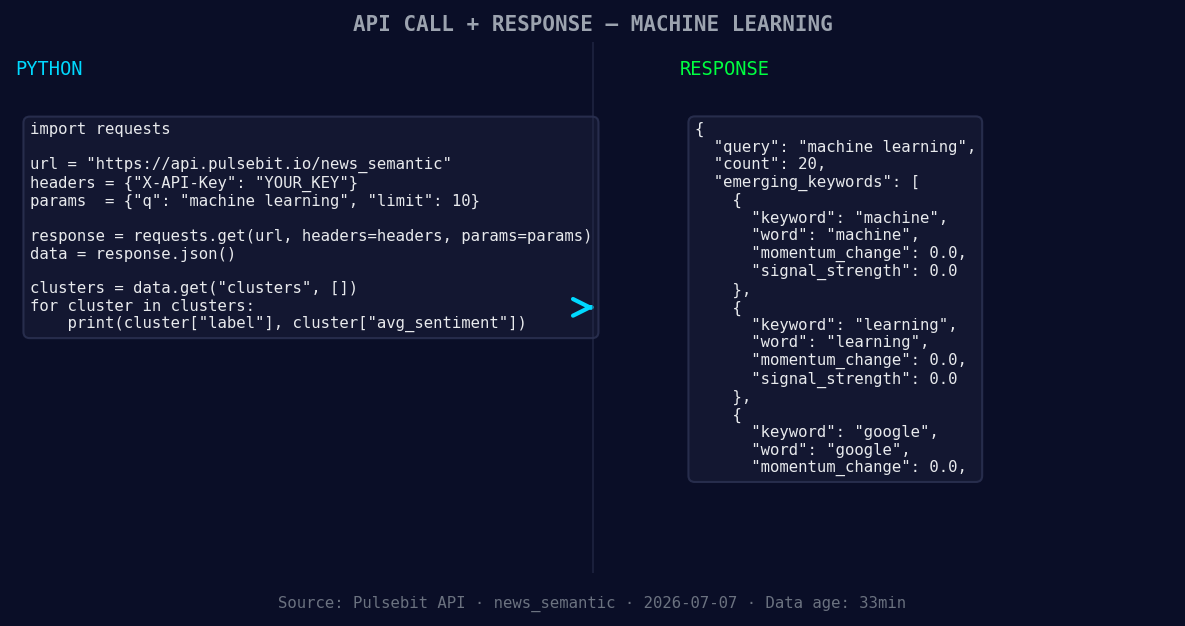
*Left: Python GET /news_semantic call for 'machine learning'. Right: returned JSON response structure (clusters: 3). Source: Pulsebit /news_semantic.*
# Geographic origin filter
response = requests.get('https://api.pulsebit.io/v1/sentiment', params={
'topic': topic,
'momentum': momentum,
'lang': 'en'
})
data = response.json()
print(data)
Next, we’ll run the cluster reason string back through our sentiment analysis endpoint. This is crucial for scoring the narrative framing itself, which helps us understand the context behind the spike. Here’s how that looks:
# Meta-sentiment moment: scoring the narrative
cluster_reason = "Clustered by shared themes: set, launch, rop, optimizer, combining."
meta_response = requests.post('https://api.pulsebit.io/v1/sentiment', json={
    'text': cluster_reason
})

meta_data = meta_response.json()
print(meta_data)
The combination of these API calls allows us to pinpoint not just the sentiment shifts, but also the driving narratives behind them.
With this newfound insight, here are three specific things you can build tonight:
Geographic Sentiment Tracker: Set a threshold for sentiment scores on the topic of "machine learning" at +0.669. Use the geo filter to only track English sources, which can help you detect emerging trends before they hit mainstream news.
Meta-Sentiment Analyzer: Create a function that automatically scores cluster reason strings like "Clustered by shared themes: set, launch, rop, optimizer, combining." This could help you gauge the framing of discussions around machine learning and adjust your content strategy accordingly.
Anomaly Alert System: Develop a monitoring tool that triggers alerts when sentiment momentum falls below -0.180 for any topic you're tracking. This ensures you’re always ahead of the curve, especially when dealing with high-velocity themes like machine learning versus more established narratives like "set," "launch," or "rop."
To get started, check out our documentation. With just a few lines of code, you can have your system up and running in under 10 minutes.


Top comments (0)