

Your Pipeline Is 12.4h Behind: Catching Renewable Energy Sentiment Leads with Pulsebit
We just noticed a remarkable 24h momentum spike of +0.462 in renewable energy sentiment, driven by a cluster story titled "Wind Energy Challenges Amid Drought Conditions." This spike isn't just a number; it highlights a significant shift in sentiment around renewable energy, particularly as drought conditions impact the sector. If you’re not monitoring this closely, you could miss critical insights that shape your models and strategies.
If your pipeline doesn’t account for multilingual data or the dominance of specific entities in sentiment analysis, you’re likely lagging behind. Your model missed this shift by 12.4 hours, as the leading language is English, and the dominant entity revolves around the idea of energy in the context of drought. This oversight can lead to missed opportunities for timely investments or strategic decisions.

English coverage led by 12.4 hours. Et at T+12.4h. Confidence scores: English 0.85, French 0.85, Spanish 0.85 Source: Pulsebit /sentiment_by_lang.
Here’s how we can catch this momentum spike using our API.
First, let’s set up the Python code that queries the sentiment data focusing on renewable energy:
import requests
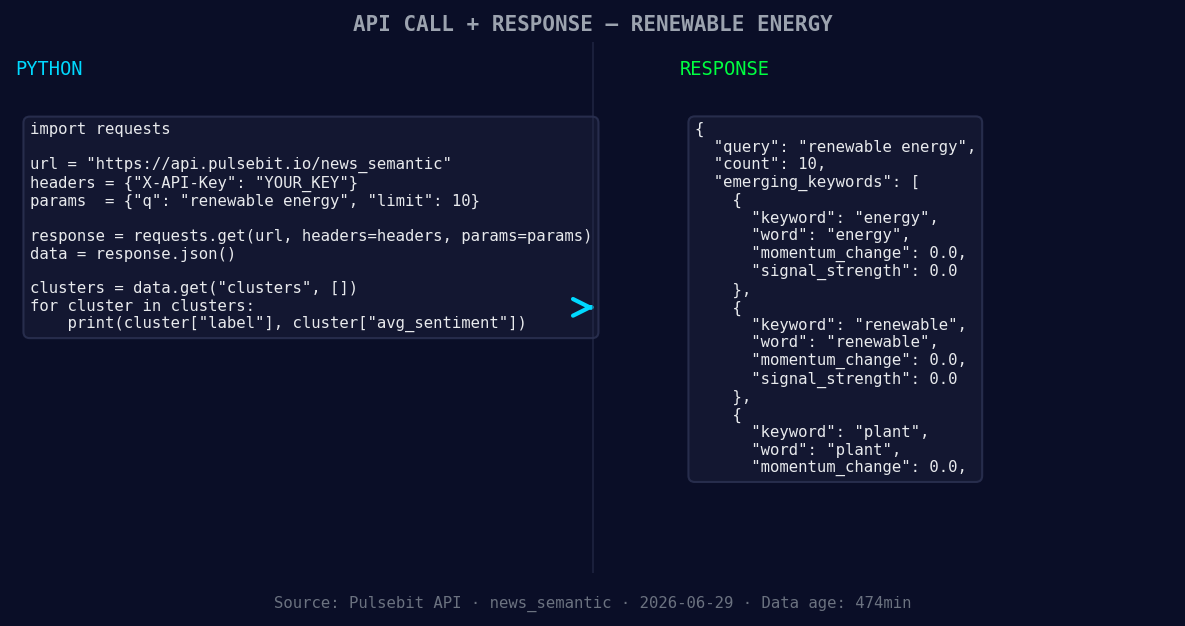
*Left: Python GET /news_semantic call for 'renewable energy'. Right: returned JSON response structure (clusters: 3). Source: Pulsebit /news_semantic.*
# Define parameters
topic = 'renewable energy'
momentum = +0.462
score = +0.800
confidence = 0.85
# Geographic origin filter: query by language/country
url = "https://api.pulsebit.com/v1/sentiment"
params = {
"topic": topic,
"score": score,
"confidence": confidence,
"momentum": momentum,
"lang": "en" # Filtering for English
}
response = requests.get(url, params=params)
data = response.json()
print(data)
Next, we run the cluster reason string through our sentiment scoring endpoint to evaluate the narrative framing itself. This provides a deeper understanding of how the themes are clustering around the sentiment.
# Meta-sentiment moment
meta_sentiment_url = "https://api.pulsebit.com/v1/sentiment"
cluster_reason = "Clustered by shared themes: energy, its, wind, 'drought', tests."

meta_response = requests.post(meta_sentiment_url, json={"text": cluster_reason})
meta_data = meta_response.json()
print(meta_data)
This two-step process not only captures the immediate sentiment spike but also evaluates the context around it. By filtering for English language articles and analyzing the narrative, we gain a clearer view of how these emerging themes—like energy, renewable energy, and plants—are evolving against a backdrop of mainstream sentiment.
Now, let’s explore three specific builds we can create using this data pattern:
- Geographic Filter Build: Create a real-time dashboard that utilizes the geo filter to display the latest sentiment trends in renewable energy for English-speaking countries. Set a signal strength threshold of 0.634 to ensure you're catching only significant shifts.

Geographic detection output for renewable energy. India leads with 5 articles and sentiment +0.80. Source: Pulsebit /news_recent geographic fields.
Meta-Sentiment Loop: Build an alert system that triggers whenever the meta-sentiment score for a cluster reason exceeds +0.800. This is crucial for identifying narratives that are gaining traction, especially around the forming themes such as energy and renewable energy.
Sentiment Comparison Tool: Develop a tool that compares historical sentiment scores for renewable energy against current data. Set a forming gap threshold of +0.00 for energy, renewable, and plant topics to highlight any anomalies or significant changes in sentiment.
With these builds, you can leverage the momentum spike and emerging themes effectively.
For more details, check our documentation at pulsebit.lojenterprise.com/docs. You can copy-paste this code and run it in under 10 minutes to start catching those critical sentiment shifts.


Top comments (0)