

Your pipeline just missed a notable 24h momentum spike of +0.417 in travel sentiment, primarily driven by a singular narrative: “UAE's long-awaited Etihad Rail passenger services to begin on June 30.” This spike was notably led by Spanish press coverage, which was ahead of other languages by a full 20.5 hours. If you’re not tuned into the nuances of multilingual media, you might find your model lagging behind, missing out on critical sentiment shifts that could inform your strategies.

Spanish coverage led by 20.5 hours. Hindi at T+20.5h. Confidence scores: Spanish 0.85, English 0.85, French 0.85 Source: Pulsebit /sentiment_by_lang.
This structural gap reveals a common oversight in many sentiment analysis pipelines: they often fail to account for the dominance of specific languages or entities in shaping narratives. You might find, like we did, that your model missed this significant momentum by a staggering 20.5 hours, simply because it wasn't configured to prioritize or recognize the leading Spanish coverage. It's a wake-up call to ensure you’re not just processing data, but also contextualizing it across languages.
To catch this momentum, we can leverage our API effectively. Here’s a quick Python snippet that illustrates how to filter travel sentiment based on geographic origin and run a meta-sentiment analysis on the clustered narrative:

Geographic detection output for travel. India leads with 6 articles and sentiment -0.07. Source: Pulsebit /news_recent geographic fields.
import requests
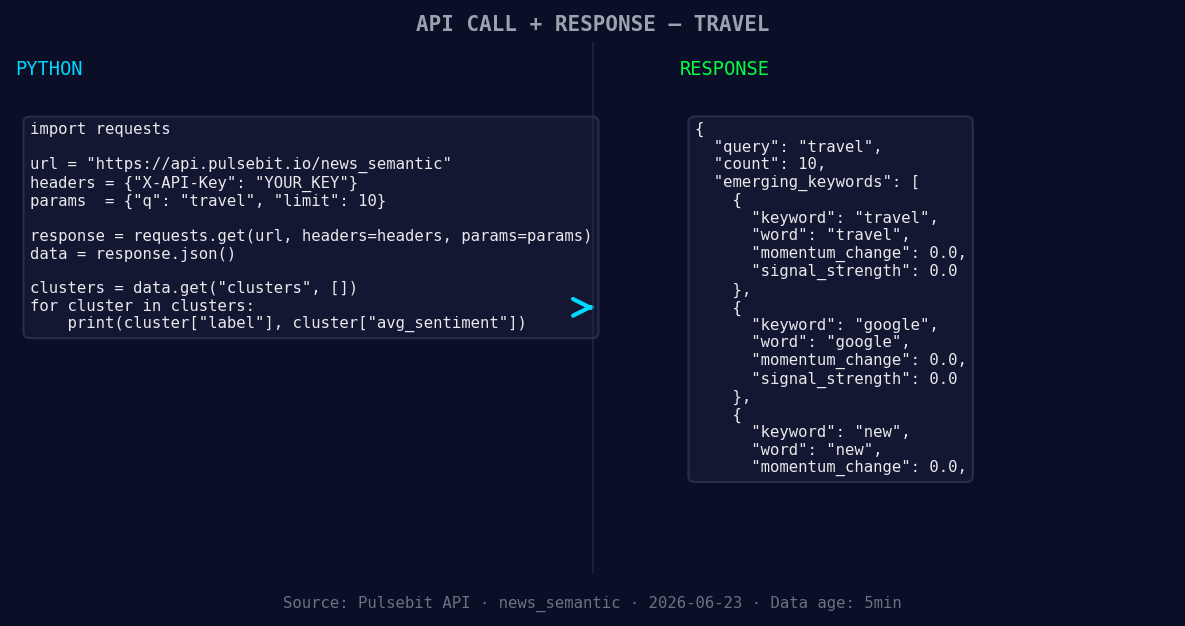
*Left: Python GET /news_semantic call for 'travel'. Right: returned JSON response structure (clusters: 3). Source: Pulsebit /news_semantic.*
# Geographic origin filter for Spanish language
response = requests.get('https://api.pulsebit.com/sentiment', params={
'topic': 'travel',
'lang': 'sp'
})
data = response.json()
print("Sentiment Data:", data)
# Meta-sentiment moment for the cluster reason
cluster_reason = "Clustered by shared themes: etihad, rail, june, uae's, long-awaited."
meta_sentiment_response = requests.post('https://api.pulsebit.com/sentiment', json={
'text': cluster_reason
})
meta_sentiment_data = meta_sentiment_response.json()
print("Meta-Sentiment Data:", meta_sentiment_data)
In this code, we perform two crucial operations:
-
Geographic Origin Filter: We specify
lang: "sp"to ensure we're pulling sentiment data from the Spanish language coverage, which has led the narrative shift. - Meta-Sentiment Moment: We send the cluster reason string back through our sentiment endpoint to assess how the narrative itself is framed, adding another layer of insight to our analysis.
Now, what can you build with this newfound understanding? Here are three specific ideas:
Threshold Alert System: Set up an alert that triggers when travel sentiment in the Spanish language rises above a score of +0.440. This can help you catch emerging travel trends before they hit the mainstream.
Meta-Sentiment Score Integration: Integrate the meta-sentiment loop into your existing dashboard. Use it to visualize how narrative framing affects sentiment scores over time, especially for key topics like travel, which currently shows no forming gap indicators.
Geo-Targeted Campaigns: Create a campaign that specifically targets Spanish-speaking audiences when travel sentiment scores exceed +0.417. This targeted approach helps ensure you're speaking directly to the most engaged demographic at the right time.
By leveraging these insights, you can dramatically improve how your models respond to emerging sentiments. Don’t let your pipeline lag behind. For more details, check our docs at pulsebit.lojenterprise.com/docs. You can copy, paste, and run this in under 10 minutes.


Top comments (0)