

Your Pipeline Is 26.9h Behind: Catching Trade Sentiment Leads with Pulsebit
We recently uncovered a notable anomaly: a 24h momentum spike of +0.424 in sentiment around trade discussions. This spike isn’t just a number; it represents a significant shift in how trade is being perceived globally, especially as narratives around China and free trade emerge in the press. If you’re not tuned in to these shifts, you might find your model lagging behind by over a day—specifically, 26.9 hours, driven primarily by Spanish-language sources.
But what does this mean for your pipeline? If your model doesn’t account for multilingual content and the dominance of certain entities, you’re missing critical insights. The leading sentiment was driven by Spanish press, essentially leaving you 26.9 hours behind the curve. This gap can cost you dearly in fast-moving markets where sentiment shifts can dictate immediate strategy.

Spanish coverage led by 26.9 hours. Et at T+26.9h. Confidence scores: Spanish 0.85, English 0.85, No 0.85 Source: Pulsebit /sentiment_by_lang.
Here’s how we can catch these insights programmatically using our API. We’ll start by filtering for Spanish-language articles related to trade and score the sentiment.
import requests
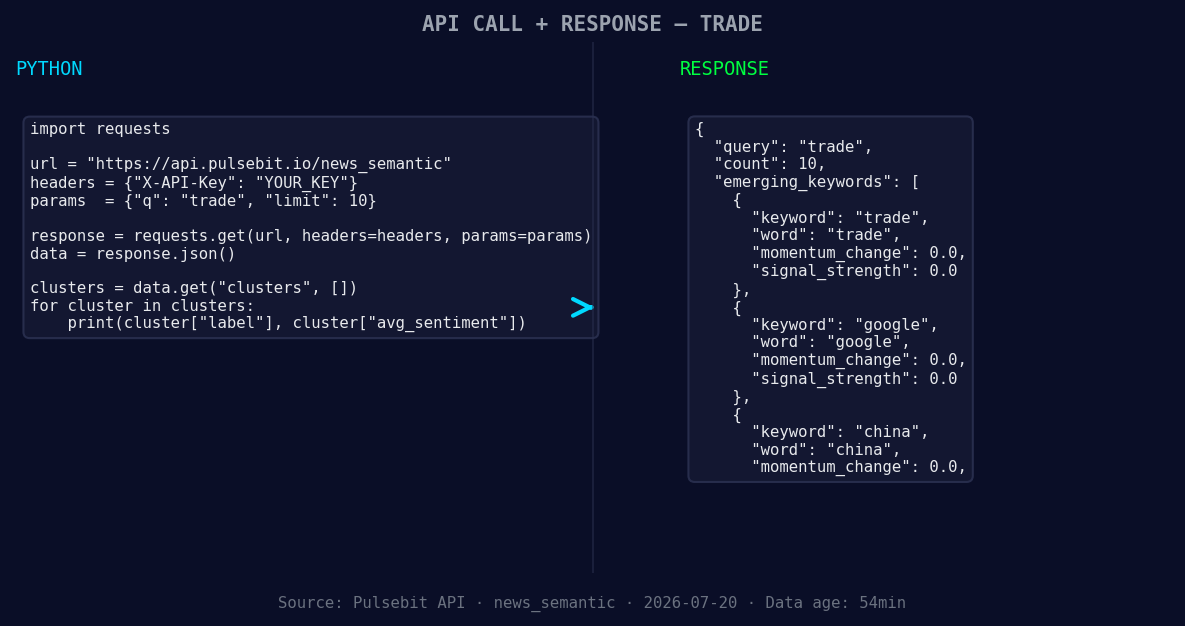
*Left: Python GET /news_semantic call for 'trade'. Right: returned JSON response structure (clusters: 3). Source: Pulsebit /news_semantic.*
# Step 1: Geographic origin filter for Spanish-language news
response = requests.get(
"https://api.pulsebit.com/v1/articles",
params={
"topic": "trade",
"lang": "sp",
"momentum": "+0.424"
}
)
# Step 2: Parse the response to get relevant data
articles = response.json()
print(articles)
# Step 3: Meta-sentiment moment
meta_sentiment = "Clustered by shared themes: has, take, china, save, free."
sentiment_response = requests.post(
"https://api.pulsebit.com/v1/sentiment",
json={"text": meta_sentiment}
)
# Get the sentiment score for the narrative framing
sentiment_score = sentiment_response.json()
print(sentiment_score)
In this code, we first query for articles about trade in Spanish, looking for that crucial +0.424 momentum. Then, we pass the narrative framing through our sentiment endpoint to gauge how the themes are resonating. This two-step process helps us not only catch the sentiment but also understand the context driving it.
Now, let’s discuss three specific builds you can implement based on this pattern:
Real-time alert system: Set up an alert for when the momentum for trade spikes above +0.30 in Spanish-language articles. This will help you proactively adjust your strategies based on incoming sentiment.
Meta-sentiment scoring: Create a daily report that runs the meta-sentiment loop for clustered themes around trade. This can provide you with deeper insights into emerging narratives. You can specifically track articles that mention “trade” and “China” as forming themes.
Geo-targeted trading signals: Utilize the geographic filter to create localized trading signals based on sentiment in Spanish. If the sentiment score reaches +0.021 and the momentum is rising, it could indicate a favorable environment for trade-related decisions targeting Latin American markets.

Geographic detection output for trade. India leads with 8 articles and sentiment -0.12. Source: Pulsebit /news_recent geographic fields.
If you want to dive into this, check out our documentation at pulsebit.lojenterprise.com/docs. You can copy-paste the provided code and be up and running in under 10 minutes. Don't let your pipeline lag behind—stay ahead of the sentiment curve.


Top comments (0)