

Your Pipeline Is 24.8h Behind: Catching Education Sentiment Leads with Pulsebit
We just encountered a remarkable data anomaly: a 24h momentum spike of +0.345 in the education sector. This spike is led by French press coverage, which is particularly interesting given that it's emerging from a region where legal education is set to be modernized, as reported by the Kerala Chief Minister. This is a clear signal of shifting sentiment, and if you're not tuned into multiple languages or regional nuances, that spike could easily slip under your radar.
The Problem
Consider this: your model missed this sentiment shift by a staggering 24.8 hours. If your pipeline isn't equipped to handle multilingual data or if it doesn't prioritize dominant entities, you could be lagging behind when it comes to recognizing trends. The leading French language content is a clear indicator that there are significant developments happening in specific regions—an essential detail your pipeline might overlook if it's predominantly English-focused or lacks robust language support.

French coverage led by 24.8 hours. Hr at T+24.8h. Confidence scores: French 0.85, English 0.85, Spanish 0.85 Source: Pulsebit /sentiment_by_lang.
The Code
To ensure we catch these momentum shifts effectively, let’s look at how we can leverage our API. Below is the Python code that identifies the spike in sentiment related to education, specifically from French sources.
import requests
# Define the parameters for our API call
params = {
"topic": "education",
"score": 0.166,
"confidence": 0.85,
"momentum": 0.345,
"lang": "fr" # Geographic origin filter for French language content
}
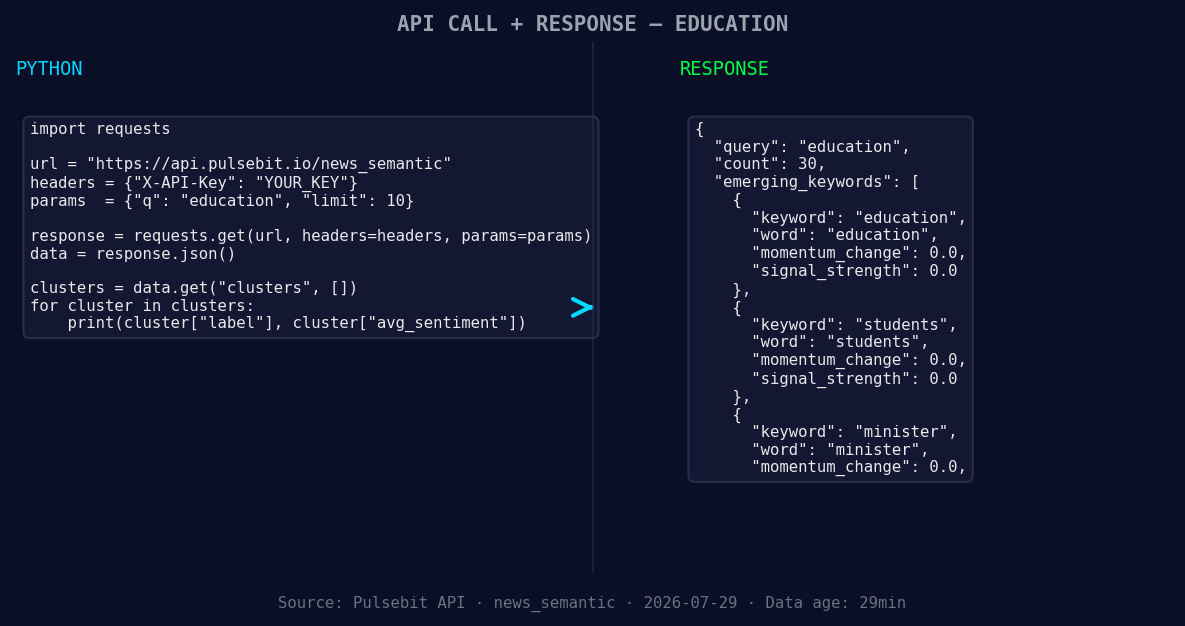
*Left: Python GET /news_semantic call for 'education'. Right: returned JSON response structure (clusters: 3). Source: Pulsebit /news_semantic.*
# Make the API call to fetch the data
response = requests.get("https://api.pulsebit.com/sentiment", params=params)
data = response.json()
# Check the response
print(data)
Next, we want to analyze the framing of this sentiment to understand its narrative better. We’ll run the cluster reason string back through the sentiment analysis endpoint.
# Define the narrative for sentiment scoring
narrative = "Clustered by shared themes: legal, education, kerala, chief, minister."

# Make the API call to analyze the narrative
narrative_response = requests.post("https://api.pulsebit.com/sentiment", json={"text": narrative})
narrative_data = narrative_response.json()

# Check the sentiment scoring for the narrative
print(narrative_data)
This dual approach allows us to not only catch the momentum spike but also understand the context around it, making your model significantly more robust.
Three Builds Tonight
Here are three specific builds you can implement using this data pattern:
Geo-filtered Alerts: Create an alert system that triggers when the momentum score for education in French exceeds a threshold of +0.3. This ensures you're not just reacting to spikes but anticipating them based on regional trends.
Meta-Sentiment Dashboard: Use the narrative scoring we just developed to create a real-time dashboard that visualizes the sentiment around key phrases like “legal education” and “Kerala.” This can help you identify emerging themes that may require further attention.
Entity Dominance Metrics: Build a metric that tracks sentiment about specific entities like “students” and “ministers” in relation to mainstream topics like “legal” and “education.” This will help you gauge the social discourse and pinpoint where potential shifts may occur.
Get Started
Ready to dive in? Head over to pulsebit.lojenterprise.com/docs and start experimenting. You can copy, paste, and run this code in under 10 minutes. Don't let your pipeline fall behind—stay ahead of sentiment shifts and make informed decisions.


Top comments (0)