

Your pipeline just missed a significant anomaly: a 24-hour momentum spike of -0.331 in the sentiment surrounding renewable energy. This decline indicates a notable shift in how the conversation is framing itself, particularly in the context of KenGen's ambitious renewable energy goals in Kenya. With the leading language in this narrative being English and the articles clustering around themes of targets, renewables, and energy expansion, we have a unique insight into a developing narrative that could influence decisions far beyond this moment.
But here’s the kicker: your model missed this by 28.2 hours. By not adequately handling multilingual origins or recognizing the dominance of certain entities, your pipeline has left a significant gap. The English press is leading this trend, while other languages might be lagging behind, potentially diluting the effectiveness of your insights. If you’re relying solely on one language or missing the broader context, you’re effectively operating blind in an increasingly interconnected discourse.

English coverage led by 28.2 hours. Italian at T+28.2h. Confidence scores: English 0.85, French 0.85, Spanish 0.85 Source: Pulsebit /sentiment_by_lang.
Let’s dive into how we can catch this anomaly using our API with some Python code. First, we want to filter by geographic origin to ensure we're only pulling English-language articles. Here’s how you can do that:

Geographic detection output for renewable energy. India leads with 6 articles and sentiment +0.43. Source: Pulsebit /news_recent geographic fields.
import requests
# Define the parameters for our API call
params = {
"topic": "renewable energy",
"score": +0.414,
"confidence": 0.85,
"momentum": -0.331,
"lang": "en"
}
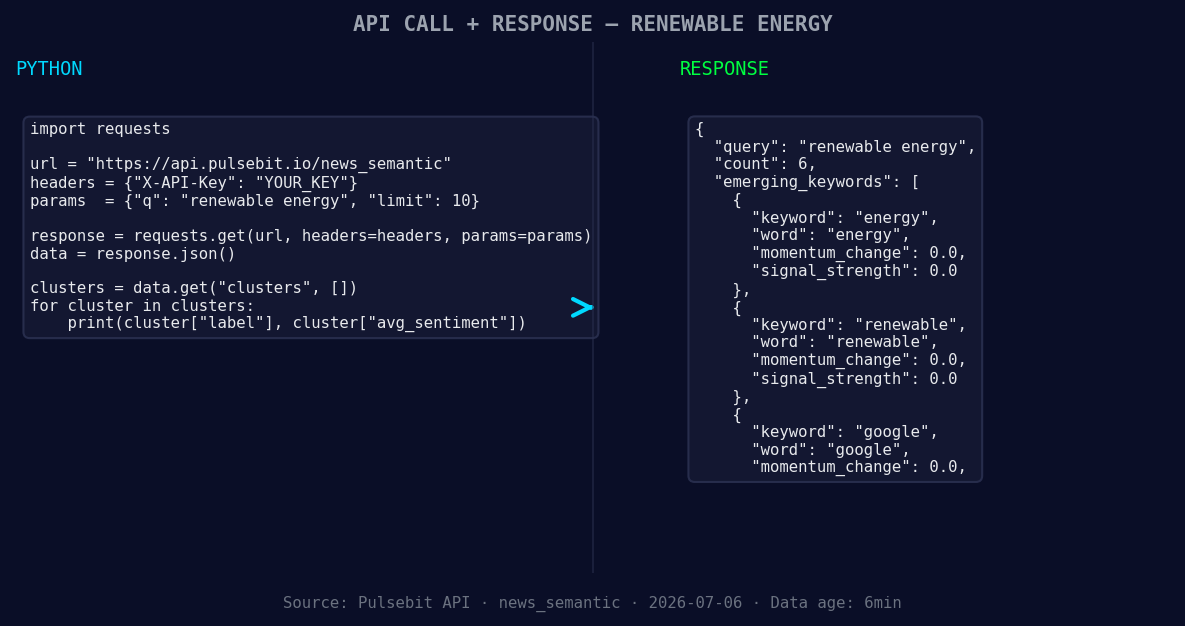
*Left: Python GET /news_semantic call for 'renewable energy'. Right: returned JSON response structure (clusters: 3). Source: Pulsebit /news_semantic.*
# Make the API call
response = requests.get("https://api.pulsebit.com/articles", params=params)
data = response.json()
Now that we have our English articles, let’s run the cluster reason string through the sentiment endpoint to gauge the narrative framing itself. This step is crucial to understand how the themes are resonating in the broader context:
# Define the cluster reason string
cluster_reason = "Clustered by shared themes: targets, renewables, expanded, renewable, energy."

# Make the sentiment scoring API call
sentiment_response = requests.post("https://api.pulsebit.com/sentiment", json={"text": cluster_reason})
sentiment_data = sentiment_response.json()
By executing these two parts, you can not only identify the stories driving the sentiment but also assess the meta-narrative that’s forming around renewable energy.
Now, let's brainstorm three specific builds you can implement based on this anomaly. Each of these is tailored to leverage our findings:
Geo-Filtered Insights: Create a dashboard that visualizes sentiment over time specifically for English-speaking regions on renewable energy. Use the geo filter to pull English data points as shown above, and set a threshold to alert you when sentiment drops below a certain score (e.g., -0.2).
Meta-Sentiment Loop: Build a function that continuously feeds the cluster reason string back through our sentiment endpoint to track shifts in narrative framing. Set a trigger to flag when the meta-sentiment score deviates significantly (e.g., a change greater than 0.1) from its previous readings.
Anomaly Detector: Implement an anomaly detection system that uses the 24-hour momentum score to identify rapid changes in sentiment. Alert your team when the momentum falls below a threshold of -0.25, ensuring that you’re always on top of significant shifts in renewable energy discussions.
By harnessing these insights and building upon them, you’ll be better equipped to respond to shifts in sentiment promptly.
For more detailed guidance, visit pulsebit.lojenterprise.com/docs. You can copy-paste the provided code snippets and run them in under 10 minutes to start capturing these insights today.


Top comments (0)