

Your Pipeline Is 27.6h Behind: Catching Sustainability Sentiment Leads with Pulsebit
We recently uncovered a fascinating anomaly: a 24-hour momentum spike of +0.301 in sustainability sentiment. This shift is particularly noteworthy as it highlights a significant trend emerging from the Spanish press, which has been leading this sentiment surge for 27.6 hours without any lag time. A single article titled "Wasabi launches cloud sustainability tracker scheme for partners and MSPs - IT P" provides the context, demonstrating a clustering around launches, cloud, and sustainability themes. This isn’t just a fleeting moment; it’s an opportunity to align your insights with real-time sentiment shifts.
But what does this mean for your pipeline? If your model doesn’t accommodate multilingual sources or entity dominance, you’ve missed this critical spike by 27.6 hours. Imagine the insights you could have extracted if your system had been built to recognize these nuances. Relying solely on English language sources could leave your analysis lagging behind, missing the frontlines of sentiment evolution.

Spanish coverage led by 27.6 hours. Af at T+27.6h. Confidence scores: Spanish 0.85, English 0.85, French 0.85 Source: Pulsebit /sentiment_by_lang.
To catch this spike, we can leverage our API effectively. Here’s how to do it in Python, starting with the geographic origin filter. We’ll query for Spanish-language articles related to sustainability:
import requests
# Define parameters
topic = 'sustainability'
score = +0.723
confidence = 0.85
momentum = +0.301
# API call: Geographic origin filter
response = requests.get('https://api.pulsebit.com/articles', params={
'topic': topic,
'lang': 'sp'
})
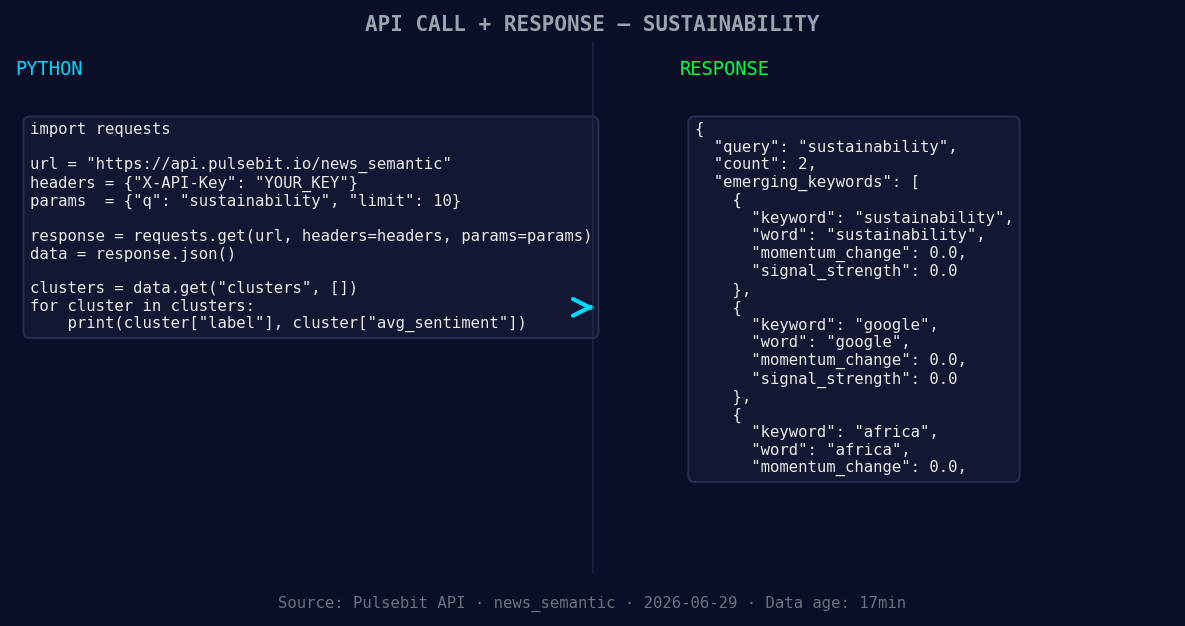
*Left: Python GET /news_semantic call for 'sustainability'. Right: returned JSON response structure (clusters: 3). Source: Pulsebit /news_semantic.*
# Check the response
print(response.json())
Once we have the relevant articles, we need to evaluate the framing of the narrative itself. Let’s run the cluster reason back through our sentiment analysis endpoint to score the narrative:
# Meta-sentiment moment
cluster_reason = "Clustered by shared themes: launches, cloud, sustainability, tracker, scheme."
sentiment_response = requests.post('https://api.pulsebit.com/sentiment', json={
    'text': cluster_reason
})

# Check the sentiment response
print(sentiment_response.json())
By using these two methods, you not only capture the momentum but also score the narrative's framing, giving you a comprehensive view of the emerging sustainability sentiment.
Now, let’s discuss three specific builds you can implement using this newfound knowledge:
- Real-time Alert System: Build a notification system that triggers when sustainability sentiment momentum exceeds +0.250 for any language, particularly Spanish. Use the geographic filter to focus on relevant articles.

Geographic detection output for sustainability. India leads with 2 articles and sentiment +0.75. Source: Pulsebit /news_recent geographic fields.
Sentiment Contextualization: Create an endpoint that takes the clustered themes and returns a sentiment score. This would help prioritize which narratives to focus on based on the emerging trends, particularly for sustainability and cloud topics.
Comparative Analysis Tool: Use the meta-sentiment loop to compare the sustainability sentiment scores across different languages. For instance, you could examine how the Spanish sentiment compares to English, focusing on forming themes like sustainability and how they relate to trends in Africa versus mainstream launches.
If you're ready to dive in, check out our documentation at pulsebit.lojenterprise.com/docs. You can copy the code snippets provided and run this in under 10 minutes. It’s time to ensure your pipeline keeps up with the evolving landscape of sentiment, especially in emerging domains like sustainability.


Top comments (0)