

Your Pipeline Is 17.2h Behind: Catching Hardware Sentiment Leads with Pulsebit
We recently noticed a striking anomaly: a 24h momentum spike of +0.798 related to the topic of hardware. This spike is particularly relevant as it indicates a sudden shift in sentiment, possibly driven by emerging stories in the media. Crucially, the leading language for this sentiment surge was Spanish, with a 17.2-hour lead time. This discovery highlights the importance of monitoring multilingual sentiment sources in a timely manner.

Spanish coverage led by 17.2 hours. Ca at T+17.2h. Confidence scores: Spanish 0.85, English 0.85, French 0.85 Source: Pulsebit /sentiment_by_lang.
When we think about sentiment analysis pipelines, we often focus solely on the dominant language or region. However, here’s the problem: if your model doesn’t account for multilingual origins or entity dominance, it might have completely missed this spike by 17.2 hours. Specifically, it’s easy to overlook how a significant sentiment shift within Spanish-speaking media can influence underlying trends in the hardware industry. If your pipeline isn’t tuned to catch this, you’re already trailing behind the news cycle.
To catch such anomalies, we can leverage our API. Here’s a quick Python snippet that demonstrates how to detect this sentiment shift for hardware specifically from Spanish-language sources:
import requests
# Set parameters for the API call
topic = 'hardware'
score = -0.600
confidence = 0.85
momentum = +0.798
lang_filter = 'sp'
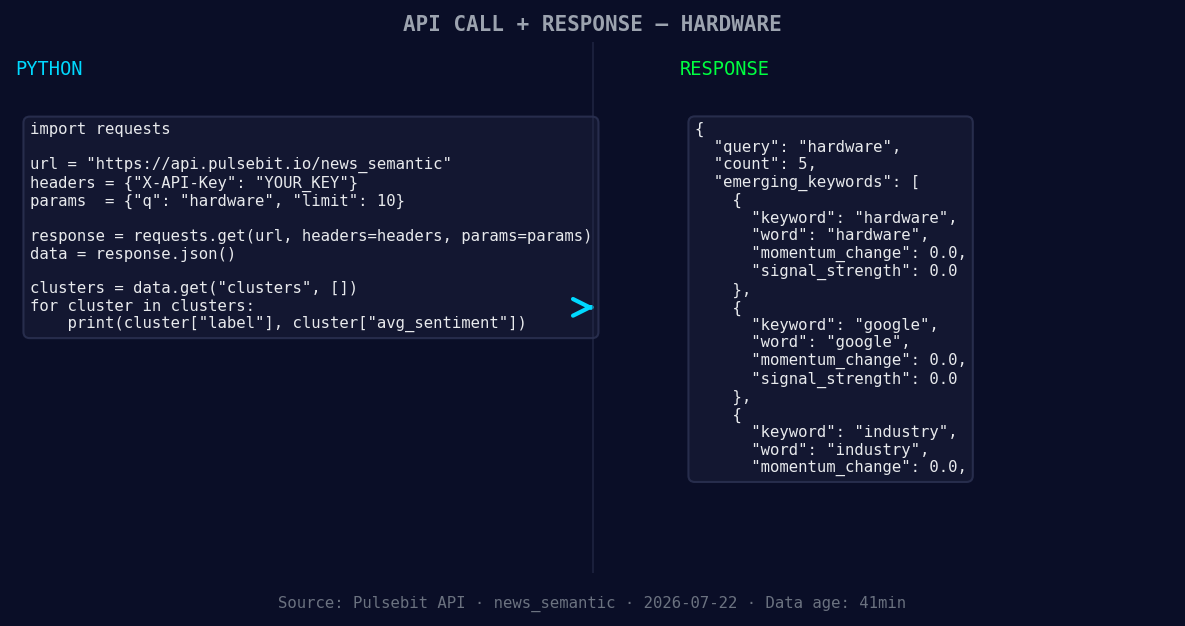
*Left: Python GET /news_semantic call for 'hardware'. Right: returned JSON response structure (clusters: 3). Source: Pulsebit /news_semantic.*
# Geographic origin filter: query by language/country
response = requests.get(f'https://api.pulsebit.com/v1/sentiment?topic={topic}&lang={lang_filter}')
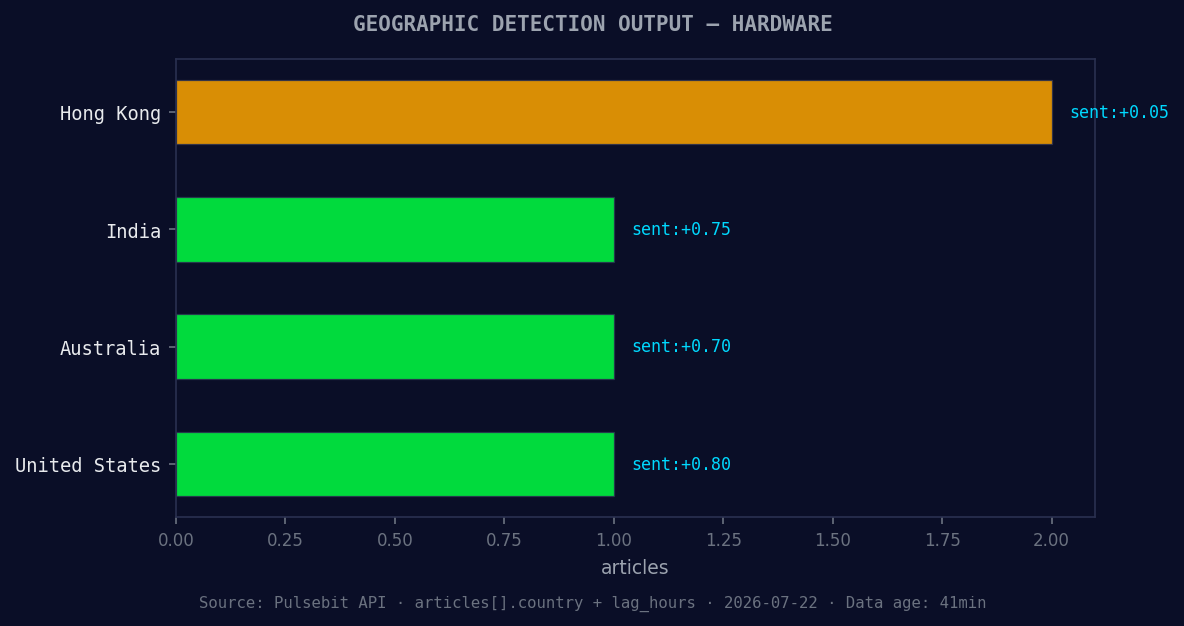
*Geographic detection output for hardware. Hong Kong leads with 2 articles and sentiment +0.05. Source: Pulsebit /news_recent geographic fields.*
# Check if the request was successful
if response.status_code == 200:
data = response.json()
print(data)
else:
print("Error fetching data")
# Meta-sentiment moment: run the cluster reason string back through POST /sentiment
meta_sentiment_input = "Clustered by shared themes: platform, hardware, investments, way, ahead."
meta_response = requests.post('https://api.pulsebit.com/v1/sentiment', json={"text": meta_sentiment_input})
# Check if the post request was successful
if meta_response.status_code == 200:
meta_data = meta_response.json()
print(meta_data)
else:
print("Error posting data")
In this code, we first fetch sentiment data specifically for hardware in Spanish. We can then analyze the narrative framing of the sentiment by sending a string through our sentiment endpoint, which provides valuable insights into how the narrative is constructed around emerging trends.
Now, let’s explore three specific builds you can implement to capitalize on this newly uncovered hardware sentiment pattern:
Spanish-Language Hardware Alerts: Set a threshold for momentum spikes above +0.5 to trigger real-time alerts for any Spanish-language articles discussing hardware. This will ensure you’re always informed about critical developments in this sector.
Meta-Sentiment Analyzer: Use the meta-sentiment loop to build a dashboard that scores the narrative framing around hardware. Set an alert for when the sentiment score dips below -0.5 and the confidence level is above 0.85. This could signal a potential market shift that needs immediate attention.
Forming Themes Monitor: Create a signal that tracks forming themes with a focus on hardware, Google, and the industry. Set a query that pulls in articles with momentum scores of +0.00 against the mainstream topics of platform, hardware, and investments. This can help you identify emerging conversations before they hit the mainstream.
If you’re ready to start building with this data, check out our documentation at pulsebit.lojenterprise.com/docs. You can copy-paste the code above and run it in under 10 minutes. Time to catch up on those 17.2 hours!


Top comments (0)