

Your pipeline has just revealed a striking anomaly: a 24h momentum spike of +0.600 in mobile sentiment. This isn’t just noise; it indicates a significant shift in how people are discussing mobile technologies and related themes. With the leading language being English and a notable cluster story titled "Mobile Base Camp: Off-Grid And On The Move [TRANSPORT]" from recoilweb.com, it’s clear that there’s a burgeoning interest in mobility solutions that are off-grid and adaptable. This spike could represent a pivotal moment for developers to tune into emerging mobile narratives.
If your model doesn’t account for multilingual origins or entity dominance, it’s likely that you missed this momentum shift by a full 25.6 hours. With the leading conversation coming from English-speaking sources and the dominant themes revolving around "base," "camp," and "mobile," your pipeline may be lagging behind in capturing timely insights. This gap can severely limit your ability to respond to trends that are gaining traction, especially in diverse linguistic markets.

English coverage led by 25.6 hours. German at T+25.6h. Confidence scores: English 0.85, Spanish 0.85, French 0.85 Source: Pulsebit /sentiment_by_lang.
Here’s how to catch this momentum spike using our API. We'll filter for English language sources and then analyze the broader sentiment narrative around the clustered themes.
import requests
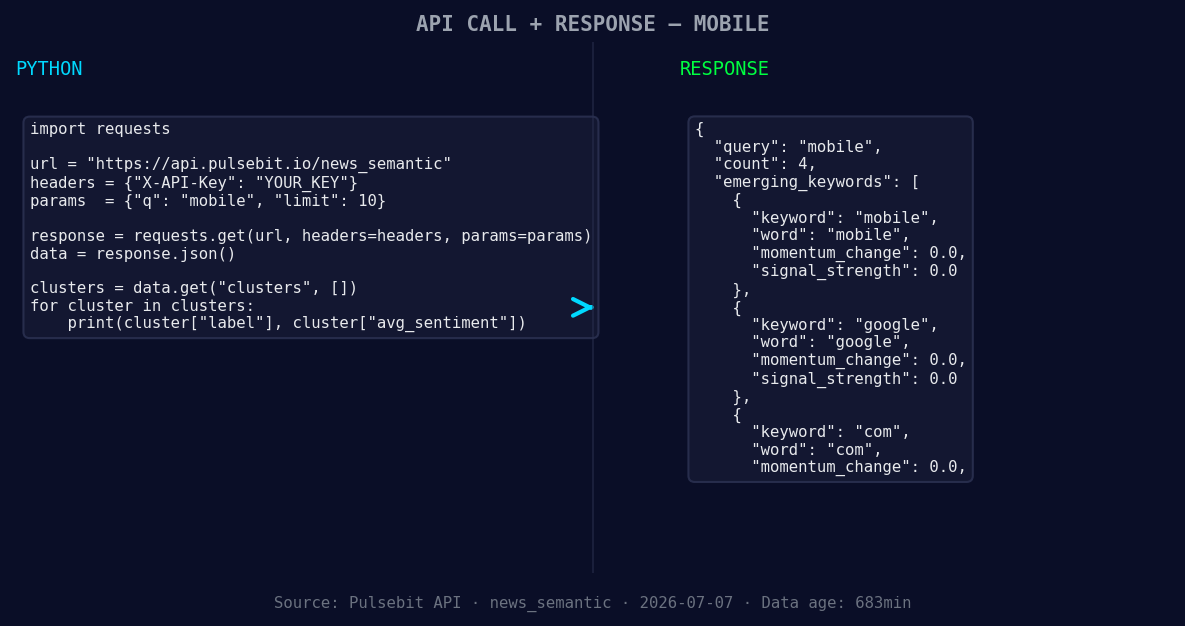
*Left: Python GET /news_semantic call for 'mobile'. Right: returned JSON response structure (clusters: 3). Source: Pulsebit /news_semantic.*
# Step 1: Geographic origin filter
url = "https://api.pulsebit.com/sentiment"
params = {
"topic": "mobile",
"score": +0.219,
"confidence": 0.85,
"momentum": +0.600,
"lang": "en" # Filter for English sources
}
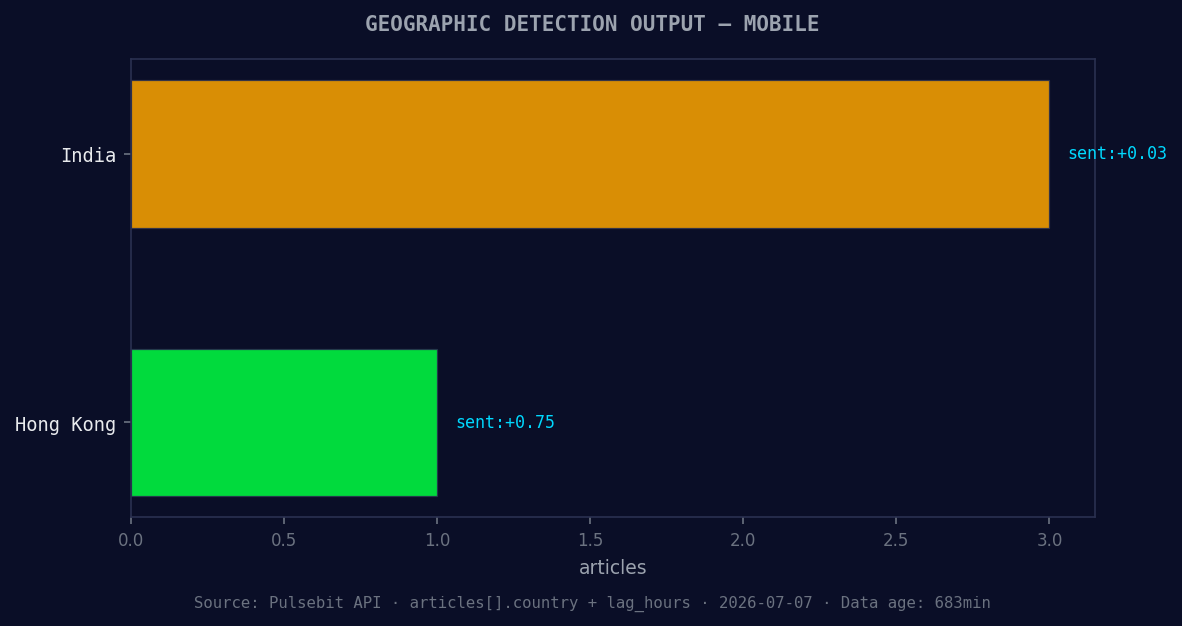
*Geographic detection output for mobile. India leads with 3 articles and sentiment +0.03. Source: Pulsebit /news_recent geographic fields.*
response = requests.get(url, params=params)
data = response.json()
print(data)
Next, we’ll take the narrative framing from our cluster reason string and run it back through the sentiment analysis to evaluate the contextual sentiment.
# Step 2: Meta-sentiment moment
cluster_reason = "Clustered by shared themes: base, camp:, off-grid, move, mobile."
meta_sentiment_url = "https://api.pulsebit.com/sentiment"

meta_response = requests.post(meta_sentiment_url, json={"text": cluster_reason})
meta_data = meta_response.json()
print(meta_data)
Here, we’ve filtered our data to hone in on English-speaking discussions and then analyzed the sentiment framing those discussions. This approach gives us a robust method to catch the momentum and understand narrative shifts.
Now, let’s talk about three specific builds you can implement with the insights from this momentum spike:
Signal Detector: Create a signal threshold that alerts you when mobile sentiment spikes beyond +0.500 in English-language articles. This can help you catch trends like the "Mobile Base Camp" narrative before they gain mainstream traction.
Geo-Filter Alert: Build an endpoint that uses the geo filter to identify emerging themes in mobile discussions across different languages, focusing on the off-grid and transport topics. This can help you localize your efforts and tailor responses to specific regions where sentiment is rising.
Meta-Sentiment Analyzer: Develop a tool that analyzes the context of clustered themes using the meta-sentiment loop. For example, track how narratives around "base" and "camp" shift over time, especially as they relate to mobile technologies. This can provide deeper insights into consumer preferences and behaviors.
For more details on how to implement these, check out our documentation at pulsebit.lojenterprise.com/docs. With this setup, you can copy, paste, and run your sentiment analysis in under 10 minutes. Don’t fall behind; leverage these insights to stay ahead of the curve in mobile sentiment trends.


Top comments (0)