

Your pipeline just missed a critical signal with a 24-hour momentum spike of +0.150. This anomaly, driven by the Spanish press, highlights a significant shift in sentiment around global events like UNESCO's recent addition of Mount Olympus and France's D-Day landing beaches to the World Heritage List. Such spikes are not just numbers; they represent opportunities to understand emerging narratives before they become mainstream conversations.
The structural gap in your pipeline is evident: if it doesn't handle multilingual data effectively, you risk missing out on pivotal shifts in sentiment by over 26 hours. In this case, the leading language was Spanish, and your model was lagging behind, which means you might have missed a chance to act on this powerful narrative while others were already capitalizing on it.

Spanish coverage led by 26.8 hours. Nl at T+26.8h. Confidence scores: Spanish 0.85, English 0.85, No 0.85 Source: Pulsebit /sentiment_by_lang.
Here's how to catch this anomaly using our API. First, we’ll filter for the relevant geographic origin—Spanish in this case. The following Python snippet demonstrates how to query sentiment data accordingly:
import requests
# Define parameters for the API call
params = {
"topic": "world",
"lang": "sp",
"score": +0.006,
"confidence": 0.85,
"momentum": +0.150
}
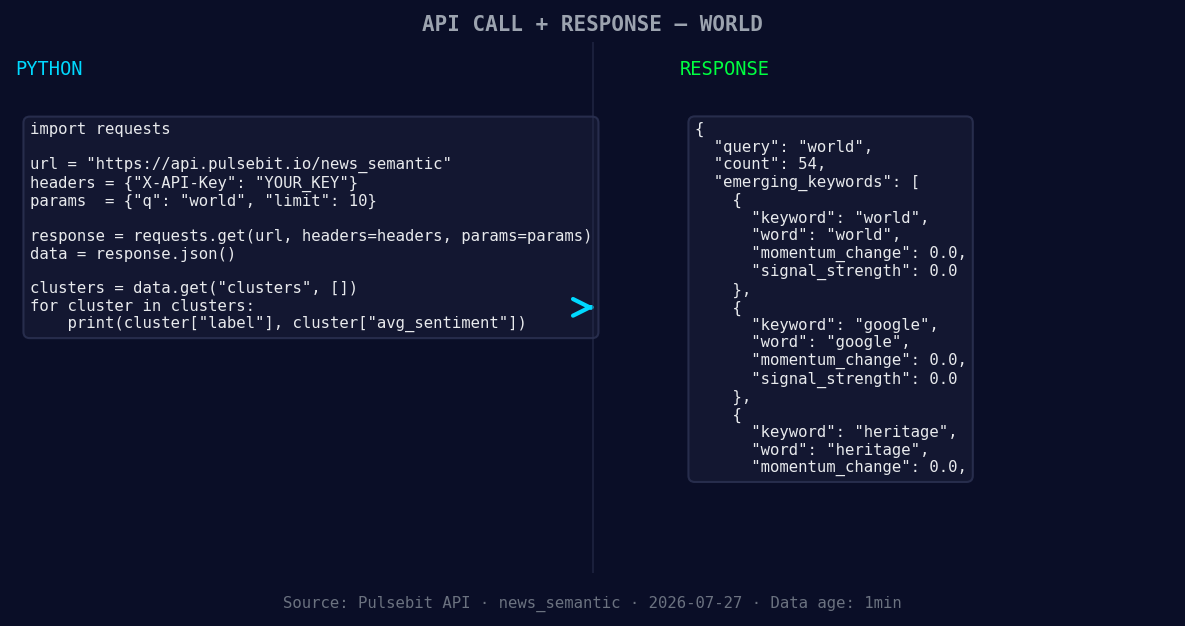
*Left: Python GET /news_semantic call for 'world'. Right: returned JSON response structure (clusters: 3). Source: Pulsebit /news_semantic.*
# Make the API call to get sentiment data
response = requests.get("https://api.pulsebit.com/sentiment", params=params)
data = response.json()
print(data)
Next, we need to evaluate the narrative framing itself. We can run the cluster reason string back through the sentiment endpoint to score its potential impact. Here's how:
# Define the cluster reason string
cluster_reason = "Clustered by shared themes: capital, rising, sea, world's, narrowest."

# Make the API call to analyze the cluster reason sentiment
response = requests.post("https://api.pulsebit.com/sentiment", json={"text": cluster_reason})
cluster_sentiment = response.json()
print(cluster_sentiment)
This two-step approach not only captures the momentum shift but also contextualizes the narrative behind it, allowing you to understand why this sentiment is gaining traction.
Now, let’s discuss three specific builds you can implement based on this pattern:
- Geographic Filter for Real-time Monitoring: Build a monitoring tool that continuously queries sentiment for the topic "world" in Spanish. Set a threshold where momentum spikes above +0.100 to trigger alerts for immediate analysis. This ensures you catch significant shifts promptly.

Geographic detection output for world. India leads with 41 articles and sentiment +0.19. Source: Pulsebit /news_recent geographic fields.
Meta-Sentiment Loop Integration: Create a dashboard that visualizes the sentiment of clustered narratives. Use the meta-sentiment loop to feed narratives back into your models, particularly focusing on how themes like "world" and "heritage" are framing public discourse. Set a threshold for sentiment scores below +0.005 to identify potential areas of concern.
Anomaly Detection in Multi-Language Contexts: Implement an anomaly detection system that flags when sentiment in one language (like Spanish) diverges significantly from the English sentiment on the same topic. Use a lag threshold of 26 hours to identify emerging stories that could influence the overall sentiment landscape.
By addressing these specific signals, you’ll be better equipped to stay ahead of trends and leverage sentiment data effectively.
To get started, check out our documentation at pulsebit.lojenterprise.com/docs. You can copy, paste, and run the provided code in under 10 minutes. Move fast and capture those sentiment shifts!


Top comments (0)