

Your model just missed a critical data point: a 24h momentum spike of +0.875. This spike, driven by discussions around inflation, has been largely fueled by English press articles, specifically the cluster story, "Fed’s Logan Says Rates Should Rise to Fight Inflation - WSJ." With a focus on sentiment surrounding inflation, you might find that your current pipeline is lagging behind by an entire day, which could mean missing out on valuable insights and trends.
The problem at hand is that any pipeline not equipped to handle multilingual origins or entity dominance is bound to miss these vital signals. In this case, the leading language is English, and your model missed this spike by 24.5 hours. This delay could mean the difference between staying ahead of inflation trends or falling behind, especially when it comes to decision-making based on timely market sentiment.

English coverage led by 24.5 hours. No at T+24.5h. Confidence scores: English 0.85, Spanish 0.85, Id 0.85 Source: Pulsebit /sentiment_by_lang.
Here's how we can catch this anomaly using our API. Below is a Python code snippet that shows how to filter for English-language articles and then score the narrative framing surrounding the inflation topic.
import requests
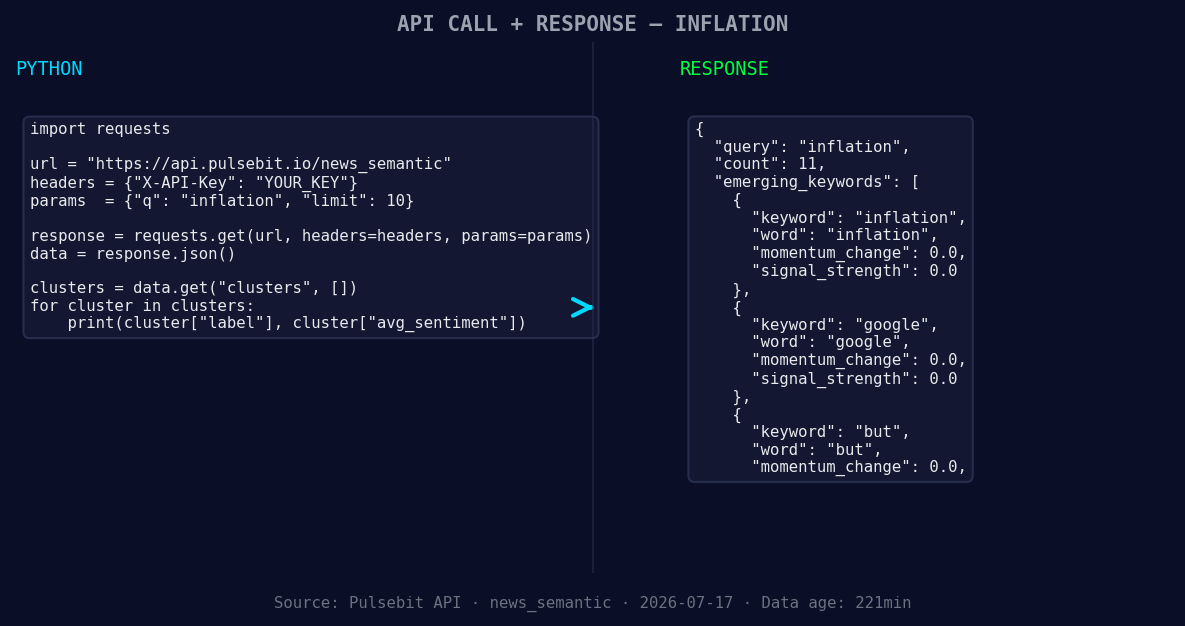
*Left: Python GET /news_semantic call for 'inflation'. Right: returned JSON response structure (clusters: 3). Source: Pulsebit /news_semantic.*
# Define the topic and parameters
topic = 'inflation'
score = +0.000
confidence = 0.85
momentum = +0.875
# Step 1: Geographic origin filter
url = "https://api.pulsebit.com/v1/insight"
params = {
"topic": topic,
"lang": "en", # Filter for English
"score": score,
"confidence": confidence,
}
response = requests.get(url, params=params)
english_articles = response.json()
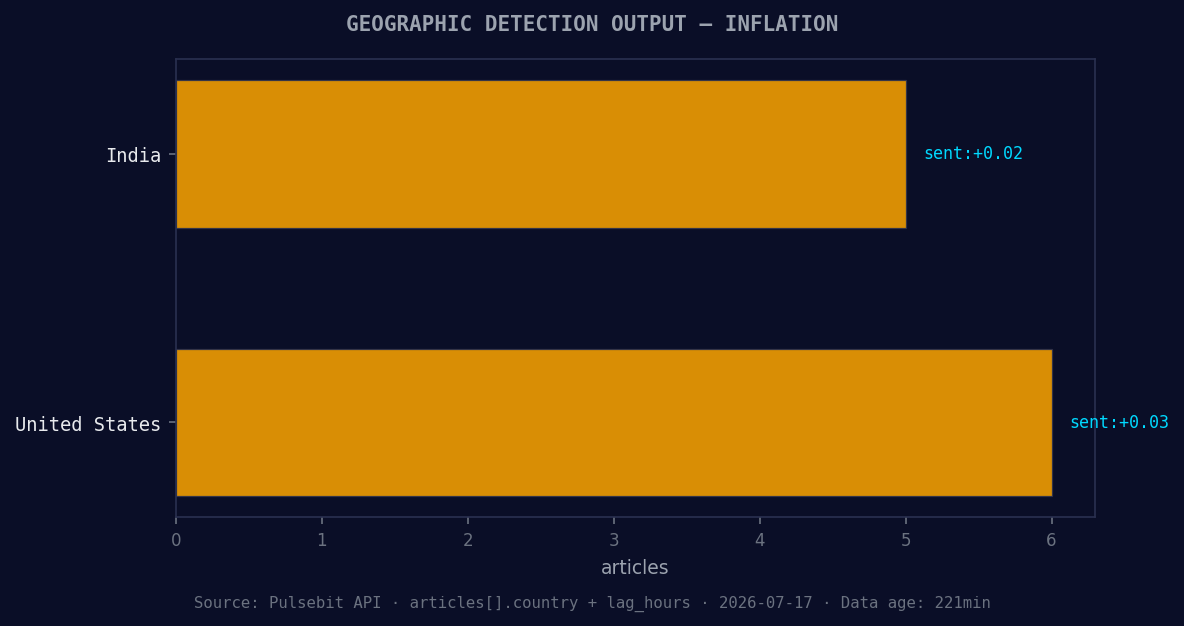
*Geographic detection output for inflation. India leads with 5 articles and sentiment +0.02. Source: Pulsebit /news_recent geographic fields.*
# Step 2: Meta-sentiment moment
cluster_reason = "Clustered by shared themes: index, core, industries, set, get."
sentiment_url = "https://api.pulsebit.com/v1/sentiment"
sentiment_response = requests.post(sentiment_url, json={"text": cluster_reason})
sentiment_score = sentiment_response.json()
print("English Articles:", english_articles)
print("Meta Sentiment Score:", sentiment_score)
In this code, we first filter articles by the English language to ensure we're capturing relevant data. Then, we send the cluster reasoning back through our sentiment endpoint to gauge the narrative framing. This dual approach allows us to not only understand the spike itself but also the context in which it appears.
Here are three specific builds we can implement using this data pattern:
Inflation Sentiment Tracker: Create a service that triggers alerts when the sentiment score for inflation exceeds a threshold, say +0.5. This can help you react promptly to emerging inflation discussions.
Cluster Analysis Dashboard: Use the meta-sentiment loop to visualize how different themes are interrelated. For instance, set a threshold for thematic mentions (e.g., "core" or "industries") and visualize how they correlate with sentiment spikes in inflation discussions.
Geo-Filtered Insights: Build an endpoint that not only tracks inflation but also integrates geographical data. For example, filter for English-language articles from specific regions (like the US) and analyze how sentiment varies across these areas.
By leveraging our API, you can ensure your insights on inflation are timely and relevant, avoiding the pitfalls of outdated data.
Ready to get started? Check out our documentation at pulsebit.lojenterprise.com/docs. With just a few lines of code, you can copy-paste this example and run it in under 10 minutes.


Top comments (0)