

Your pipeline just missed a significant anomaly: a 24-hour momentum spike of +0.215. This surge in sentiment around the topic of "world" suggests that something noteworthy is happening, particularly in English-language press coverage. It’s crucial to note that this spike was led by a 23.7-hour lag in coverage, suggesting your model might not be capturing emerging narratives quickly enough, especially when dealing with multilingual origins. This gap is a clear indicator that if you're not tracking language dominance or geographic sentiment, your insights could be well behind the curve.

English coverage led by 23.7 hours. Ro at T+23.7h. Confidence scores: English 0.95, Spanish 0.95, French 0.95 Source: Pulsebit /sentiment_by_lang.
If your sentiment analysis pipeline is not equipped to handle multilingual data or the dominance of particular entities, you might find yourself 23.7 hours late to crucial developments. In this case, the English-language articles provided the leading edge on a story that’s gaining traction globally. You could easily miss out on timely insights that could inform your strategies or decisions effectively. The competitive edge is often in the details, and understanding sentiment from multiple perspectives is key to staying ahead.
Here’s how you can catch this momentum spike using our API. Below is Python code that filters for English-language articles on the topic "world" and scores the sentiment around the narrative itself.
import requests
# Define parameters for the API call
params = {
"topic": "world",
"lang": "en",
"momentum": +0.215,
"score": +0.164,
"confidence": 0.95
}
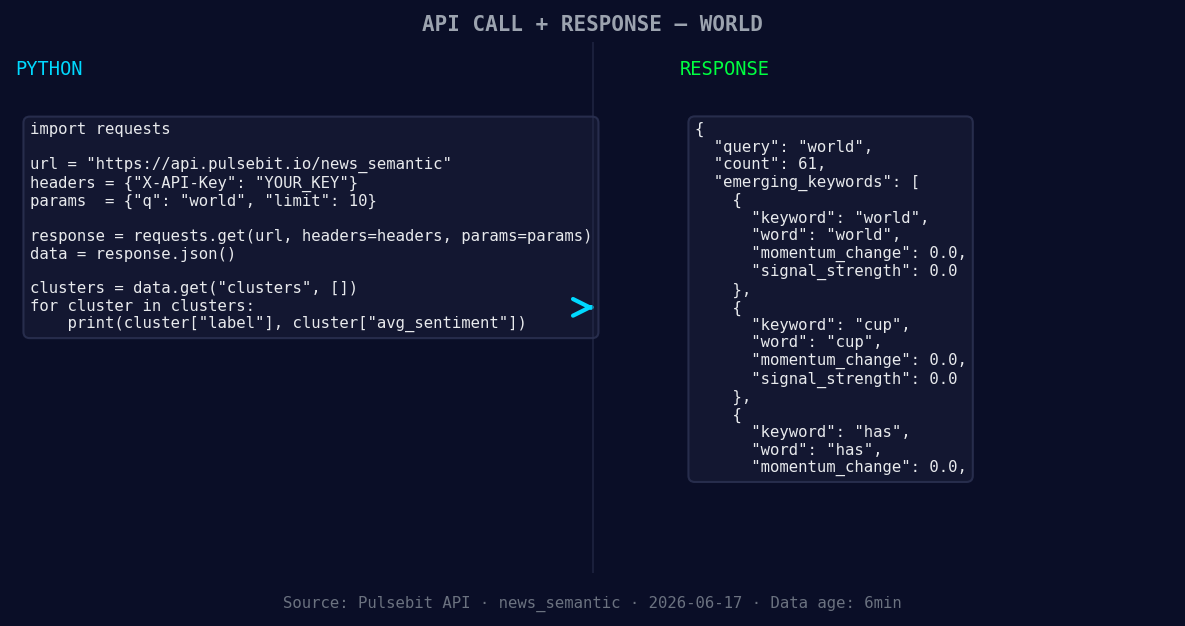
*Left: Python GET /news_semantic call for 'world'. Right: returned JSON response structure (clusters: 3). Source: Pulsebit /news_semantic.*
# Geographic origin filter: Get articles in English
response = requests.get("https://api.pulsebit.com/articles", params=params)
articles = response.json()
# Check if articles were returned
if articles:
print(f"Found {len(articles)} articles on the topic 'world'.")
# Meta-sentiment moment: Score the narrative framing
cluster_reason = "Clustered by shared themes: world, has, 193, countries, but."
sentiment_response = requests.post("https://api.pulsebit.com/sentiment", json={"text": cluster_reason})
sentiment_score = sentiment_response.json()
print(f"Narrative sentiment score: {sentiment_score['score']} with confidence: {sentiment_score['confidence']}")
In this code, we first query for articles related to "world" in English, capturing the spike in sentiment. The next step is to analyze the narrative framing behind the spike by sending the cluster reason string through our sentiment endpoint. This approach allows us to gauge the underlying themes and sentiments driving the spike, giving you richer insights into what's resonating in the news.
With this pattern, here are three specific builds you can implement tonight:
Geo-Filtered Article Aggregator: Set up a daily job that fetches articles on "world" filtered for English. Use a signal strength threshold of 0.652 to alert you on significant spikes.
Narrative Analyzer: Create a function that processes clustered themes using the meta-sentiment loop. Input the cluster reason: "Clustered by shared themes: world, has, 193, countries, but." This helps you understand how narratives evolve over time.
Dynamic Alert System: Implement a real-time alert system that triggers when sentiment momentum exceeds +0.215 for themes like "world," "cup," or "has." This ensures you stay updated on forming narratives that could impact your domain.
By leveraging our API effectively, you can ensure your sentiment analysis is timely and relevant. For more granular insights, visit pulsebit.lojenterprise.com/docs. You can copy, paste, and run the code above in under 10 minutes. Don’t let critical insights slip through the cracks!


Top comments (0)