

Your model missed a critical 24h momentum spike of +0.621, signaling a rise in innovation sentiment centered around TELUS. This anomaly surfaced amidst an otherwise stable landscape, suggesting a novel trend that you may have overlooked. Given that the leading language driving this momentum is English, with a notable press mention from Forbes about TELUS's loyalty innovation in a commodity category, this is not just a minor fluctuation — it’s a significant signal that deserves attention.
The problem here is clear: if your pipeline isn't equipped to handle multilingual origins or account for the dominance of certain entities, you risk being out of sync by over 22 hours. In this case, the English press led the narrative, and if you’re not tracking regional sentiments or the nuances of entity mentions, you’re missing out on crucial insights. The risk is not just theoretical; it’s a tangible gap that could cost you valuable time in recognizing emerging trends.

English coverage led by 22.8 hours. Hr at T+22.8h. Confidence scores: English 0.85, French 0.85, Spanish 0.85 Source: Pulsebit /sentiment_by_lang.
To catch this anomaly, we can construct a Python script utilizing our API. Below is the code that allows us to query the necessary data and analyze the sentiment surrounding the topic of innovation.
import requests
# Define the parameters for the API call
params = {
"topic": "innovation",
"lang": "en", # Geographic origin filter
}
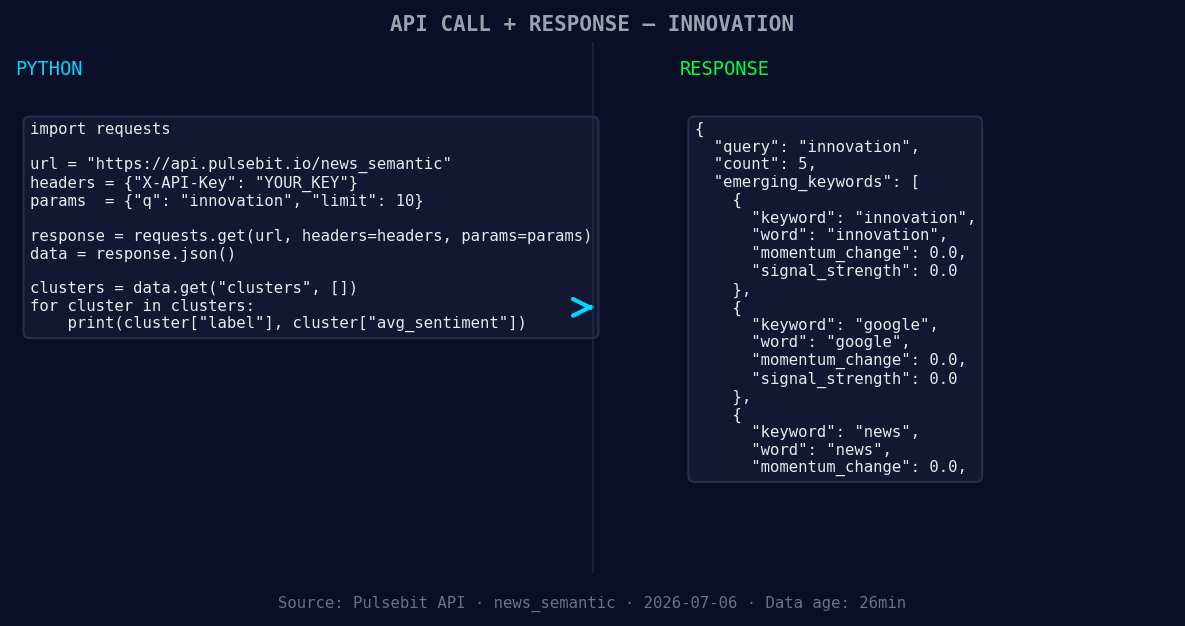
*Left: Python GET /news_semantic call for 'innovation'. Right: returned JSON response structure (clusters: 3). Source: Pulsebit /news_semantic.*
# Make the API call to fetch articles
response = requests.get("https://api.pulsebit.com/articles", params=params)
data = response.json()
# Print the fetched data for verification
print(data)
# Now score the meta-sentiment of the cluster reason
cluster_reason = "Clustered by shared themes: telus, adds, loyalty, innovation, commodity."
sentiment_payload = {
"text": cluster_reason,
}
# Make the API call to score the narrative framing itself
sentiment_response = requests.post("https://api.pulsebit.com/sentiment", json=sentiment_payload)
sentiment_data = sentiment_response.json()
# Print the sentiment analysis result
print(sentiment_data)
In this code, we first filter articles by the English language, ensuring we capture the relevant sentiment from the right demographic. Once we retrieve the articles, we then pass the cluster reason back through our sentiment analysis endpoint to gauge the narrative framing. This dual approach helps us not only catch the signal but also understand the context behind it.
Now, let’s discuss three specific builds we can implement with this pattern:
Geo Filter Build: Utilize the geographic origin filter to create a dashboard that tracks innovation sentiment specifically from English-language sources. Set a threshold of +0.5 momentum to trigger alerts for significant spikes, helping you stay ahead of trends.
Meta-Sentiment Loop: Build a function that continuously loops through newly formed clusters and automatically scores the narrative framing. Use the string "Clustered by shared themes: telus, adds, loyalty, innovation, commodity." to analyze emerging topics like innovation and Google, ensuring your model adapts to the latest trends.
Forming Themes Comparison: Implement a comparative analysis that juxtaposes forming themes like innovation (+0.00) against mainstream mentions of telus, adds, and loyalty. Set an alert for any discrepancies that exceed a certain threshold, enabling proactive engagement with emerging narratives.
For those ready to dive in, check out our documentation at pulsebit.lojenterprise.com/docs. The code above can be copy-pasted and executed in under 10 minutes, allowing you to harness this momentum spike for your own applications effectively.


Top comments (0)