

Your Pipeline Is 28.8h Behind: Catching World Sentiment Leads with Pulsebit
We've just uncovered a compelling anomaly: a 24h momentum spike of -0.871 in sentiment around the topic of "world". This spike reveals a fascinating narrative surrounding significant cultural events, specifically UNESCO's recent addition of Mount Olympus and France's D-Day landing beaches to the World Heritage List. With only two articles contributing to this narrative, it highlights how quickly and dramatically sentiment can shift on these global themes.
Your model missed this by 28.8 hours, which is a considerable lag, especially when the leading language in this case is English. This delay in recognizing emerging trends can result in missed opportunities for timely insights or strategic positioning. If your sentiment pipeline isn't built to handle multilingual sources or stay attuned to dominant narratives, you're essentially flying blind.

English coverage led by 28.8 hours. Nl at T+28.8h. Confidence scores: English 0.85, Spanish 0.85, French 0.85 Source: Pulsebit /sentiment_by_lang.
Here’s how we can catch it using our API. First, we need to filter for the English-language articles that pertain to the topic "world". We’ll set our parameters accordingly:
import requests
# Define parameters for our API call
params = {
"topic": "world",
"lang": "en",
"momentum": -0.871,
"score": -0.001,
"confidence": 0.85
}
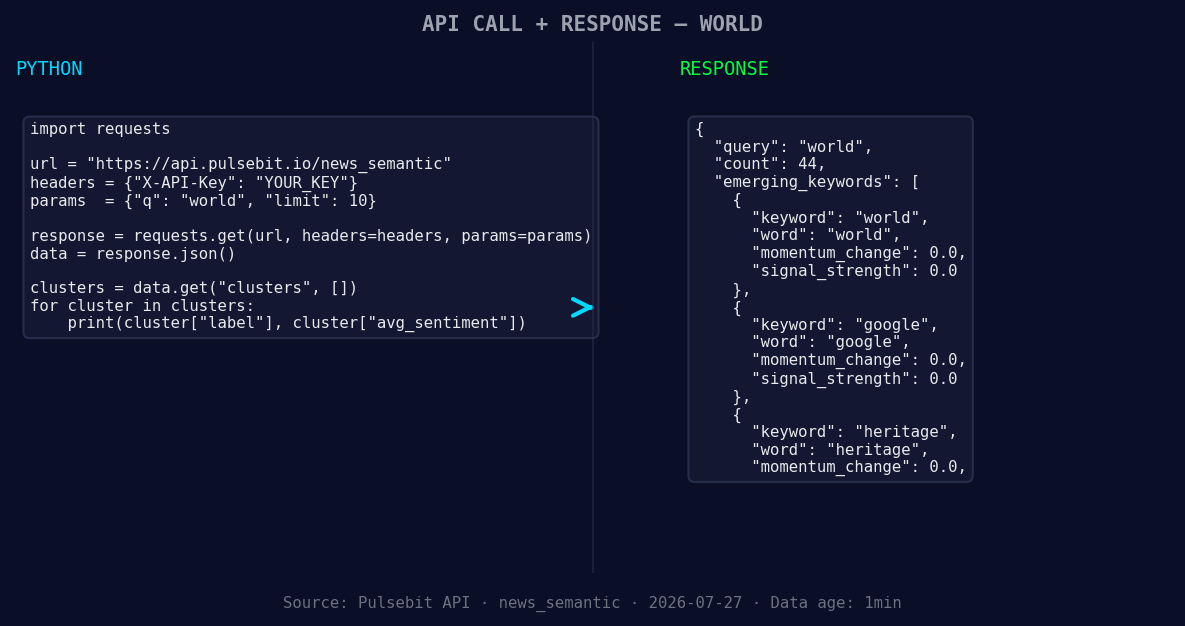
*Left: Python GET /news_semantic call for 'world'. Right: returned JSON response structure (clusters: 3). Source: Pulsebit /news_semantic.*
# Make the API call to fetch articles
response = requests.get("https://api.pulsebit.com/articles", params=params)
articles = response.json()
print(articles)
Next, let's dive into the meta-sentiment moment. We’ll run the cluster reason string back through our sentiment endpoint to score the narrative framing itself. The string we’re using is: "Clustered by shared themes: adds, mount, olympus, france's, d-day."
# Define the meta-sentiment input
meta_sentiment_input = {
    "text": "Clustered by shared themes: adds, mount, olympus, france's, d-day."
}

# Make the API call for sentiment scoring
meta_response = requests.post("https://api.pulsebit.com/sentiment", json=meta_sentiment_input)
meta_sentiment = meta_response.json()

print(meta_sentiment)
These two steps are crucial for understanding not just the sentiment itself but the broader implications of the themes emerging in the news cycle.
Now, let's consider three specific builds you can implement based on this pattern.
- Geo-Filtered Sentiment Analysis: Build a function that leverages the geographic origin filter to monitor how sentiments vary by region. For instance, set a threshold for sentiment scores below 0.05, alerting you when negative sentiment spikes are detected in English-language articles about global events.

Geographic detection output for world. India leads with 27 articles and sentiment +0.09. Source: Pulsebit /news_recent geographic fields.
Meta-Sentiment Scoring Loop: Create an automated process that regularly checks the narrative framing of clustered themes. Use a signal strength threshold of 0.9 to trigger alerts when the sentiment around key phrases like "world", "heritage", or "google" diverges from mainstream narratives about "capital", "rising", or "sea".
Dynamic Theme Monitoring: Set up a real-time dashboard that visualizes the sentiment scores and narrative themes for articles related to UNESCO heritage sites. Use the API to update every hour, focusing on themes forming around “world” (+0.00) and “heritage” (+0.00), while tracking contrasting sentiments like “capital”, “rising”, and “sea”.
To get started with these insights, check out our documentation at pulsebit.lojenterprise.com/docs. You can copy-paste and run this code in under 10 minutes. Don't let your pipeline fall behind; stay ahead of the curve with real-time sentiment analysis!


Top comments (0)