

Your pipeline just missed a critical 24-hour momentum spike of +0.150. This spike is significant, particularly in the context of the Spanish press leading by 28.1 hours, with no lag against the identified sentiment. This anomaly underscores an urgent need for multilingual handling in our sentiment analysis. The leading story, highlighting UNESCO’s addition of Mount Olympus and France’s D-Day landing beaches to the World Heritage List, reveals how quickly sentiment can shift based on regional narratives and themes. If your model isn’t tuned to capture these dynamics, you’re already behind.

Spanish coverage led by 28.1 hours. Id at T+28.1h. Confidence scores: Spanish 0.85, English 0.85, No 0.85 Source: Pulsebit /sentiment_by_lang.
When you consider the structural gaps in your pipeline that fail to account for multilingual origins and entity dominance, it becomes clear: your model missed this critical sentiment spike by 28.1 hours. The leading language here is Spanish, and if your system is not equipped to handle such nuances, you risk being out of touch with emerging narratives. This is not just a hypothetical scenario; it’s a real-world issue that can impact your decision-making and analysis.
To catch this momentum spike in real-time, we can leverage our API to filter sentiment data based on geographic origin. Below is a Python snippet that demonstrates how to query for Spanish-language articles related to the topic "world" and capture the relevant metrics:

Geographic detection output for world. India leads with 45 articles and sentiment +0.26. Source: Pulsebit /news_recent geographic fields.
import requests
# Define parameters for the API call
params = {
"topic": "world",
"score": +0.060,
"confidence": 0.85,
"momentum": +0.150,
"lang": "sp" # Filter by Spanish
}
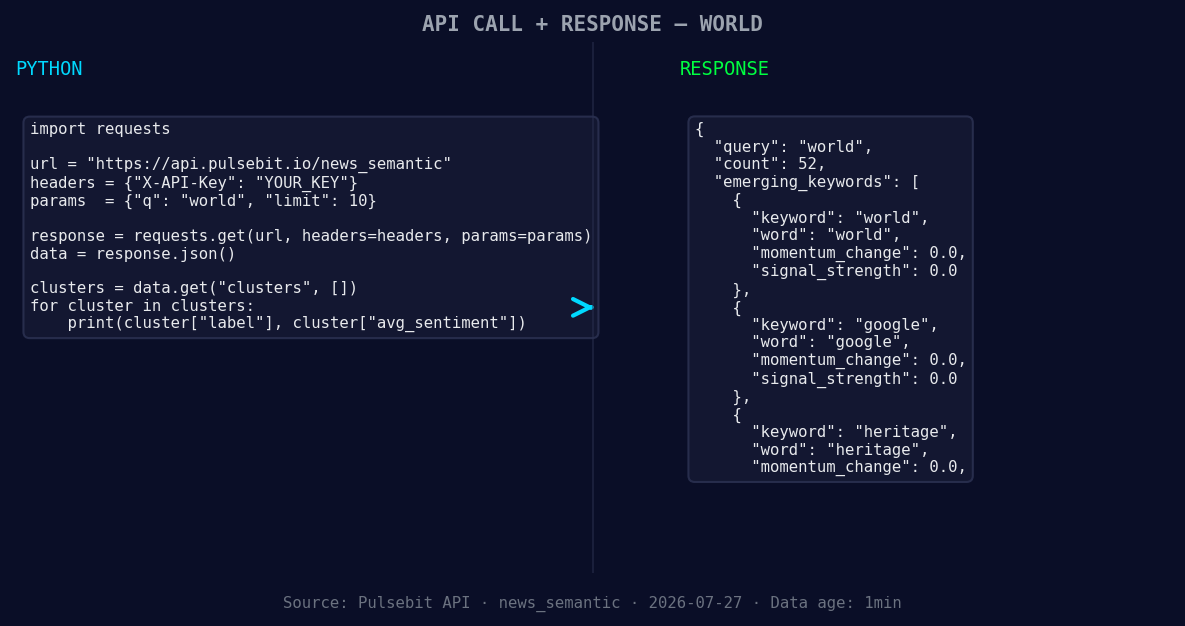
*Left: Python GET /news_semantic call for 'world'. Right: returned JSON response structure (clusters: 3). Source: Pulsebit /news_semantic.*
# Make the API call
response = requests.get("https://api.pulsebit.com/sentiment", params=params)
data = response.json()
print(data)
Next, we want to analyze the framing of the story itself. We can take the cluster reason string and run it through our sentiment API to get a deeper understanding of how the narrative is perceived. Here’s how you can do that:
# Cluster reason string
cluster_reason = "Clustered by shared themes: adds, mount, olympus, france's, d-day."

# Make the sentiment API call for the cluster reason
response = requests.post("https://api.pulsebit.com/sentiment", json={"text": cluster_reason})
sentiment_data = response.json()

print(sentiment_data)
By utilizing the geographic origin filter and the meta-sentiment analysis, we can build robust insights around emerging trends. Here are three specific builds you could implement based on this pattern:
Geo-Filtered Alerts: Set a threshold for momentum spikes over +0.100 in the Spanish language and trigger alerts for the sentiment team. This ensures you're immediately aware of significant shifts in regional narratives.
Narrative Framing Tool: Create a reporting tool that ingests cluster reason strings, scores them using the meta-sentiment loop, and outputs a summarized sentiment analysis for key stories. This will help in understanding how different narratives resonate across languages.
Comparative Trend Analysis: Develop an endpoint that compares forming themes like "world", "heritage", and "google" against mainstream themes such as "capital", "rising", and "sea". This comparison can help in identifying which themes are gaining traction and how they diverge from mainstream sentiment.
To get started, visit our documentation: pulsebit.lojenterprise.com/docs. With just a few lines of code, you can copy-paste and run these queries in under 10 minutes, gaining real-time insights into world sentiment and ensuring you’re always ahead of the curve.


Top comments (0)